
Public urged to track ticks on platform
Advertisement
Read this article for free:
or
Already have an account? Log in here »
We need your support!
Local journalism needs your support!
As we navigate through unprecedented times, our journalists are working harder than ever to bring you the latest local updates to keep you safe and informed.
Now, more than ever, we need your support.
Starting at $15.99 plus taxes every four weeks you can access your Brandon Sun online and full access to all content as it appears on our website.
Subscribe Nowor call circulation directly at (204) 727-0527.
Your pledge helps to ensure we provide the news that matters most to your community!
To continue reading, please subscribe:
Add Brandon Sun access to your Free Press subscription for only an additional
$1 for the first 4 weeks*
- Enjoy unlimited reading on brandonsun.com
- Read the Brandon Sun E-Edition, our digital replica newspaper
*Your next Free Press subscription payment will increase by $1.00 and you will be charged $20.95 plus GST for four weeks. After four weeks, your payment will increase to $24.95 plus GST every four weeks.
Read unlimited articles for free today:
or
Already have an account? Log in here »
As ticks spring up in high volumes this season across southwestern Manitoba, data tracking the various species is in the public’s hands.
In April 2021, the Manitoba government announced it was joining the eTick platform to provide “expert advice to help Manitobans determine their risk of Lyme disease.”
The public platform allows individuals to submit images of personally located ticks across Canada, and indicate where they were found. A team of experts analyzes the images to determine the species.

Veterinarian Dr. Sherry Wurtz visits with Gemma, a six-year-old black Labrador retriever cross, during an appointment at the clinic on Friday. Gemma is one of many dogs treated for tick prevention at the clinic. (Photos by Tim Smith/The Brandon Sun)
Kateryn Rochon, an associate professor in the Department of Entomology at the University of Manitoba, is one of the experts who analyzes the images submitted to eTick.
Speaking with the Sun on Friday, Rochon noted that while there is a high volume of ticks this season, most of the images submitted to eTick so far have been sightings of the American dog tick, commonly referred to as the wood tick.
Wood ticks do not transmit Lyme disease to humans. However, the black-legged-tick, also known as the deer tick, can transmit Lyme disease to people and pets.
Rochon had received about 20 submissions of tick images to the site by the time she spoke with the Sun on Friday. She said some submissions this year have captured ticks that are rare to southern Manitoba regions, but one tick species is being submitted the most.
“It’s a big tick year, but really, right now? It’s the American dog tick. However, we have had a few people submit black-legged tick nymphs. That, from a public health point of view, is really useful … They could transmit Lyme.”
While the submissions to eTick have primarily been wood ticks so far this season, a veterinarian in Brandon said she has noticed more deer ticks on dogs this year.
Dr. Sherry Wurtz, the lead veterinarian at the Wheat City Veterinary Clinic, described a “flush” of ticks that came out last month, after seeing lower amounts in April.
“I just think there definitely are more deer ticks around,” Wurtz said Friday. “We’re seeing more deer ticks on dogs, and people should be aware, and check themselves. Because they’re the size of a poppyseed sometimes.”
She said Friday that only two pets with appointments at her clinic have tested positive for Lyme disease this season, and both are doing well.
“That means they have antibodies. They were exposed to it, and their immune system fought it off. But it’s good for us to know what’s around,” she said. “It acts like a bit of a canary in the coal mine … We have a very quick table-top test that can show us whether the dog has been exposed to it.”
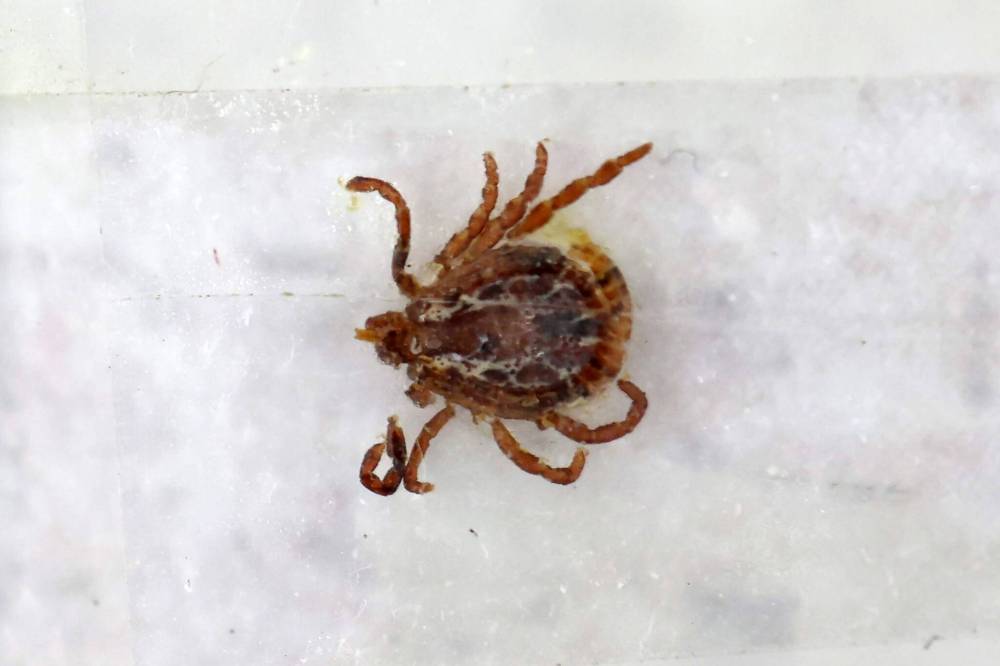
A slide featuring an American dog tick specimen at Wheat City Veterinary Clinic on Friday.
Both Wurtz and Rochon suggested that people should check themselves for ticks daily, and Rochon hopes that Manitobans will continue to use the eTick service.
“To know, through this platform, that the (deer tick) nymphs are out there, and they’re active — it’s information that we wouldn’t get otherwise,” said Rochon.
She said that the passive method of gathering data used by the eTick program is not necessarily ideal, because it relies on people participating in the program and submitting information.
“It is effective, but it will only be as good as the participation,” Rochon said of eTick. “If people don’t take the time to take pictures and submit them, then we don’t have the information.
“But it does give information that is valuable for public health.”
To access eTick and its data, or to upload a tick sighting, visit etick.ca.
» jmurray@brandonsun.com