
Mayors hail bail reform legislation after push for change
Advertisement
Read this article for free:
or
Already have an account? Log in here »
We need your support!
Local journalism needs your support!
As we navigate through unprecedented times, our journalists are working harder than ever to bring you the latest local updates to keep you safe and informed.
Now, more than ever, we need your support.
Starting at $15.99 plus taxes every four weeks you can access your Brandon Sun online and full access to all content as it appears on our website.
Subscribe Nowor call circulation directly at (204) 727-0527.
Your pledge helps to ensure we provide the news that matters most to your community!
To continue reading, please subscribe:
Add Brandon Sun access to your Free Press subscription for only an additional
$1 for the first 4 weeks*
- Enjoy unlimited reading on brandonsun.com
- Read the Brandon Sun E-Edition, our digital replica newspaper
*Your next Free Press subscription payment will increase by $1.00 and you will be charged $20.95 plus GST for four weeks. After four weeks, your payment will increase to $24.95 plus GST every four weeks.
Read unlimited articles for free today:
or
Already have an account? Log in here »
Manitoba mayors say a sweeping bail and sentencing reform bill becoming law is a step in the right direction for improving public safety.
“There was this sense that some people were losing faith in the justice system,” Brandon Mayor Jeff Fawcett told the Sun on Friday. “We do feel that (the bill) does make the community a little bit safer and gives opportunities for the courts to put more confidence back into the public.”
Bill C-14 received royal assent and became law on Monday. The federal government said the legislation, which will come into effect on July 15, includes 80 changes to the Criminal Code.
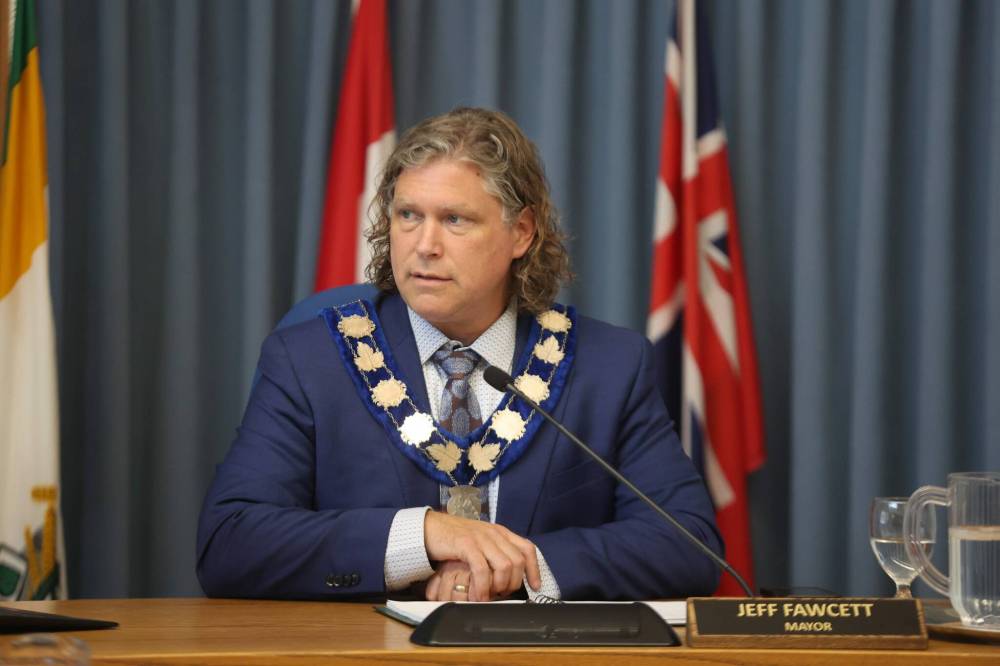
Brandon Mayor Jeff Fawcett said he anticipates Bill C-14 will take some pressure off police, as they are often rearresting some of the same people repeatedly. (Alex Lambert/The Brandon Sun)
The new rules modify the “principle of restraint” in a way that instructs courts to lean toward denying bail rather than granting it, particularly in cases involving repeat offenders and those accused of more severe crimes.
It expands the list of offences encompassed in “reverse onus” provisions, in which an accused must explain why they should be let out on bail, rather than requiring Crown attorneys to argue why they should remain in custody.
A slate of new crimes will be subject to reverse onus under the new law, including violent and organized auto theft, break and enter of homes, human trafficking and violent extortion.
Repeat violent offenders, offences committed against first responders or public transit workers, organized retail crime and theft of copper will be considered aggravating factors in sentencing.
Fawcett said he was happy that the bill received royal assent after months of pushing for bail reform alongside Portage la Prairie Mayor Sharilyn Knox, Winnipeg Mayor Scott Gillingham and Association of Manitoba Municipalities president Kathy Valentino.
“It’s been a long time for discussion, but in the political world actually it was pretty swift,” Fawcett said. “It’s a step in the justice world. We want people to have faith in our system.”
Fawcett said he anticipates the changes will take some pressure off police, as they are often rearresting some of the same people repeatedly.
Fawcett said Knox spearheaded the push after the death of Kellie Verwey, who worked as a tourism co-ordinator in Portage. The alleged drunk driver charged in relation to Verwey’s death had a warrant out for his arrest at the time after he had violated bail conditions.
Fawcett said the death of Verwey was a story that “resonated with anybody,” and this bill will hopefully prevent similar situations.
Contacted Friday, Knox said she is feeling a lot of relief that Bill C-14 was enacted into law after all the advocacy efforts that took place throughout the province to move the bill forward.
“It has certainly been a group effort of a lot of people that want to see the safety in our communities improved,” she said.
In a community the size of Portage, Knox said sometimes it’s the same 15 to 20 repeat offenders who are causing the most harm.
“I just can’t imagine the level of frustration that (police) must feel sometimes … There’s times in a weeklong period where they might be putting someone in cells three times,” Knox said.
After she started talking publicly about Verwey’s death, Knox said she heard many stories from people across the country who had dealt with similar situations.
“Although it started at a local level for us, it’s something that our entire country needed,” she said. “We need to know that victims are being protected and we need to know that levels of government are working to make our communities safer.”
Gillingham said he was pleased to find out the bill had received royal assent and gave credit to Fawcett, Knox and Valentino.
“The four of us have worked very hard for many months in making the call for changes,” he said. “This has really been a team effort.”
Valentino said she is “so proud” of all Manitobans for having a strong voice to help with advocacy.
“Manitoba took the lead nationally to get this to the national table, so (I’m) very proud and very happy,” she said.
Brandon-Souris Conservative MP Grant Jackson congratulated the municipal leaders who stepped up and advocated to the federal government that bail reform is needed.
However, he said he didn’t think the bill went far enough.
“There are still significant gaps that we feel, as the official Opposition, should have been addressed around minimum sentences, for example. But any progress is progress,” he said.
He said clearly the Liberals recognized that the system they had created over the last 10 years was not acceptable.
“Now comes the implementation, and we’re going to be watching very closely to see whether judges and the judicial system are applying this law appropriately to keep our communities safe.”
Ben Wickstrom, who is the spokesperson for the Manitoba Association of Crown Attorneys, said the changes may put an extra burden on Crown attorneys.
“Any time there’s harsher sentences or more stringent rules around bail, it means it’s more likely that there’s going to be litigation in a contested hearing … It means Crown attorneys need more time to prepare for those contested hearings and it means the courts need more time to have those contested hearings,” he said.
He said the association believes there are not adequate resources in place to deal with the potential increase in litigation that the changes to the law are going to cause.
» sanderson@brandonsun.com, with files from Tyler Searle