
Wildfire evacuees arrive in Brandon
Advertisement
Read this article for free:
or
Already have an account? Log in here »
We need your support!
Local journalism needs your support!
As we navigate through unprecedented times, our journalists are working harder than ever to bring you the latest local updates to keep you safe and informed.
Now, more than ever, we need your support.
Starting at $15.99 plus taxes every four weeks you can access your Brandon Sun online and full access to all content as it appears on our website.
Subscribe Nowor call circulation directly at (204) 727-0527.
Your pledge helps to ensure we provide the news that matters most to your community!
To continue reading, please subscribe:
Add Brandon Sun access to your Free Press subscription for only an additional
$1 for the first 4 weeks*
- Enjoy unlimited reading on brandonsun.com
- Read the Brandon Sun E-Edition, our digital replica newspaper
*Your next Free Press subscription payment will increase by $1.00 and you will be charged $20.95 plus GST for four weeks. After four weeks, your payment will increase to $24.95 plus GST every four weeks.
Read unlimited articles for free today:
or
Already have an account? Log in here »
The first wave of evacuees fleeing the escalating wildfire threat in northern Manitoba arrived in Brandon on Saturday evening.
The exercise marked the beginning of what is expected to be a major evacuation effort involving hundreds of residents from the Town of Lynn Lake and nearby First Nations.
Most of the evacuees are being flown in due to the distance — Brandon is nearly 778 kilometres by air and about 1,175 kilometres by road from Lynn Lake, a drive of more than 16 hours.
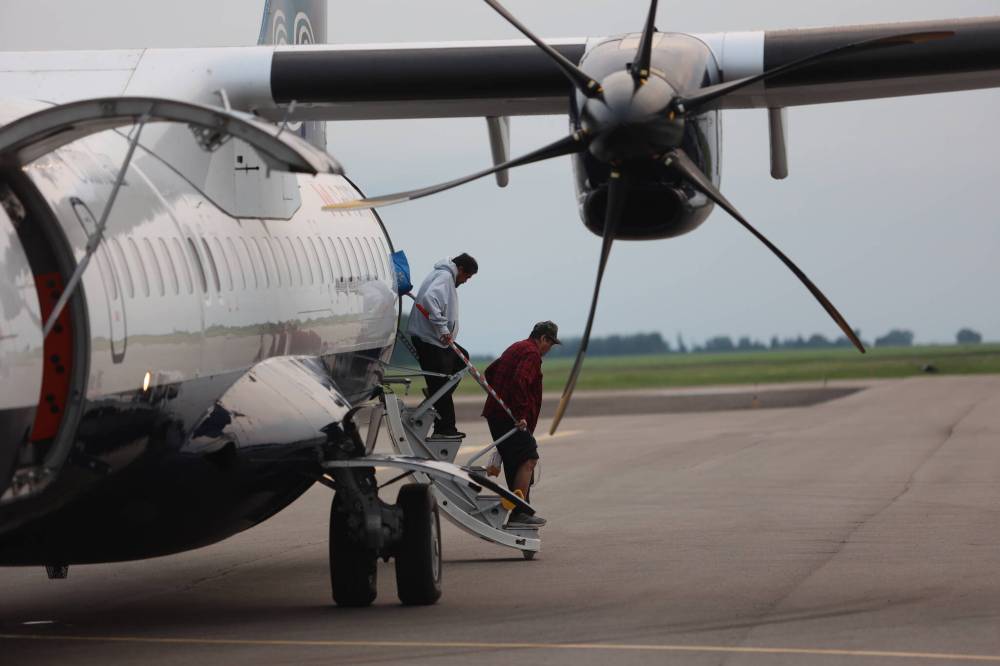
Flights carrying evacuees touched down at Brandon Municipal Airport between 7 p.m. and 9:40 p.m. on Saturday.
The first small aircraft operated by Adventure Air landed shortly after 7 p.m. with nine passengers on board. A second flight carrying eight evacuees arrived around 8:30 p.m., followed by a third flight with seven passengers at approximately 9 p.m. A larger Calm Air aircraft carrying more than 56 passengers landed shortly before 10 p.m.
A source with the Canadian Red Cross told the Sun that approximately 165 evacuees were expected to arrive in Brandon on Saturday alone, with additional flights scheduled for Sunday.
Lynn Lake Mayor Brandon Dulewich said roughly 80 people were expected to leave the northern community on Saturday, with additional evacuation flights continuing throughout Sunday.
“We’re currently sitting around 200,” Dulewich said of the number of residents expected to relocate to Brandon between Saturday and Sunday. “Registration efforts were still ongoing and many residents had chosen to travel by road or stay with family and friends.”
The evacuation comes as Wildfire No. 050 continues to threaten the remote northern community. In a Sunday morning update, the Town of Lynn Lake said the fire had grown to approximately 5,100 hectares and was slowly creeping east toward Wasekan Lake. Forecast temperatures of 27 C combined with low humidity and shifting winds were expected to create challenging conditions for firefighters.
While fire activity remained at a smouldering Rank 1 on Sunday morning, crews continued constructing fire guards, installing hose lines and preparing strategic backburn operations. Manitoba Wildfire Services also deployed additional aerial support, including a medium helicopter, as officials worked to protect the community and key infrastructure.
On Saturday, the Town of Lynn Lake said in a statement shared on social media that extreme fire behaviour had prevented Manitoba Wildfire Services from attacking the blaze directly.
Conditions had reached Rank 5 and Rank 6, making it unsafe for ground crews to engage. Aerial suppression efforts involving water bombers were also cut short after the fire generated its own storm system, producing lightning and forcing the withdrawal of crews and grounding of helicopters.
Emergency Social Services and the Canadian Red Cross are providing registration, accommodation, meals and ongoing support to evacuees arriving in Brandon. The town announced Sunday that the final evacuation flight from Lynn Lake was preparing to depart, effectively completing the evacuation of the community.
The wildfire emergency is also affecting neighbouring Indigenous communities.
In a statement released Sunday, the Marcel Colomb First Nation announced it had activated its evacuation plan, with approximately 110 members being relocated because Lynn Lake serves as a critical supply and service hub for the First Nation.
Meanwhile, O-Pipon-Na-Piwin Cree Nation remains under a state of emergency, with about 200 priority evacuees expected to be transported over two days as wildfire activity threatens the community and cuts off road access.
For many arriving in Brandon, the evacuation marks a painful return to a familiar reality. This is the second consecutive summer that Lynn Lake and several northern First Nations have faced widespread evacuations because of wildfires, reviving memories of last year’s devastating fire season.
» aodutola@brandonsun.com
» X: @AbiolaOdutola