
Growing U.S. demand keeps woodworker busy
Advertisement
Read this article for free:
or
Already have an account? Log in here »
We need your support!
Local journalism needs your support!
As we navigate through unprecedented times, our journalists are working harder than ever to bring you the latest local updates to keep you safe and informed.
Now, more than ever, we need your support.
Starting at $15.99 plus taxes every four weeks you can access your Brandon Sun online and full access to all content as it appears on our website.
Subscribe Nowor call circulation directly at (204) 727-0527.
Your pledge helps to ensure we provide the news that matters most to your community!
To continue reading, please subscribe:
Add Brandon Sun access to your Free Press subscription for only an additional
$1 for the first 4 weeks*
- Enjoy unlimited reading on brandonsun.com
- Read the Brandon Sun E-Edition, our digital replica newspaper
*Your next Free Press subscription payment will increase by $1.00 and you will be charged $20.95 plus GST for four weeks. After four weeks, your payment will increase to $24.95 plus GST every four weeks.
Read unlimited articles for free today:
or
Already have an account? Log in here »
VIRDEN — For Jonathan Paddison, what began as a weekend woodworking hobby has grown into a thriving small business attracting customers not only across Canada but increasingly from the United States, even as looming tariffs threaten to reshape cross-border sales.
The founder of Northern Prairie Woodworks said inquiries from American buyers have risen steadily over the past two years, prompting him to formally register the business and expand its online presence to serve customers south of the border.
“It kind of surprised me,” Paddison told the Sun. “Regardless of what is happening tariff-wise or politically, the demand for Canadian-made goods is still there in the U.S.”
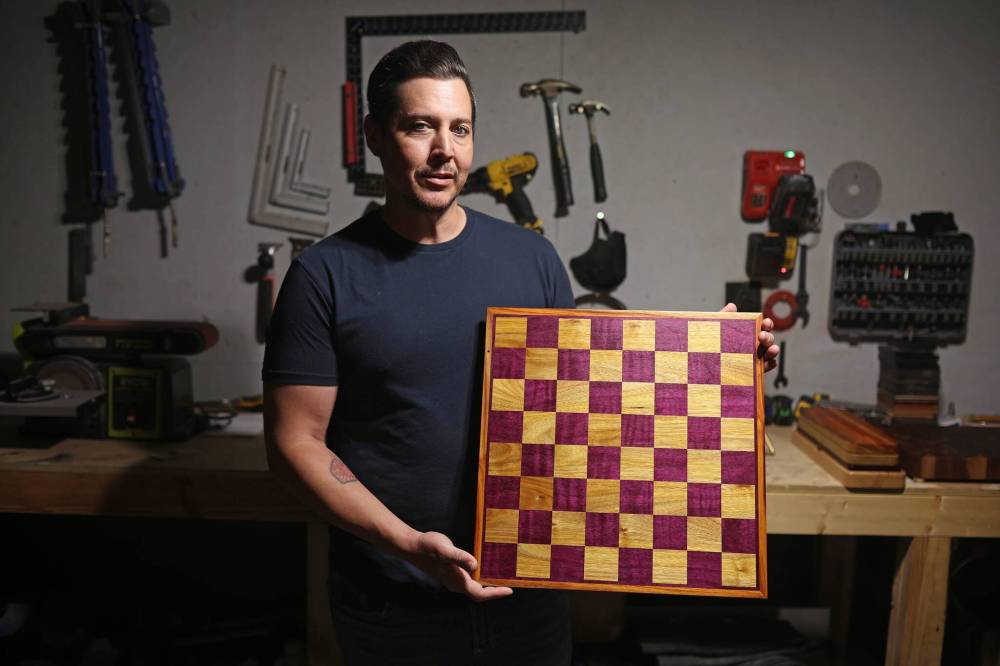
Jonathan Paddison, owner of Northern Prairie Woodworks, holds a custom chess board he made at his wood shop in Virden. (Tim Smith/The Brandon Sun)
Paddison has been woodworking for about a decade, spending the first eight years creating projects as a hobby before requests from friends, family and acquaintances turned his passion into a business.
“It started with people asking, ‘Can you make me a cutting board, a clock or a planter?’” he said in an interview. “I just enjoy creating things and getting ideas out of my head into something physical.”
Today, the one-person operation produces handcrafted cutting boards, charcuterie boards, butcher blocks, cribbage boards, chess boards, whiskey smokers and other custom wood products.
While local customers remain the backbone of the business, online platforms such as Etsy and his website have helped expand Paddison’s reach across Canada and into the U.S.
He said roughly one-quarter of his products are now shipped to American customers, with orders heading to states like Florida, North Dakota, Montana and Tennessee.
The growing international interest, however, comes at a time of increasing uncertainty over trade rules.
He recently received notice from Etsy that duties and tariffs on U.S.-bound shipments will need to be clearly disclosed to customers, while additional changes to cross-border shipping rules are expected next year.
The uncertainty, he said, could make Canadian products less competitive if additional duties significantly increase prices.
“I don’t know what the duties and tariff percentages are going to be yet,” he said. “With a small business, the profit margin isn’t huge, so it eats away at those profits.”
Although Canadian-made handcrafted goods currently benefit from exemptions under existing trade agreements, Paddison said constantly changing policies make long-term planning difficult.
“My hope is it’s temporary,” he said. “You can’t run a business on hope, but it does create uncertainty.”
Rather than relying on exports, Paddison said he is placing greater emphasis on Canadian customers, where products can be sold without the complications of international trade.
That approach aligns with a growing “buy local” movement that has gathered momentum amid trade tensions.
Paddison said about 20 per cent of his business now comes from customers who specifically seek products made in Canada.
“The sentiment is definitely out there,” Paddison said. “People want to support Canadian-made businesses.”
As demand continues to grow, Paddison is already planning for expansion.
He hopes to move into a larger workshop next year, allowing him to install bigger equipment capable of producing larger furniture pieces and higher production volumes.
The additional space would also create room to hire employees as the business grows.
“You start with one person, then two as demand increases,” he said. “But it’s important to find people who have that same passion and attention to detail.”
For now, managing demand remains a balancing act. During the Christmas season, orders arrive through Etsy, his website and word-of-mouth referrals, often requiring production schedules stretching four to six weeks.
Because each board is handcrafted, glue joints must cure for up to 24 hours before work can continue, allowing multiple projects to move through different stages simultaneously, he said.
Despite the challenges, Paddison said handcrafted products continue to stand apart from mass-produced ones.
Every cutting board begins with carefully hand-selected lumber, chosen for its grain patterns and structural qualities before being milled, glued, cut, sanded and finished with food-safe mineral oil over a process that spans about three days, he said.
His hands-on labour totals roughly three hours per board, but the attention paid to wood movement, grain direction and finishing allows him to offer a lifetime guarantee on many of his cutting boards.
“If you put the wood together properly and pay attention to the details, they’ll last more than a lifetime,” he said.
Although tariffs may temporarily slow U.S. sales, Paddison said his long-term vision remains unchanged.
“I built the business on being handmade, locally made and built to last,” he said. “It’s still a hobby to me, even though it’s a paid hobby. I just enjoy doing it.”
» aodutola@brandonsun.com
» X: @AbiolaOdutola