
Storms, floods wash out crops
Advertisement
Read this article for free:
or
Already have an account? Log in here »
We need your support!
Local journalism needs your support!
As we navigate through unprecedented times, our journalists are working harder than ever to bring you the latest local updates to keep you safe and informed.
Now, more than ever, we need your support.
Starting at $15.99 plus taxes every four weeks you can access your Brandon Sun online and full access to all content as it appears on our website.
Subscribe Nowor call circulation directly at (204) 727-0527.
Your pledge helps to ensure we provide the news that matters most to your community!
To continue reading, please subscribe:
Add Brandon Sun access to your Free Press subscription for only an additional
$1 for the first 4 weeks*
- Enjoy unlimited reading on brandonsun.com
- Read the Brandon Sun E-Edition, our digital replica newspaper
*Your next Free Press subscription payment will increase by $1.00 and you will be charged $20.95 plus GST for four weeks. After four weeks, your payment will increase to $24.95 plus GST every four weeks.
Read unlimited articles for free today:
or
Already have an account? Log in here »
WAWANESA — Farmers in several regions of Westman are turning to insurance as storms have damaged crops both on family farms as well as an indoor tomato growing operation.
Farmers near MacGregor, Minto and Wawanesa told the Sun on Thursday they are looking to crop insurance following damage to hundreds of acres of land, from edible beans to wheat. Heavy rains, hail, wind and overland flooding are to blame for the damage. North of Dauphin, a large-scale tomato growing operation was flooded when a river swelled nearby and poured over the property.
According to Simon Ellis, a Wawanesa-area farmer, roughly 50 per cent of his family farm’s crop is expected to be written off as completely destroyed this year. The damage follows a recent storm last weekend that dropped hail for 20 minutes and then blew the hail around, battering roughly 775 acres of wheat and soybeans, he said.
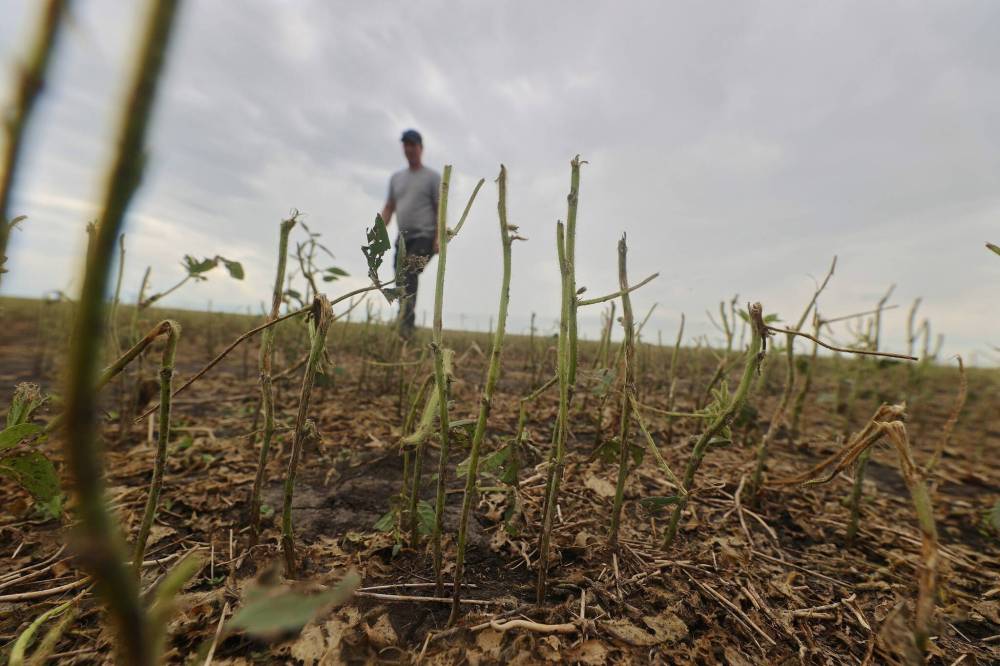
Simon Ellis, a Wawanesa-area farmer, walks through a field of crops that had been battered by wind and hail in July. Ellis expects around 50 per cent of his total crops to be written off completely for the year due to the significant storm that hit the area last weekend. (Connor McDowell/The Brandon Sun)
“I’m hoping some fields come back, but those might be gone as well,” Ellis said. “The soybeans (we had are now) just sticks.”
Ellis was expecting an insurance representative to visit his property on Thursday and hoped to get an answer before next week about compensation the farm may receive.
“It’s not going to cover everything, but it will soften the blow, and hopefully next year we can have a good year and make back the difference,” he said. “There is not a whole lot we can do.”
The farmer hopes to find secondary use of the land, perhaps growing livestock feed once the answer comes in about insurance coverage, he said.
Near MacGregor, a recent rain of about 114 millimetres combined with downhill flooding from surrounding areas that received about 140 mm has led to flooding on 150 acres of crops of edible beans, said Dean Toews, a family farmer in the area.
The beans had been underwater more than 24 hours, he said.
“Kind of been getting it on the chin on those acres there.”
Toews said the family farm may look to try to get some value out of the land yet.
“The biggest flooded field there, we are thinking we will try to put some green feed in and maybe oats,” he said. “But the water has to be gone and it has to be firm enough that we can actually get in there and seed something, but the clock is ticking. It’s still a big risk to do that.”
Toews said he received a payout from hail damage already, but also expects productivity losses on other acres.
He was able to adjust a contract he had set as a response to the damage, obligating him to sell less beans, he said.
Vermillion Growers, an indoor tomato growing operation near Dauphin, was flooded with knee-high water last week that led to a total shutdown of the facility, the vice-president of engineering and development said.
Cormac Foster said that the facility is built on land beside the Vermillion River, which swole up and flushed across the property last week. The facility has a 12-acre footprint.
“It just completely overflowed its banks and flowed right across our property,” he said. “It basically just flew right through us.”
The indoor facility was filled with water over two feet high, contaminating an estimated 5,400 cases of packaged tomatoes that were ready to be shipped, and rendering unsafe 540,000 kilograms of tomatoes that were still on the vine, he said. Silt, sand and dirt was deposited in the building as a result.
“It was catastrophic,” Foster said. “The water came fast, there was nothing that anybody could have done about it.”
Due to the fact that overland flooding water is typically contaminated, the company decided to scrap all the tomatoes that had been affected by the floodwater for public health reasons, he said.
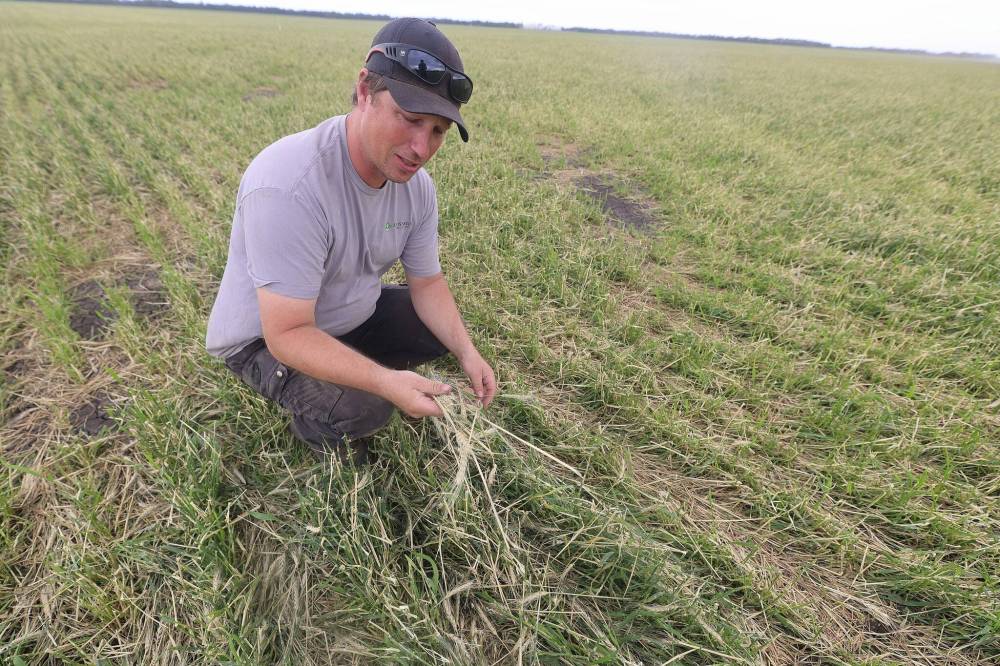
Simon Ellis holds the remainder of wheat crops between his fingers in his farm fields outside Wawanesa. A storm this past weekend brought hail to the region, which was then blown by strong winds, battering the wheat that was about knee-high beforehand. (Connor McDowell/The Brandon Sun)
“From a food-safety and a public-health perspective, because that has come right through our entire growing area, we can’t salvage or sell or any of those tomatoes, and so unfortunately that’s an entire loss.”
The company has insurance to cover the staff so that layoffs are not needed, he said. The facility does not yet have a timeline on when it plans to reopen — a significant amount of technology, including robotics, in the facility was flooded and so there will be a lot of inspection and replacement needed for the facility’s equipment, he said.
“We’re working with the insurance company to evaluate and assess, where do we go from here?”
The next season has been delayed due to the facility’s shutdown — the next round of tomatoes were originally scheduled to start in mid-August, but that is no longer possible.
Jake Ayre, a Minto-area farmer, said that roughly 255 acres of canola were destroyed by rain and hail this season, forcing him to reseed. Other parts of his farmland that he had seeded took the form of a lake, covered in water following recent heavy rainfall.
“It literally looked like we had a lake, and it was seeded crop,” he said. “Our front field, right in front of our yard, was completely underwater.”
Ayre said he is working with local municipalities to ensure culverts are clear so water can flow away, and with neighbours to work out if there are any water blockages. He added that the dust storms which blew up topsoil around the area this spring left dirt in ditches and other areas that is now preventing water from flowing properly.
Ayre said aerial spraying companies are seeing a surge in business as farmers need to spray their crops, but cannot get out on wet acres with tractors that would potentially make a mess and get stuck.
“When you can’t even get out on your land with a ground sprayer to spray for that, farmers are forced to either, try and get out and we make an absolute mess, or you know, call in for reinforcements and call in aerial applicators.”
To rebound the season and clear up land, Ayre said he is hoping for heat — anything above 25 C. Generally, a wet year like what has been observed so far leads to about 10 to 15 per cent losses, he said.
“There’s a lot of very stressed and concerned people this year, as you’d expect, myself included,” he said. “It has been a stressful year.”
He said that going forward, it’s a game of adjusting to what Mother Nature offers.
“It’s just do what you can, like the bison, weather the storm, try and pick yourself up and face tomorrow.”
» cmcdowell@brandonsun.com