
Extreme weather in store for northern Manitoba
Advertisement
Read this article for free:
or
Already have an account? Log in here »
We need your support!
Local journalism needs your support!
As we navigate through unprecedented times, our journalists are working harder than ever to bring you the latest local updates to keep you safe and informed.
Now, more than ever, we need your support.
Starting at $15.99 plus taxes every four weeks you can access your Brandon Sun online and full access to all content as it appears on our website.
Subscribe Nowor call circulation directly at (204) 727-0527.
Your pledge helps to ensure we provide the news that matters most to your community!
To continue reading, please subscribe:
Add Brandon Sun access to your Free Press subscription for only an additional
$1 for the first 4 weeks*
- Enjoy unlimited reading on brandonsun.com
- Read the Brandon Sun E-Edition, our digital replica newspaper
*Your next Free Press subscription payment will increase by $1.00 and you will be charged $20.95 plus GST for four weeks. After four weeks, your payment will increase to $24.95 plus GST every four weeks.
Read unlimited articles for free today:
or
Already have an account? Log in here »
WINNIPEG — Manitoba’s experience with wildfire evacuations, destructive storms and flooding this year is a stark warning of the turmoil caused by extreme weather events, says the federal emergency management minister.
“The situation in Manitoba underscores what we all know already: disasters are becoming more frequent, more severe and more costly,” Eleanor Olszewski said during an online news conference Thursday.
And more weather events can be expected this summer in northern Manitoba.
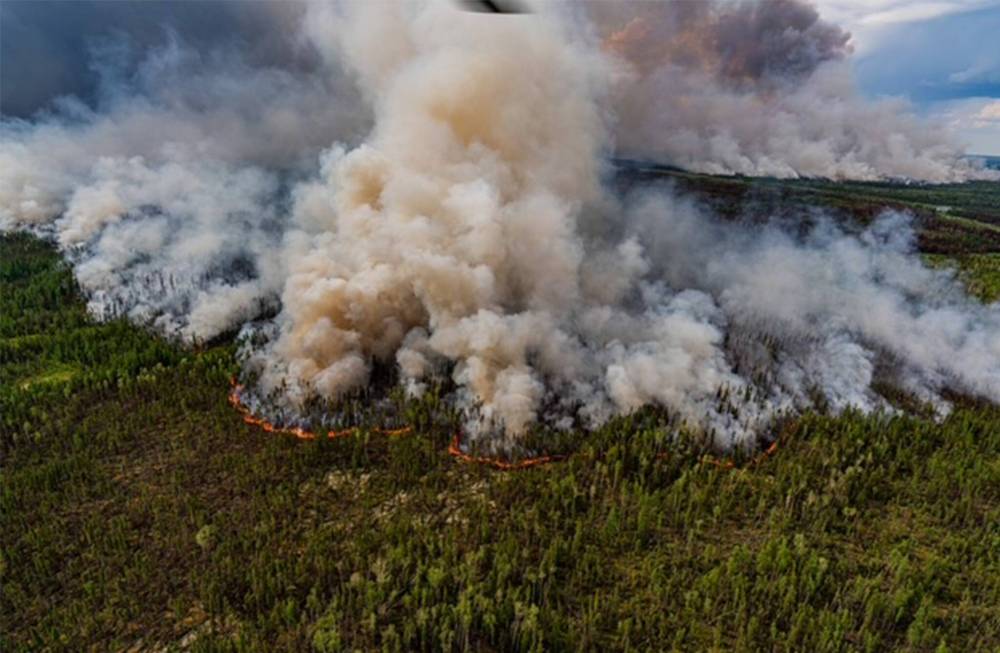
A wildfire burns near the Wuskwatim Generating Station in June. Natural Resources Canada’s latest modelling indicates elevated fire danger in northern Manitoba for July and August. (Supplied)
The fire danger is elevated for July and August. Northern Manitoba, the Northwest Territories, Nunavut and areas around Hudson Bay are at greatest risk, as per Natural Resources Canada’s latest modelling.
Residents of Marcel Colomb First Nation and Lynn Lake in Northern Manitoba have already experienced wildfire evacuations this season, the federal minister noted.
“We recognize the challenges and disruptions for those who have to evacuate,” she said.
Looking ahead, above-normal temperatures and below-normal precipitation are expected this summer across Manitoba and northwestern Ontario.
Thursday’s national wildfire forecast update says to expect above-normal temperatures for all regions, except southern Alberta and Saskatchewan. Above-normal precipitation is forecast for the Northwest Territories, Yukon, Alberta, southern Quebec and the Maritimes.
The wildfire season is beginning to heat up.
The latest information from the Canadian Interagency Forest Fire Centre, which is based in Winnipeg, shows there have been 3,100 fires across the country so far this season, compared to around 2,900 at this time last year.
As of Thursday, 796 of those were active fires, and 60 were considered out of control.
The total area burned this year is less than last year, at around 12,000 square kilometres, down from 46,000 square kilometres.
“The forest fire season is rapidly intensifying,” said St. Boniface-St. Vital MP Ginette Lavack, parliamentary secretary to Indigenous Services Minister Mandy Gull-Masty.
“First Nations are disproportionately affected,” Lavack said from Winnipeg. “Four out of five communities are located in areas of high risk of wildfires.”
This year, 45 wildfires have affected 42 First Nations, leading to the evacuation of 4,110 people from 17 communities. As of Thursday, 1,601 evacuees from seven communities remained displaced, Lavack said.
“As a Manitoban, I’ve seen how quickly these emergencies can change lives,” she said. “I’ve also seen neighbours, community leaders and First Nations come together with remarkable resilience and generosity, Lavack said.
“Our government will continue to support you every step of the way.”
The federal government has funded equipment and training to Indigenous communities to deal with the increased wildfire risk and air quality issues resulting from smoke, officials said.
Indigenous Services Canada said it provided funding for 13,000 air purifiers and 900 generators.
Olszewski said the new fleet of 10 federally funded aircraft have all been deployed multiple times across the country.
On Thursday, Public Safety Canada showed a wildfire smoke dispersion forecast map depicting smoke hovering over most of northern Manitoba. The smoke prompted Environment and Climate Change Canada to issue air-quality alerts for the area.
“Monitoring of wildfire conditions and forecasting future dangers is so important so we can be better prepared and better protect Canadians,” said Calgary MP Corey Hogan, parliamentary secretary to Natural Resources Minister Tim Hodgson.
The 2025 wildfire season was the second-worst on record, with more than 89,000 square kilometres burned across the country. That followed a record season in 2023, when the total area burned in all 13 provinces and territories was more than double any other year since 1983.
By late May of 2025, the country was at a Level 5 agency preparedness level — the highest — and remained there until late August. It is currently at a Level 4.
» Winnipeg Free Press, with files from The Canadian Press