
Alberta, Saskatchewan could make strong case for meeting U.S. oil demand: Hoekstra
Advertisement
Read this article for free:
or
Already have an account? Log in here »
We need your support!
Local journalism needs your support!
As we navigate through unprecedented times, our journalists are working harder than ever to bring you the latest local updates to keep you safe and informed.
Now, more than ever, we need your support.
Starting at $15.99 plus taxes every four weeks you can access your Brandon Sun online and full access to all content as it appears on our website.
Subscribe Nowor call circulation directly at (204) 727-0527.
Your pledge helps to ensure we provide the news that matters most to your community!
To continue reading, please subscribe:
Add Brandon Sun access to your Free Press subscription for only an additional
$1 for the first 4 weeks*
- Enjoy unlimited reading on brandonsun.com
- Read the Brandon Sun E-Edition, our digital replica newspaper
*Your next Free Press subscription payment will increase by $1.00 and you will be charged $20.95 plus GST for four weeks. After four weeks, your payment will increase to $24.95 plus GST every four weeks.
Read unlimited articles for free today:
or
Already have an account? Log in here »
EDMONTON – The U.S. ambassador to Canada said Monday that Alberta and Saskatchewan could make the “most compelling” case to meet the oil needs of the United States.
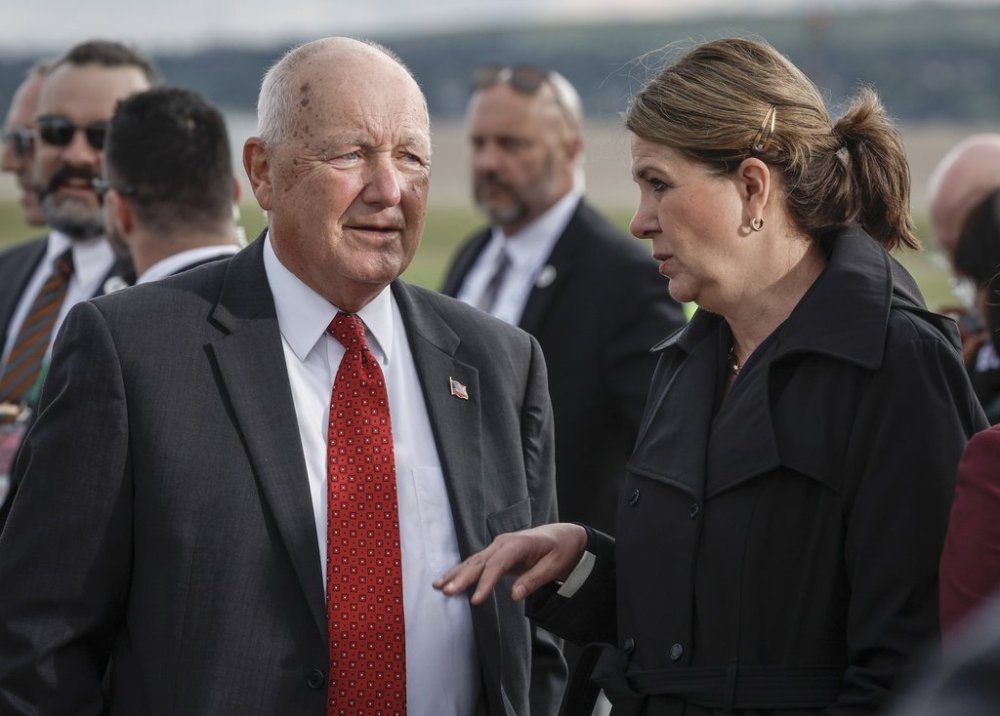
Pete Hoekstra, speaking at a conference in Edmonton, said the U.S. needs to find three to four million more barrels per day over the next decade and noted that Alberta was already a good business partner.
‘We want oil. We need oil,” said Hoekstra, speaking at the Pacific Northwest Economic Region’s annual summit.
“And we have found over the last couple of decades that one of the best places in world to get oil from is Canada.”
Hoekstra said that when Prime Minister Mark Carney met with U.S. President Donald Trump last fall, there were two members of Trump’s government that were more than eager to take up a preliminary offer from Carney to send more oil south of the border.
“The president had to advise them that crawling across the table and shaking Carney’s hand … was not necessarily the best negotiating strategy,” Hoekstra said, adding that the U.S. has other options.
Hoekstra touched on the ongoing trade uncertainty between Canada and the U.S., saying he expects an agreement to be reached at some point despite Trump declining to extend the existing Canada-U.S.-Mexico trade agreement.
“They’re continuing to have discussions. And we’ll see where they end up,” he said.
Hoekstra noted that the U.S. was further along in talks with Mexico and reiterated that he thinks the fact that many Canadians soured on the United States is making it harder to get a deal in place.
The ambassador did say he thinks Canada and the U.S. could partner in other areas, like critical mineral development, and said the trade relationship between the two countries is critical for national security and economic reasons.
“This relationship is so critical, we need to grow it, and we need stabilize it, and the future will be very, very bright for all of us.”
Hoekstra, who has clashed with Ontario Premier Doug Ford over cross-border trade, declined to speak negatively about any Canadian political leader and didn’t mention how Trump has threatened additional tariffs on Canada after wildfire smoke from northern Ontario blanketed multiple states in recent days.
Before leaving the stage, the ambassador gave a toast and downed a shot of whisky with the rest of the crowd. Hoekstra said it was a new tradition that was brewing and started at a recent event in Regina he attended alongside members of Saskatchewan’s government.
Alberta Premier Danielle Smith spoke at the conference later Monday, telling the crowd of business leaders and elected officials from both sides of the border that the region could only prosper if all sides keep working together.
“The rewards for all of us will be enormous, and the benefits will be shared far beyond our corner of the North American continent, not only to our friends and neighbours within North America, but also around the world,” said Smith.
This report by The Canadian Press was first published July 20, 2026.