
Water plant upgrades aim to meet Health Canada guidelines by 2029
Advertisement
Read this article for free:
or
Already have an account? Log in here »
We need your support!
Local journalism needs your support!
As we navigate through unprecedented times, our journalists are working harder than ever to bring you the latest local updates to keep you safe and informed.
Now, more than ever, we need your support.
Starting at $15.99 plus taxes every four weeks you can access your Brandon Sun online and full access to all content as it appears on our website.
Subscribe Nowor call circulation directly at (204) 727-0527.
Your pledge helps to ensure we provide the news that matters most to your community!
To continue reading, please subscribe:
Add Brandon Sun access to your Free Press subscription for only an additional
$1 for the first 4 weeks*
- Enjoy unlimited reading on brandonsun.com
- Read the Brandon Sun E-Edition, our digital replica newspaper
*Your next Free Press subscription payment will increase by $1.00 and you will be charged $20.95 plus GST for four weeks. After four weeks, your payment will increase to $24.95 plus GST every four weeks.
Read unlimited articles for free today:
or
Already have an account? Log in here »
Brandon’s upgraded water treatment facility will be able to consistently meet Health Canada guidelines as early as 2029, city officials say.
The $139-million project currently underway aims to improve drinking water quality, which has been in a state of non-compliance in recent years.
“The main driver for getting the (new) system in place was the water quality, with the Assiniboine (River) being our main source of water. There’s a lot of organics in it,” said Alan Howe, manager of the water treatment facility, during a tour of the existing facility last month.
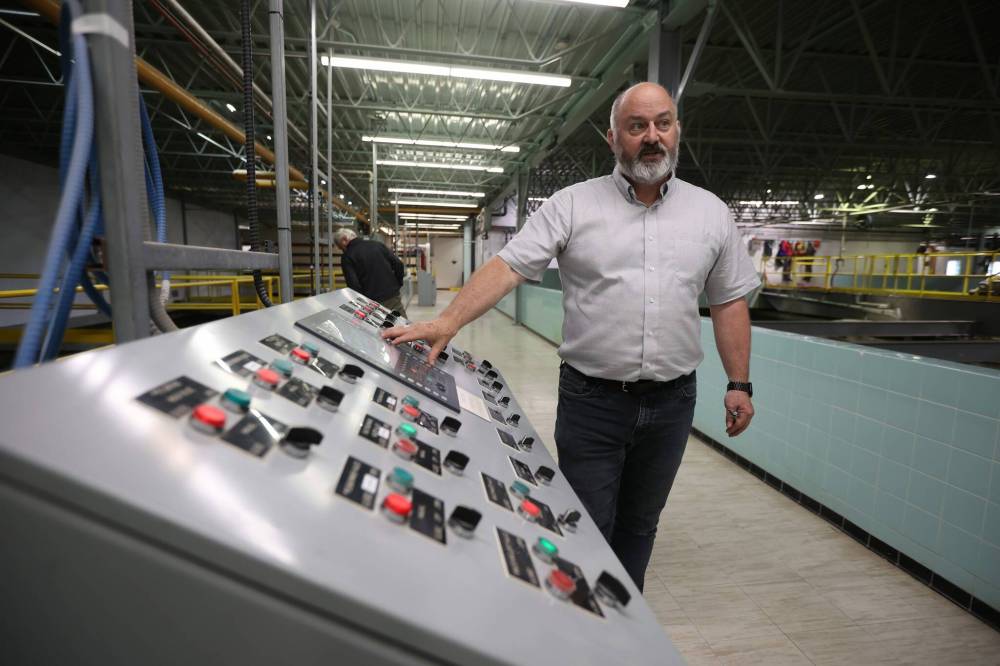
Alan Howe, manager of the City of Brandon’s water treatment facility, explains the facility’s operations during a tour last month. Construction is currently underway on an expansion of the plant at 108 26th St., with upgrades expected to be completed in October 2029. (Tim Smith/The Brandon)
Construction is currently underway on the expansion at 108 26th St., with upgrades expected to be completed in October 2029.
When the water is treated with chlorine or sodium hypochlorite, there is a potential that it creates byproducts called trihalomethanes (THM) and haloacetic acids (HAA), which are known carcinogens in rats.
The city says the water is safe to drink, but some tests have shown slightly elevated levels of THMs and HAAs.
“Health Canada has extrapolated, saying, ‘This would be the maximum threshold. If you’re above this, there’s a potential or higher potential for cancer forming in the consumers of that,’” Howe said.
Health Canada’s website describes THMs as a “possible human carcinogen.”
The city’s director of utilities, Alexia Stangherlin, told council last year that the current plant isn’t doing as good a job as it should in meeting the guidelines.
“It just does not remove those constituents in the water to the degree that we need them to,” Stangherlin told council in July 2025.
On Monday, Stangherlin told the Sun that the chlorine is used at the end of the cleaning process, after organic material has been separated.
“If you’re not able to remove sufficient organics through your treatment process, the chlorine will react with organics in the water in the pipes that are going into the distribution system, so it creates a new chemical,” she said.
Quarterly results showed that the city was slightly above guidelines for HAAs in May, with 0.084 milligrams per litre registered in two of 16 tests during the year, slightly above the 0.08 mg/L limit. The average over the course of the year was 0.056 mg/L.
The THM results failed on more occasions, with 14 out of 20 tests being over the limit.
The THM limit is set at 0.1 mg/L, with the city’s average measuring 0.116 mg/L. The highest result came in at 0.156 mg/L in May.
Stangherlin said the reason this has become a concern for the city is because guidelines have been updated in more recent years.
The provincial government updated its standards in 2012 and 2017.
Stangherlin said the new dual-membrane system with “ultra filtration and nano filtration” won’t replace the current treatment facility built in the 1940s, but will instead blend the water together.
She said the expansion of the existing facility is the most affordable approach for the city.
“For the most part, our current system works very well. It’s an economical system. It’s mechanical, so simpler to operate and maintain. And we knew there was inherent value there, and that we needed to improve water quality, but we didn’t need to improve it tenfold,” Stangherlin said.
The city plans to blend the water from the new and existing system 50-50, though it can change the ratio depending on demand.
With the new system in place, the city expects to be “well below” Health Canada’s guidelines and it will be “robust enough” to handle potential future changes to the country’s guidelines.
“We’re quite confident in the approach. We know other systems using the same source water have had success reducing their THMs in the system,” she said.
While the city’s 2026 budget earmarked about $2.8 million for chemicals for the treatment plant, Stangherlin declined to give an estimate on how much the city might spend each year when the upgrades are complete, as the chemicals industry is “volatile” and prices can change greatly.
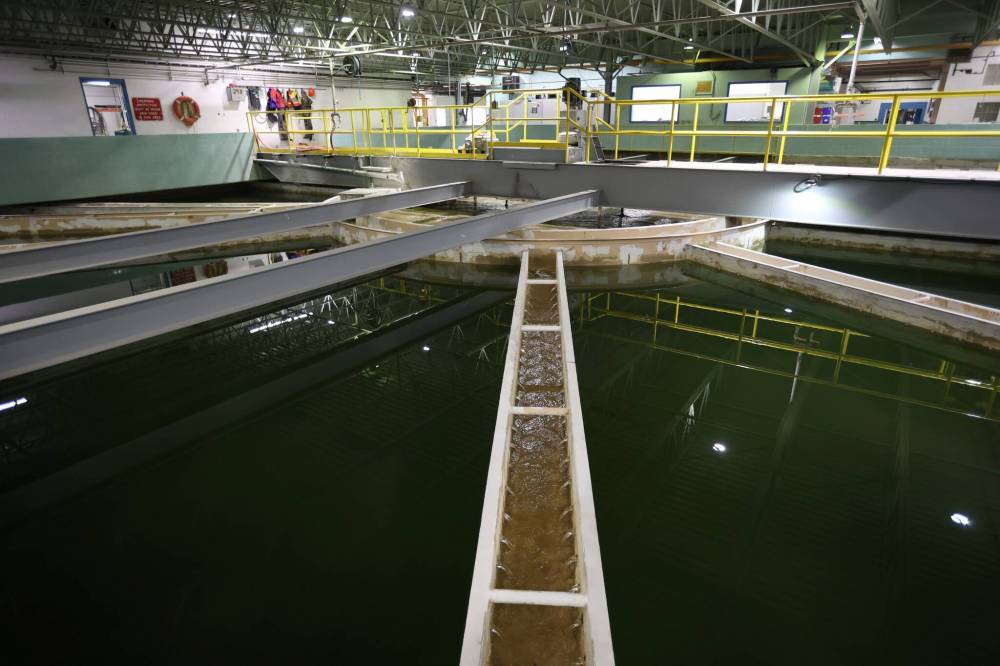
The city draws water from the Assiniboine River into the facility, where it is filtered, softened and treated. The city adds carbon dioxide, lime and soda ash among other chemicals to help treat the water. (Tim Smith/The Brandon)
The city will also be purchasing some different types of chemicals for the new plant.
Stangherlin said she’s hoping that the change won’t have a significant impact on the budget.
During last month’s tour, Howe said the new facility will be like “apples and oranges” in terms of how easy it will make his job.
The expansion will require only one additional staff member, as the system will largely be automated.
Howe said after the city draws water from the Assiniboine River into the facility, it is filtered, softened and treated.
The city adds carbon dioxide, lime and soda ash among other chemicals to help treat the water.
The lime and soda ash help soften the water, which reduces the amount of calcium buildup on pipes. The carbon dioxide helps neutralize the pH level that was raised by the other chemicals.
On a typical Thursday last month, the plant was running 24 million litres on the day.
Howe said it takes about four or five hours from the time the water is drawn from the river until it reaches taps in homes and businesses.
The city has multiple intake locations on the river in case of an emergency.
A year or two ago, a tractor fell into the river upstream from the city and spilled about 400 litres of diesel.
After the spill, the station switched to a lower intake screen to avoid the spill, and did lots of testing to make sure it didn’t contaminate the city’s drinking water.
The facility also has multiple giant pools that help separate clean water.
The excess waste that is separated from clean water is then used as soil conditioner for farmers.
“If you see any white mounds in the middle of the farmer’s field, that’s our sludge. It dries out and it turns into a white powder, and it’s easy to till into the soil,” Howe said.
Once the water is completely treated, it gets pumped out across the city.
» alambert@brandonsun.com