
NDP chips in for train station
Advertisement
Read this article for free:
or
Already have an account? Log in here »
We need your support!
Local journalism needs your support!
As we navigate through unprecedented times, our journalists are working harder than ever to bring you the latest local updates to keep you safe and informed.
Now, more than ever, we need your support.
Starting at $15.99 plus taxes every four weeks you can access your Brandon Sun online and full access to all content as it appears on our website.
Subscribe Nowor call circulation directly at (204) 727-0527.
Your pledge helps to ensure we provide the news that matters most to your community!
To continue reading, please subscribe:
Add Brandon Sun access to your Free Press subscription for only an additional
$1 for the first 4 weeks*
- Enjoy unlimited reading on brandonsun.com
- Read the Brandon Sun E-Edition, our digital replica newspaper
*Your next Free Press subscription payment will increase by $1.00 and you will be charged $20.95 plus GST for four weeks. After four weeks, your payment will increase to $24.95 plus GST every four weeks.
Read unlimited articles for free today:
or
Already have an account? Log in here »
RIVERS — The provincial government is kicking in $98,000 to help restore the Rivers train station, develop a bicycle museum on the site and expand bike trails in the community.
Municipal and Northern Relations Minister Glen Simard made the announcement in Rivers on Wednesday, saying the train station is an important part of the province’s history.
“This project preserves a key piece of Manitoba’s heritage, and it creates new opportunities for tourism, culture and local economic and recreational development,” Simard, the MLA for Brandon East, told a crowd of about 25 people.
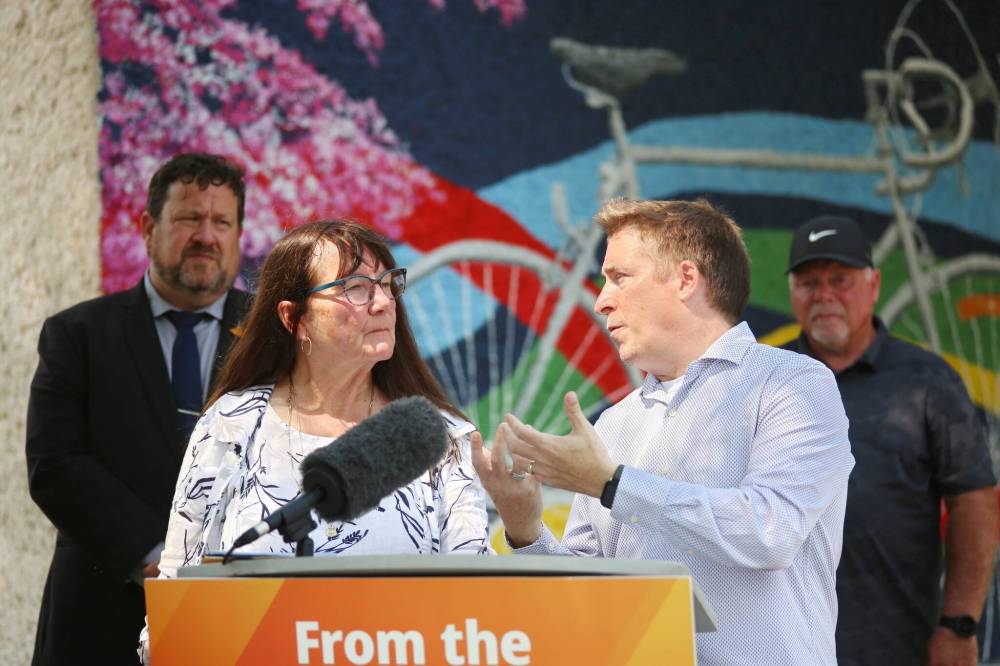
Donna Morken, chair of the Rivers Train Station Restoration and Heritage Committee, and Wayne Kelly, director of the Rural Development institute at Brandon University, answer questions from the media on how a $98,000 grant from the province will be used for economic development in the community of Rivers during a press conference on Wednesday afternoon. (Matt Goerzen/The Brandon Sun)
The funding, which is coming from the province’s From the Ground Up — Safe Healthy Communities for All program, is also going toward researching and producing the Sekine bicycle story with Ryukoku University in Kyoto, Japan, for the planned museum.
Rivers hosted a Sekine bicycle factory for the Japanese company from 1973 to 1981, shipping parts by rail across North America through the town’s train station.
Simard said the train station and former bicycle factory — which is commemorated with a mural along Main Street — show the strength, resilience, culture and history of the municipality.
He said the restoration of the station, which will include a virtual and physical museum and more amenities for riders, is an important way to honour the past and will serve as a space for residents, artists and Via Rail passengers.
The station’s main building on Wednesday remained shuttered, with concrete crumbling from the building’s base.
Donna Morken, chair of the Rivers Train Station Restoration and Heritage Committee, couldn’t say how much the restoration of the facility will cost, or give a timeline for repairs.
She said officials will now need to sit down together to figure out how to divide the funds.
“You have no idea how excited we are,” Morken told Simard.
“Our committee is absolutely thrilled to receive such good news for our community.”
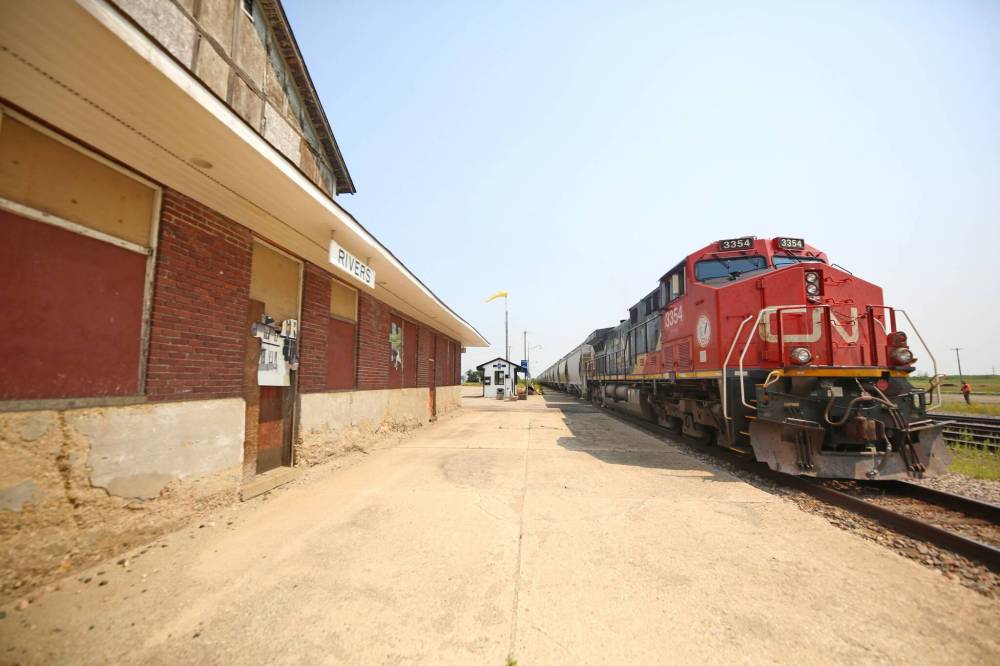
A Canadian National train passes by the aging train station in Rivers on a hot Wednesday afternoon. (Matt Goerzen/The Brandon Sun)
Some of the funding is being allocated for a research project to determine how best to develop rural communities in other parts of the province.
The director of the Rural Development Institute at Brandon University, Wayne Kelly, who is leading the research project, said the funding is split between the community and researchers, who will be on the ground in Rivers.
“As we work with community groups that are doing this type of work on the ground, we’re going to be developing the training and some of those techniques to sort of train other community groups around research skills on the ground, so that they don’t necessarily need a PhD to come in and do community research,” Kelly said.
Other Westman, Interlake and francophone communities could also be part of the pilot project as it expands, he said.
“What do they need both in terms of resources and supports from places like Brandon University, like the Rural Development Institute?” Kelly said. “And how we can all help our rural communities in Manitoba sort of continue to grow and develop as they want to direct it?”
» alambert@brandonsun.com