
New severe storm alert system on tap
Advertisement
Read this article for free:
or
Already have an account? Log in here »
We need your support!
Local journalism needs your support!
As we navigate through unprecedented times, our journalists are working harder than ever to bring you the latest local updates to keep you safe and informed.
Now, more than ever, we need your support.
Starting at $15.99 plus taxes every four weeks you can access your Brandon Sun online and full access to all content as it appears on our website.
Subscribe Nowor call circulation directly at (204) 727-0527.
Your pledge helps to ensure we provide the news that matters most to your community!
To continue reading, please subscribe:
Add Brandon Sun access to your Free Press subscription for only an additional
$1 for the first 4 weeks*
- Enjoy unlimited reading on brandonsun.com
- Read the Brandon Sun E-Edition, our digital replica newspaper
*Your next Free Press subscription payment will increase by $1.00 and you will be charged $20.95 plus GST for four weeks. After four weeks, your payment will increase to $24.95 plus GST every four weeks.
Read unlimited articles for free today:
or
Already have an account? Log in here »
Environment and Climate Change Canada is launching a modernized weather service next Tuesday that will make severe storm alerts more timely and targeted.
The upgrade, called Convective Alert Modernization, will allow forecasters to define areas most likely to be affected by severe thunderstorms and tornadoes, and then warn the people inside them, ECCC spokesperson Samantha Bayard said Thursday.
“This will give everyone the information they need to act quickly and stay safe,” Bayard said in an email. “People in Canada will receive more precise severe thunderstorm and tornado warnings faster.”
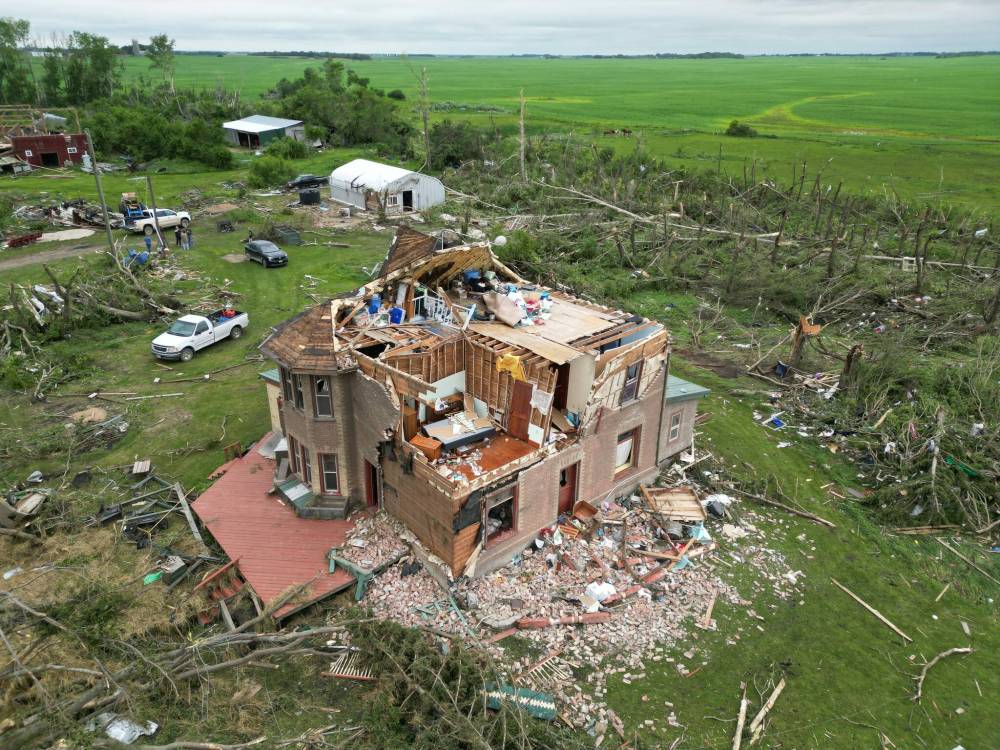
The devastation to the home and property belonging to Brian and Bernadine Brown south of Rossburn is visible after a powerful tornado hit the property on June 28 while the couple was inside. Bernadine said a more targeted warning system would give greater significance to extreme weather alerts. (Tim Smith/The Brandon Sun files)
The upgrade will allow forecasters to send alerts out only to people in defined areas — compared to regions or zones. All other weather alerts will continue to be issued in zone-based areas, Bayard said.
Bernadine Brown, a Rossburn resident who survived a tornado that destroyed her historic home in late June, said a more targeted warning system would give greater significance to extreme weather alerts.
Regular alerts could become tedious and counterproductive, Brown said.
“Sometimes you get bombarded when they keep sending those alerts — like that beep beep beep beep. It kind of cuts out your whole system. It gets annoying. So after a while, you don’t care what it says anymore,” she said.
“The warning system, it sounds like an alert. It sounds very serious. But when you try to put everything into place and it blows over in half an hour or an hour, and nothing really happens, then you just get used to the fact that it’s probably not going to affect us anyway.”
Brown said she and her husband, Brian, would have acted differently had they known that the warnings they received in June were targeted to a smaller area. She said the couple received general alerts before their home was ripped apart by a tornado.
“(The alert just said) that there were tornadoes in the area, or possible tornadoes (and) high winds in the area. But it didn’t specifically say Rossburn. I mean, our area is pretty wide when you look at it.
“We didn’t take it as seriously as it was because it’s never really happened that way.”
Bayard said that in addition to the direct alerts, the WeatherCAN app will make use of the new warning precision when sending notifications to users — and targeted areas will be visible on the interactive weather information map found at Canada.ca/weather.
ECCC is continuously improving scientific tools, technology and automation, Bayard said, adding that the changes to severe thunderstorm and tornado warnings will be evaluated on an ongoing basis.
Weather alerts are issued by working in close collaboration with health authorities, emergency management organizations and media, she said.
“Our prediction and warning services are critical to anticipate, manage and adapt to the risks created by severe summer weather such as tornadoes, hurricanes, wildfires and extreme heat.”
» cmcdowell@brandonsun.com