
Normalcy returning slowly to region hit by floods
Advertisement
Read this article for free:
or
Already have an account? Log in here »
We need your support!
Local journalism needs your support!
As we navigate through unprecedented times, our journalists are working harder than ever to bring you the latest local updates to keep you safe and informed.
Now, more than ever, we need your support.
Starting at $15.99 plus taxes every four weeks you can access your Brandon Sun online and full access to all content as it appears on our website.
Subscribe Nowor call circulation directly at (204) 727-0527.
Your pledge helps to ensure we provide the news that matters most to your community!
To continue reading, please subscribe:
Add Brandon Sun access to your Free Press subscription for only an additional
$1 for the first 4 weeks*
- Enjoy unlimited reading on brandonsun.com
- Read the Brandon Sun E-Edition, our digital replica newspaper
*Your next Free Press subscription payment will increase by $1.00 and you will be charged $20.95 plus GST for four weeks. After four weeks, your payment will increase to $24.95 plus GST every four weeks.
Read unlimited articles for free today:
or
Already have an account? Log in here »
Western Manitoba municipal officials in areas that severely flooded earlier this summer say their communities are slowly getting back to normal, but more work still needs to be done.
“A lot of people have gotten to the point where it’s no longer a disaster. It’s just really annoying and has to be dealt with,” Swan Valley West Reeve Bill Gade said Tuesday.
There are still a lot of bridges and roads that are out of commission due to two rounds of flooding in June and early July, he said. But people can get almost anywhere now.
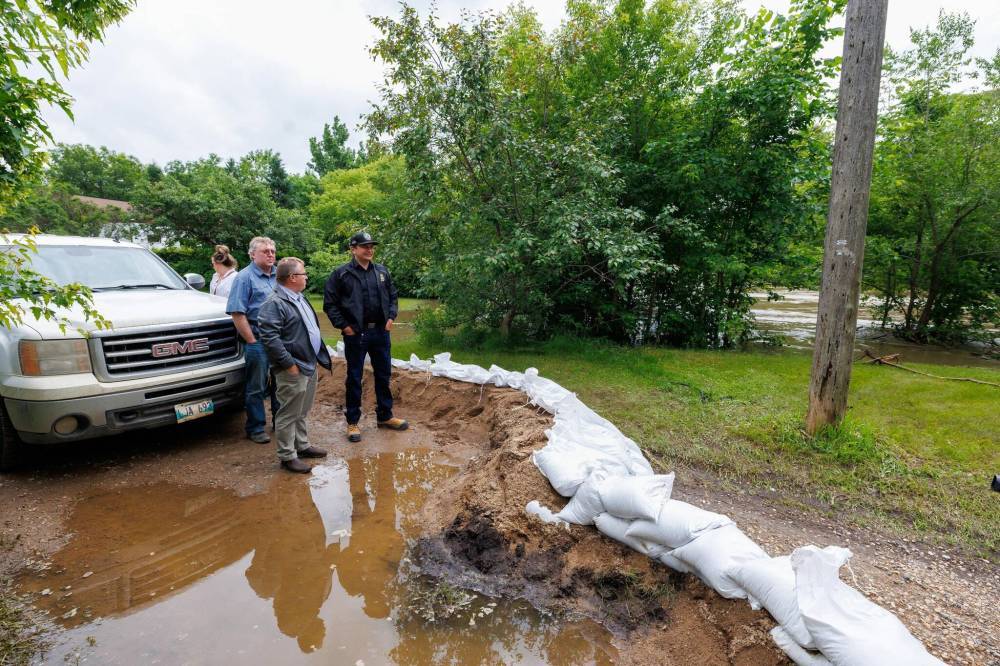
Manitoba Premier Wab Kinew is given a tour of Swan River by Mayor Lance Jacobson (centre) and Bill Gade, reeve of the RM of Swan Valley West (left), on July 2. (Mike Deal/Winnipeg Free Press files)
“Things are starting to get back to normal more. We’re not there yet, but most people now can go about their daily stuff without a whole bunch of interruption,” Gade said.
“People have for the most part got their houses cleaned up to the point where they can go to work and not worry about them during the day.”
Gade said there are still some parts of life that haven’t returned to normal. A day that would typically be spent at the lake is now spent at home because residents aren’t sure if the road they would use is even passable.
“You can get there, but it’s a two- or three-hour detour to get to the place that used to be a half-hour drive, so there’s a lot of just differences in how people are doing things and what they’re doing,” he said.
The municipality’s staff and elected officials, he said, are “doing OK,” while “pulling our hair out at the same time.”
Trying to maintain Swan Valley West’s 600 miles of road while carrying out millions of dollars’ worth of repairs at the same time is a “delicate balancing act,” Gade said.
The municipality received $500,000 from the province for repairs before the second round of flooding, he said, and is expecting to receive more soon.
Five engineering reports for damaged infrastructure — four of which were for bridges — have been completed so far at a cost of almost $22 million, he said.
“We’re expecting a $12-million cheque to hit our bank account here in a couple days,” he said, adding that the funds will be used to cover a variety of expenditures.
Gade said he’s also hearing about residents receiving money from the province’s disaster recovery program. That’s a positive, he said, because people were concerned they might not get any money back for recovery or that it would take a long time.
The timeline for all repairs is “up in the air,” he said, adding that he has heard emergency repairs for bridges can take years, though the municipality wants that process to be faster.
Swan River Mayor Lance Jacobson said most people in his town have moved back into their homes, with a small number of people still waiting as water came over their floorboards and contractors continue to work.
“Most people got things to the point where it’s functional, and then kind of go from there. But there’s still a long ways to go,” Jacobson said.
Most of the town’s municipal infrastructure was unaffected, aside from parks flooding, he said. The flooded parks remain closed.
Jacobson said it will probably take a year or more for the town to return to its original state, but that mentally, he doesn’t know if it will ever be the same as it was before the two floods.
Swan River received 106.8 millimetres of rain between June 28 and July 2, and a combined 269.5 mm for all of June. That compares to an average of 84.8 mm it typically receives during that month.
The flooding caused widespread damage of land, homes and roads. Municipalities in Swan Valley had already started recovering and rebuilding from the first flood when the second flood in July hit the region.
Down the road in Minitonas-Bowsman, acting reeve Gary Bartel said the recent reopening of Highway 10 between Swan River and Minitonas has “certainly made a big difference” for travel between the two communities.
The highway reopened on July 31, a provincial spokesperson said. Crews cut Highway 10 during the first round of flooding in June to allow floodwaters to flow downstream.
Bartel said the closure turned what had been a 10- to 12-minute drive into an hour-plus venture. The increased traffic on the rural roads was also hard on those thoroughfares.
The municipality has seen a lot of rural roads beat up and is working on small repairs now.
Larger repairs could include building bridges where crossings weren’t needed before, Bartel added.
“A lot of roads aren’t going to be open for harvest here,” he said. “It’s going to be a bit inconvenient, but that’s just the way it is when you’re beat up to the extent we got here in Minitonas-Bowsman.”
He said some bridges could take two to three years to be repaired or built.
“There are going to be situations where we’re probably not going to have certain roads open for two years, I would say, at probably the earliest,” he said. “Because we are in August already, and this year is basically gone.”
Flooding and flood damage continue to impact the province’s highway network. Highway 10 is still closed near Ethelbert and Highway 83 near the Shell River is also closed, a provincial update on Wednesday said.
A plethora of smaller highways were also closed as of Wednesday, including portions of highways 266, 352, 366, 367, 478, 484, 486, 488, 579, 584, 593 and 594. Highway conditions and closures can be found at Manitoba 511.
In Dauphin, Mayor David Bosiak said some precipitation on Tuesday was the first bit of rain since the flooding at the start of July. That dry weather over the last five weeks has allowed people to clean out basements.
Provincial emergency officials and the Red Cross were in the community on Monday and Tuesday, he said, to assist people with insurance and disaster financial assistance work.
“The water came quickly and left quickly, and so from a municipal standpoint, we had very little municipal damage,” Bosiak said.
Some residents were “dramatically affected” by the flood while some only experienced a minor inconvenience and others weren’t impacted at all.
Dauphin received 118.9 mm of rain between June 28 and July 2 and a combined 211.3 mm for the entire month of June. The average for Dauphin in June was previously 80.7 mm.
Along with the temporary loss of the Dauphin Regional Health Centre after the building’s basement flooded, the cancellation of the National Ukrainian Festival was a large blow to the city.
The economic loss of the cancellation was difficult, Bosiak said.
The closure of the hospital was “huge” as patients are now forced to travel to Minnedosa, Neepawa, Brandon or Swan River for treatments and appointments.
“It’s a regional health centre. It serves more than Dauphin,” Bosiak said. “It has a catchment area of about 45,000 people in the Parkland region, and so our greatest concern (is) for the specialists, the surgeons and anesthesiologists and others who work at the hospital.”
He said he doesn’t want to see them to leave the community when the hospital reopens.
Premier Wab Kinew said in July it would take nine to 12 months for the hospital to reopen, which he called “unacceptable.”
Bosiak said after receiving updates from health officials, “it appears” that the timeline could now be shorter.
A temporary diagnostic patient service centre offering walk-in X-ray, urine collection, blood tests, electrocardiogram and Holter monitoring services is now open in Dauphin, Prairie Mountain Health’s website says. The services are provided out of the Dauphin Provincial Building at 27 Second Ave. SW.
The emergency department at the Ste. Rose General Hospital is open 24-7 while Grandview Hospital’s emergency department is open daily from 7 a.m. to 7 p.m.
Looking ahead, celebrations are being planned for the affected communities.
Swan Valley West is hosting its delayed Canada Day celebrations on Saturday. Swan River has its Rally for the Valley on Aug. 29, including some events it couldn’t do on Canada Day. A smaller Ukrainian festival and street fair in Dauphin is also set for the middle of September.
» alambert@brandonsun.com