
Hospital access a struggle for dialysis patient
Advertisement
Read this article for free:
or
Already have an account? Log in here »
We need your support!
Local journalism needs your support!
As we navigate through unprecedented times, our journalists are working harder than ever to bring you the latest local updates to keep you safe and informed.
Now, more than ever, we need your support.
Starting at $15.99 plus taxes every four weeks you can access your Brandon Sun online and full access to all content as it appears on our website.
Subscribe Nowor call circulation directly at (204) 727-0527.
Your pledge helps to ensure we provide the news that matters most to your community!
To continue reading, please subscribe:
Add Brandon Sun access to your Free Press subscription for only an additional
$1 for the first 4 weeks*
- Enjoy unlimited reading on brandonsun.com
- Read the Brandon Sun E-Edition, our digital replica newspaper
*Your next Free Press subscription payment will increase by $1.00 and you will be charged $20.95 plus GST for four weeks. After four weeks, your payment will increase to $24.95 plus GST every four weeks.
Read unlimited articles for free today:
or
Already have an account? Log in here »
For the past five years, Caroline Fisher has consistently used the Access Transit buses three times a week to get to and from the dialysis unit at the Brandon Regional Health Centre to receive life-sustaining treatment.
Up until three months ago, she — along with other dialysis patients who struggle with mobility — were dropped off at the hospital door. Now, Fisher estimates she walks about 91 metres (300 feet) from the drop-off point to the door, aided by the use of a walker.
“Who made this decision?” she said in an interview Tuesday. “It’s hard enough with a walker, I cannot imagine pushing a person in a wheelchair.”
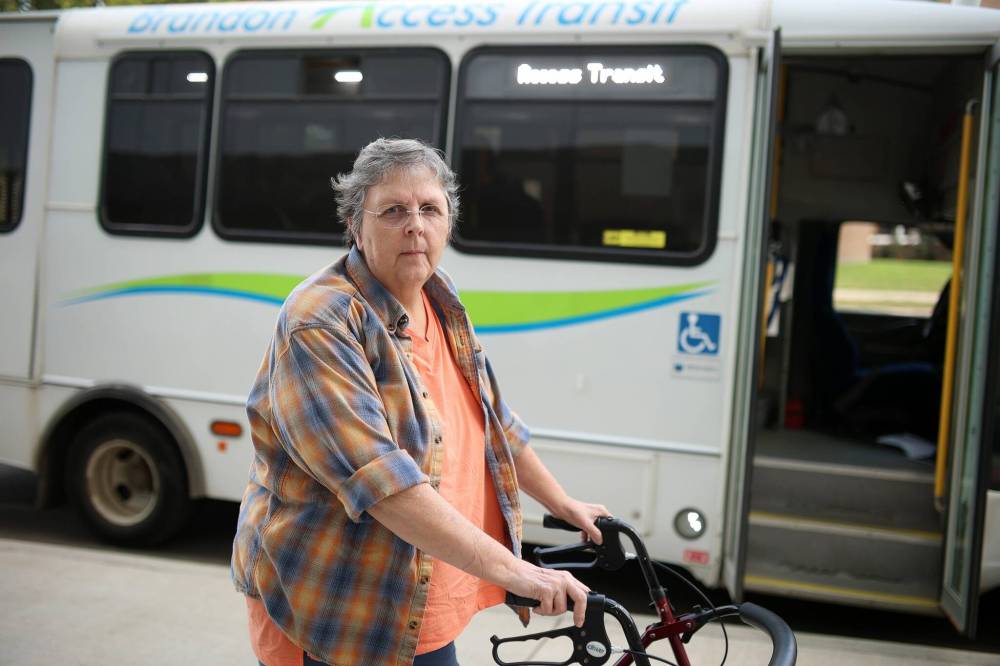
Caroline Fisher stands in front of the Access Transit bus after being dropped off at the Brandon Regional Health Centre for dialysis treatment on Wednesday. (Tim Smith/The Brandon Sun)
The parking stalls are sloped down from the entrance, Fisher said, expressing concerns how snow, ice and wind will impact the trek in the winter.
“Sometimes I go out and walk 300 feet in the rain,” she said.
“I’m capable, but I’ve walked with a woman that immediately collapsed and needed to sit down as it was too far for her,” Fisher said, adding that once inside the hospital, she was able to grab a wheelchair for the woman.
In May, Prairie Mountain Health added the new designated parking stalls for medical transport drivers and Access Transit in an effort to reduce congestion in the traffic loop outside the hospital’s main entrance.
At the time, PMH said the decision to add the parking stalls was to allow for a safer place to load and unload passengers.
Fisher says she’s glad there are parking spaces for medical transport but maintains they’re in the wrong spot.
Dialysis treatment filters and cleans blood in the final stages of kidney failure. In-centre hemodialysis — meaning it’s administered at the hospital or medical centre — lasts about four hours, three times per week.
More than 1,800 adults in Manitoba rely on the service, according to Kidney Health Manitoba.
“This is not a nice disease to have to live with,” she said. “No one is listening.”
Fisher claims she notified the hospital about the accessibility issues with the parking stalls five times since May, and suggested potential solutions, but never received a response.
“We’d like some answers,” she said. “There’s small doors (close to the entrance) that have been locked since COVID-19.” She suggested opening them as a solution.
According to Fisher, if a person in a wheelchair isn’t able to move themselves, transit drivers assist them to the door.
Amalgamated Transit Union Local 1505 — the union that represents transit drivers in Brandon and Winnipeg, including the accessible buses — said their operators are aware of the issue, but it’s out of their hands.
“(Some have) concerns regarding inclement weather and how this would affect their passengers,” a spokesperson said in an email to the Sun on Tuesday, adding that an operator would be unable to do an interview.
“Discussing this publicly would jeopardize the operator’s job … To protect our operators’ jobs, we do not encourage them to do public interviews,” the email said.
Shared Health — the provincial health authority with an accessibility committee tasked with overseeing and drafting the Shared Health Accessibility Plan every two years — declined to comment, redirecting questions to PMH.
A PMH spokesperson said in a statement that the situation is being monitored and “plans are underway to improve accessibility through curb modifications to the Handi-van/transit loading area.”
“Specific to dialysis patients, staff are available to assist clients to bring them to the front entrance of the facility,” the statement said. “PMH continues to actively monitor and assess parking and access routes into and through BRHC designated areas.”
» rgerrard@brandonsun.com