
Water rate increases ‘killing’ residents
Advertisement
Read this article for free:
or
Already have an account? Log in here »
We need your support!
Local journalism needs your support!
As we navigate through unprecedented times, our journalists are working harder than ever to bring you the latest local updates to keep you safe and informed.
Now, more than ever, we need your support.
Starting at $15.99 plus taxes every four weeks you can access your Brandon Sun online and full access to all content as it appears on our website.
Subscribe Nowor call circulation directly at (204) 727-0527.
Your pledge helps to ensure we provide the news that matters most to your community!
To continue reading, please subscribe:
Add Brandon Sun access to your Free Press subscription for only an additional
$1 for the first 4 weeks*
- Enjoy unlimited reading on brandonsun.com
- Read the Brandon Sun E-Edition, our digital replica newspaper
*Your next Free Press subscription payment will increase by $1.00 and you will be charged $20.95 plus GST for four weeks. After four weeks, your payment will increase to $24.95 plus GST every four weeks.
Read unlimited articles for free today:
or
Already have an account? Log in here »
Three years after the City of Brandon began hiking water rates to make up for years of inaction, residents are feeling the financial strain — and some say their high utility bills should be an election issue.
Utility rates have increased by 79 per cent since 2023, when the city charge was initially $1.83 per cubic metre of water used and $1.63 per cubic metre of wastewater.
After the most recent hike, effective on Jan. 1 of this year, city residents now pay $3.16 per cubic metre of water and $3.05 for wastewater.
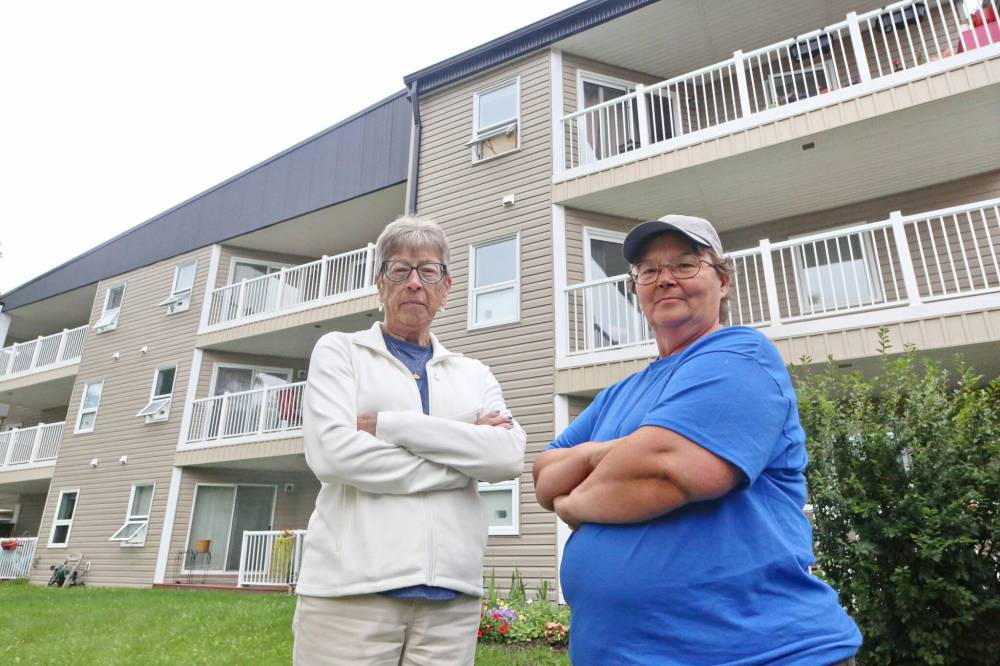
Spruce Woods Housing Co-operative board president Noreen Mitchell (left) stands with property manager Eva Cameron on Friday morning outside the housing complex on Braecrest Drive in Brandon. (Matt Goerzen/The Brandon Sun)
For the Spruce Woods Housing Co-op, this increase raised its quarterly water bill from $7,350.32 in 2023 to $13,131.22 this year.
Eva Cameron, property manager of the non-profit housing co-operative, said the new rate is “killing” them.
“If we raised rent by $100, it wouldn’t cover (water rates), and people wouldn’t be able to afford it,” Cameron said in an interview Friday morning.
The Spruce Woods Housing Co-op is an 81-unit property with townhouses and apartments that house more than 150 people, according to Cameron.
Tenants pay 30 per cent of their monthly income as rent, with some paying as little as $300, making it a struggle to afford building maintenance on top of city utility bills, she said.
The highest-priced unit available is a two-bedroom townhouse, with rent set at $889 per month.
“It’s hard and people are struggling,” Cameron said.
Co-op board chair Noreen Mitchell said the challenge extends far beyond the co-op.
“You’re nailing us, and every apartment or condo or multi-unit building,” she said.
“We just keep plugging along because we have to.”
Cameron said the co-op board’s hands are tied.
“If we were to bring up rent, families, children, seniors will be on the street,” she said.
Mitchell added: “We’re trying to help the low-income people council simply ignores.”
In 2017, water efficiency systems were added to the property, such as low-flow toilets, and water-saving shower heads. Cameron said they also have regulations on plant watering that restrict residents from watering between 9 a.m. and 9 p.m.
Despite the effort, the two say the co-op is still struggling with the ever-increasing utility costs.
The steady jump in city water rates since 2023 is driven by a deficit that accumulated during a seven-year period when water rates remained stagnant, while operating costs and inflation continued to rise.
A Public Utilities Board report from Oct. 20, 2023 said, “the period between rate reviews is unacceptable.”
Before council can raise the water utility rates, the city must submit an application to the utilities board to be reviewed and approved.
The last approved rate by the PUB, before the 2023 hike, was in 2016, despite a provincial recommendation for municipalities to submit rate reviews every three years.
The three-year recommendation is set in place to protect municipal financial positions and the need for a significant rate hike in one year, the report said.
“Had the city been diligent in making rate applications to the board every three years, the operating deficits incurred by the utility may have been mitigated or avoided entirely,” said the report.
The report also recommended that the city “consult with customers, stakeholders, non-profit organizations, and other relevant persons/groups/organizations about creating targeted programs to alleviate the financial hardship” caused by the rate increase.
Cameron said that as a non-profit that provides community services, the co-op should have been consulted on the price jump, but she says they never were.
A year after the report was released, Cameron followed up in an email with the area’s elected official, Coun. Heather Karrouze (Ward 1), asking if consultations had taken place.
Cameron said she never received a response.
Cameron and Mitchell are both calling for a change in council, one that would prioritize affordable housing and saving money, rather than relying on raising taxes or increasing the tax base.
The Sun reached out to city residents through various social media community groups regarding the increase in water rates and whether it would be an issue in the October election.
Many said the rates were too high and were critical of the current council.
“I don’t know how families are surviving,” said Nick Girouard, a Brandon resident for more than 10 years.
“My wife and I do not have children, are both working, and we still feel the effect of the high taxation (from) both water and property taxes,” he wrote to the Sun.
He added that the couple has considered moving outside Brandon to get away from the “extreme taxation.”
A woman who reached out to the Sun through social media, but did not want to participate in an interview, said her choices at the grocery store are impacted by the water bill increase.
Another woman, who works in the Brandon School Division but declined to give her name, told the Sun her water bill had almost tripled over the past 10 years from $200 quarterly to around $250 monthly.
“We’ve gone from around $800 a year to about $3,000 a year. That’s a significant increase, even ignoring inflation,” she said.
“My concern isn’t simply that taxes or utility rates increase; it’s whether increases are bringing more value to us as citizens and the answer is I don’t believe it does at all,” the woman said.
A resident who has lived in Brandon for 12 years and works at the Brandon Regional Health Centre said he hasn’t seen an increase in his quarterly water bill and applauded the city for implementing development charges for water and wastewater.
“I am thrilled that the city council decided to increase the burden on developers to pay for new water infrastructure … It should not be a burden solely carried by the homeowners in the city,” he said.
The development charges cover costs associated with new infrastructure to support new areas, while water utility rates pay for “day-to-day operations,” said Troy Tripp, director of finance for the city.
Tripp said the water utility rates cover the cost of “the water that is distributed throughout the city … as well as the processes that the city uses in its collection and treatment and disposal of the wastewater.”
“Rates primarily focused on that, but also some of the regular capital programming,” which means infrastructure maintenance, replacement and preservation, he said in an interview.
“So, the cost of all of that are accounted for in our water and wastewater rates,” he said.
Mayor Jeff Fawcett said he’s empathetic to people feeling the impacts of the increases, noting that costs are going up for everything, including for the municipality.
“Everybody understands the water rates and a large chunk of that is tied to the $130-million project,” Fawcett said, referring to the ongoing water treatment facility expansion that was announced in July 2025.
“There’s probably another year or so of some correction (in the water rates) and then we can probably get things stabilized where we have natural growth,” he said in an interview on Friday.
He also said that the city has been “very articulate” about the water rates over the last three years.
“We’re paying a lot less than most communities,” he said. “Unfortunately, you’re going to have to watch around the province as rates are going to climb significantly higher than ours again.”
Len Isleifson, a mayoral candidate and former councillor and MLA, said he hasn’t heard much about water bills while campaigning, but encourages residents to “open up the line of communication.”
If elected, Isleifson said he’d want to help drive the economy and strengthen it by adding a larger tax base.
“If you go too low on your tax base, then you’re going to be in a spot where, five, 10 years from now, the next generation is going to be really hit hard because we didn’t do our job and due diligence,” he said.
The municipal election is set for Oct. 28.
» rgerrard@brandonsun.com