
Gossip in the Graveyard brings history to life
Advertisement
Read this article for free:
or
Already have an account? Log in here »
We need your support!
Local journalism needs your support!
As we navigate through unprecedented times, our journalists are working harder than ever to bring you the latest local updates to keep you safe and informed.
Now, more than ever, we need your support.
Starting at $15.99 plus taxes every four weeks you can access your Brandon Sun online and full access to all content as it appears on our website.
Subscribe Nowor call circulation directly at (204) 727-0527.
Your pledge helps to ensure we provide the news that matters most to your community!
To continue reading, please subscribe:
Add Brandon Sun access to your Free Press subscription for only an additional
$1 for the first 4 weeks*
- Enjoy unlimited reading on brandonsun.com
- Read the Brandon Sun E-Edition, our digital replica newspaper
*Your next Free Press subscription payment will increase by $1.00 and you will be charged $20.95 plus GST for four weeks. After four weeks, your payment will increase to $24.95 plus GST every four weeks.
Read unlimited articles for free today:
or
Already have an account? Log in here »
There was plenty of gossip in the graveyard Saturday evening— but none of it came from the living.
Instead, visitors to Brandon Municipal Cemetery were invited to step back in time as actors portraying some of Brandon’s prominent historical residents emerged from among the gravestones to tell stories of the people, businesses and events that helped shape the city.
The annual Gossip in the Graveyard event uses historical research and theatrical performances to bring some of the city’s early residents back to life, with performers speaking in character beside, or in connection with, the graves of those whose stories they portrayed.
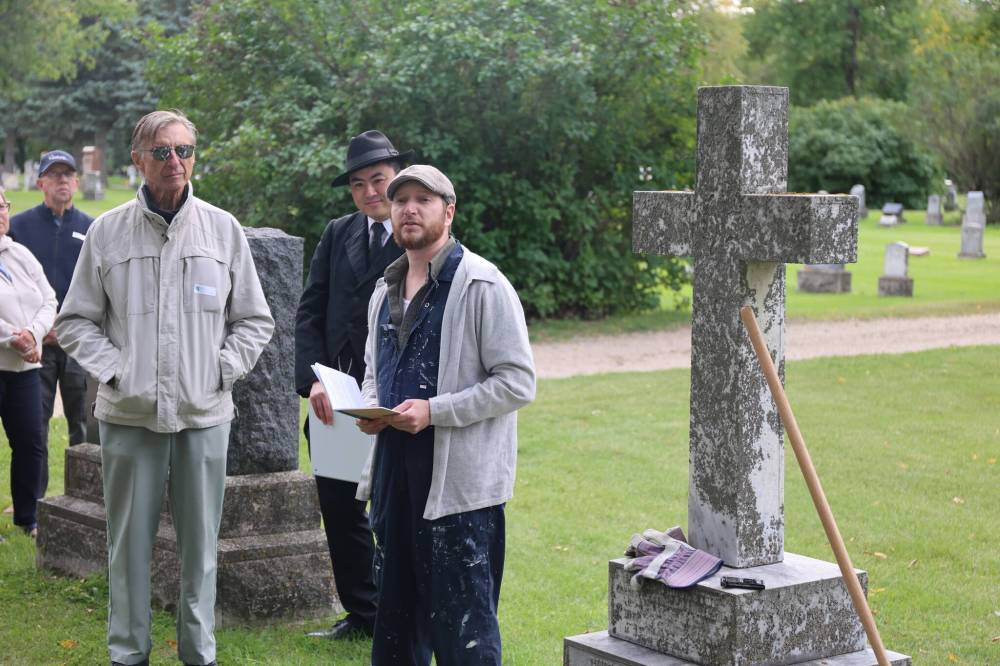
Keith Waterfield portrays Peter Middleton during Gossip in the Graveyard at the Brandon Municipal Cemetery on Saturday evening. Middleton was a horticulturist, parks board member, alderman and advocate for the beautification of Brandon. (Abiola Odutola/The Brandon Sun)
Among them was Margaret “Maggie” Stewart McMillan, portrayed by Sarah Hay, who told visitors about her husband, Archibald McMillan, Brandon’s first chief of police.
“I’m visiting from far away,” Hay said in character. “I’m assuming some of you are from far away, because let me tell you, this city is not what I remember from 1883.”
Hay recalled a dramatically different Brandon in the early 1880s, when the arrival of the Canadian Pacific Railway helped transform the small prairie community into a rapidly growing settlement.
In just a few years, Brandon grew from a few hundred people to almost 3,000, bringing with it a reputation for gambling, liquor and the rough-and-tumble behaviour that came with a rapidly expanding western town.
“My husband was a very interesting man,” Hay, portraying Maggie, told the guests. “He was well over six feet tall, very uncommon for that time frame, and he was a sober, hardworking, intelligent man.”
McMillan became Brandon’s first chief of police in early 1883, working with just three constables to police a community where fights, drunken brawls and reckless horse-and-carriage driving were common, she said.
“Imagine walking down the streets of Brandon and dealing with a brawl, because there were many, and your backup is across town or sleeping,” Hay told the crowd.
“Maggie’s” story also included the tragic circumstances of her husband’s death in 1885, when a rifle he was attempting to put into a cloth case discharged, killing him.
The death shocked the young community. Stores closed, flags were flown at half mast, and hundreds of people attended his funeral procession, which stretched almost three-quarters of a mile.
“That was one heck of a send-off,” she said. “And I’ll tell you this: that man deserved every bit of it.”
The performance also explained a curious detail about why visitors could not find McMillan’s grave in the Brandon cemetery: Maggie had her husband’s body exhumed five weeks after his death and returned to Ontario, where he was reburied in Guelph.
The graveyard’s stories extended beyond tragedy.
Shannon Saltarelli portrayed Mary Winnifred Johnston Brockie, telling the story of George Brockie, the founder of what eventually became Brockie Donovan Funeral Home.
Brockie arrived in Brandon in 1906 at age 21 after learning the funeral business in Ontario. He later established Brockie Funeral Service in 1916, alongside a furniture business — a combination that was common at the time.
“The skills of a furniture maker and an undertaker often went hand in hand,” Saltarelli as Brockie explained. “One required craftsmanship, and the other required compassion, and George had both.”
The story described a man whose life extended beyond the funeral home. Brockie loved baseball, raced horses and occasionally performed as a singer at community events.
His family was also closely connected to music and community life, with his wife and daughters participating in church choirs and performances.
The business eventually passed to his daughter Mary and her husband, Jack Donovan, in 1956, becoming Brockie Donovan Funeral Home.
But perhaps the most unexpected story came from Peter Middleton, portrayed by Keith Waterfield.
A horticulturist, parks board member, alderman and advocate for the beautification of Brandon, Middleton helped promote parks, trees, flowers and boulevards throughout the city.
“Maybe I planted it. Maybe not. But I sure take some responsibility for it,” Waterfield as Middleton said, pointing toward a tree in the cemetery.
Middleton arrived in Brandon in 1896 and spent much of his later life working to transform what had been a prairie settlement into a greener, more attractive city.
He was also a strong advocate for the poor, using his position as an alderman to support charities and describing poverty as a threat that needed to be confronted through community assistance.
“The wolf hunters need your assistance,” “Middleton” said in a speech recreated for the event. “Will you help?”
Another portrayal highlighted the entrepreneurial spirit of women in early Brandon.
Mary Wardle portrayed Alberta Hannah Hornibrook, a teacher-turned-milliner who operated her own hat business downtown and employed several single women.
Hornibrook came west in 1882 and established her own business premises in 1917.
Her former shop stood at 121 10th Street, a location that has passed through several chapters of Brandon history. The building, constructed in 1891, later housed the Carlton Cafe and Trifon’s Pizza and is now home to Pirouette Dancewear.
But the building’s history goes even deeper.
It was once home to the first Bank of Montreal in Brandon and later became the site of James Dillon’s cigar factory.
Through Hornibrook’s story, visitors learned about Dillon, a prominent Brandon businessman, sportsman and baseball supporter who established the Ione Cigar Factory in 1899.
The factory eventually became the largest cigar operation between Brandon and Edmonton.
Its legacy remains visible today in the form of a painted advertisement on the building. The sign was hidden for decades when the Strand movie theatre was constructed in 1916 before being exposed again after the theatre was demolished in 2018.
» aodutola@brandonsun.com
» X: @AbiolaOdutola