
Sale of campground to preserve history, aid ongoing research
Former campground to be held in trust by City of Brandon
Advertisement
Read this article for free:
or
Already have an account? Log in here »
We need your support!
Local journalism needs your support!
As we navigate through unprecedented times, our journalists are working harder than ever to bring you the latest local updates to keep you safe and informed.
Now, more than ever, we need your support.
Starting at $15.99 plus taxes every four weeks you can access your Brandon Sun online and full access to all content as it appears on our website.
Subscribe Nowor call circulation directly at (204) 727-0527.
Your pledge helps to ensure we provide the news that matters most to your community!
To continue reading, please subscribe:
Add Brandon Sun access to your Free Press subscription for only an additional
$1 for the first 4 weeks*
- Enjoy unlimited reading on brandonsun.com
- Read the Brandon Sun E-Edition, our digital replica newspaper
*Your next Free Press subscription payment will increase by $1.00 and you will be charged $20.95 plus GST for four weeks. After four weeks, your payment will increase to $24.95 plus GST every four weeks.
Read unlimited articles for free today:
or
Already have an account? Log in here »
The recent purchase of a piece of land west of Brandon through a partnership between the City of Brandon and the province will help preserve residential school history and allow further cemetery research to take place at the site.
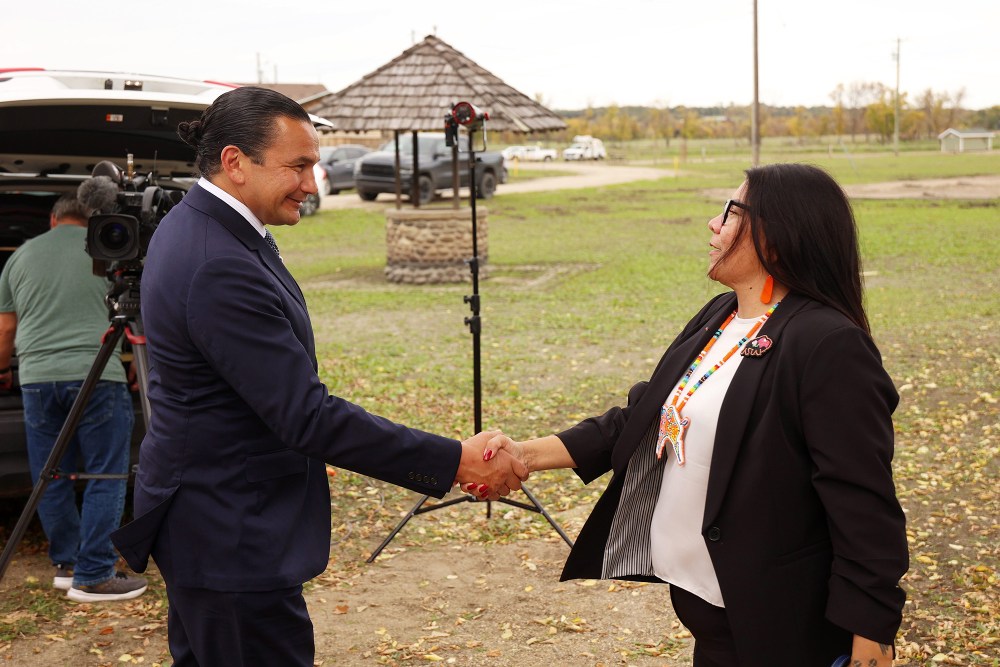
Formerly known as the Turtle Crossing Campground, the land was purchased as a contribution to the aims of Truth and Reconciliation, Manitoba Premier Wab Kinew told the Sun. The property will serve to educate future generations about residential schools, the premier said.
“We live in an era where people are trying to deny what happened in residential schools,” Kinew said during a Tuesday afternoon visit to the former campground site. “It’s an important part of our national history, and keeping that truth alive.”
Kinew said the property has “huge national significance” for education about residential school history because it is one of the “most documented” in the country. He carried photographs, and some 20th century newspaper clippings from The Brandon Sun around the site and referred to them throughout the afternoon.
The graves of at least 56 children are located at the campground, the Sioux Valley Dakota Nation has said, pointing to a geophysical study conducted by an archeology firm in 2018.
There have been long-standing concerns from Indigenous leaders and community members that people were camping on the resting place of children victimized by colonialism.
The school, which was located about five kilometres northwest of Brandon, operated from 1895 to 1972. It used a grave site near the Assiniboine River until 1912, with grave markers removed in 1921 so the area could be transformed into a park.
The 4100 Grand Valley Road property will be held in trust by the City of Brandon until a long-term decision is made about it’s future. Mayor Jeff Fawcett said that the land may eventually be transferred to First Nation ownership.
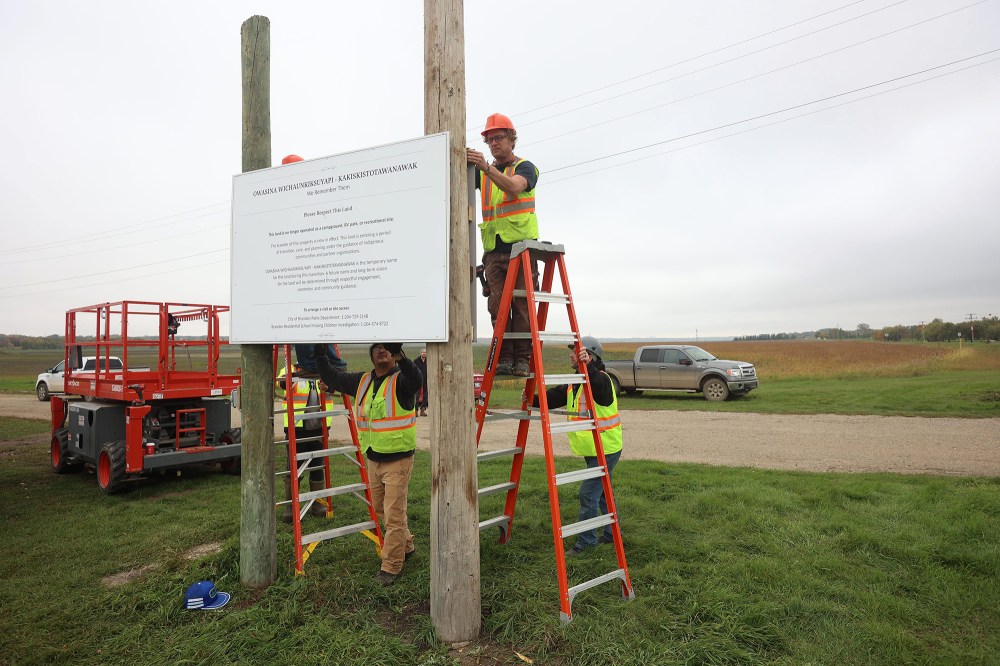
Physical signs were erected at the former campground Tuesday morning declaring that the property is “no longer operated as a campground, RV park, or recreational site.” The sign said that the property is now in a period of transition, care and planning under the guidance of Indigenous communities and partner organizations.
A team from Sioux Valley Dakota Nation will now investigate the earth around the Brandon Residential School Cemetery, according to Chris Mancuso, the principal investigator with the First Nation’s Brandon Indian Residential School Missing Children Investigation. The first goal, he said, is to identify the “true” boundaries of the cemetery, which is currently a fenced space within the former Turtle Crossing Campground.
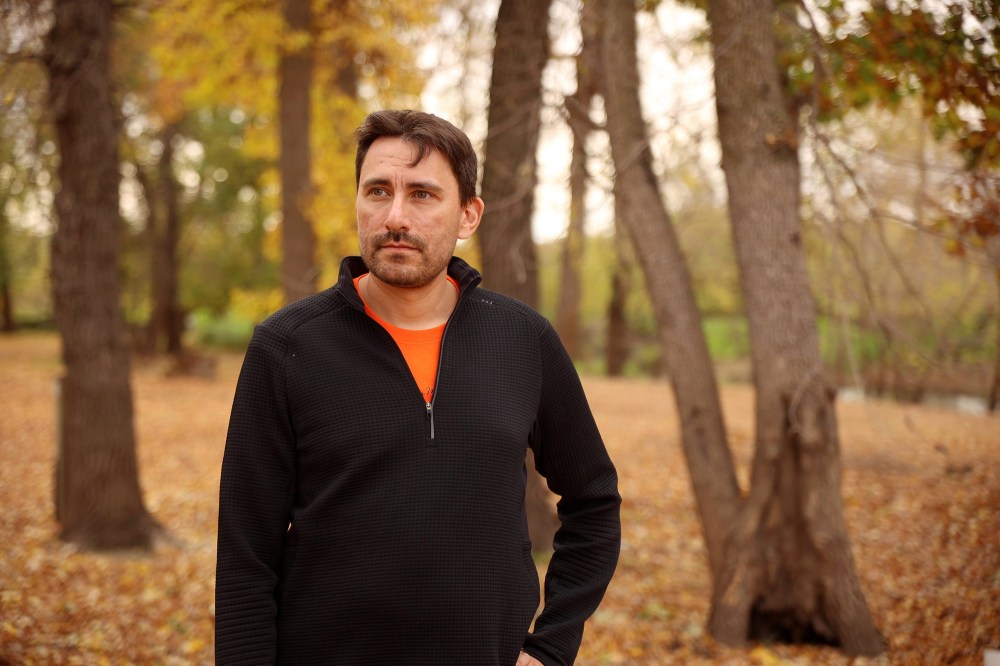
The researcher expects to discover additional signs of burials outside the cemetery’s limits, leading the cemetery to be expanded.
“I anticipate it will expand around the current area where the fence is,” Mancuso said.
Technologies such as ground penetrating radar, magnetism and electromagnetics, which are non-invasive, will be used at the site to investigate the boundaries of the cemetery, he said.
Sioux Valley has a two-year budget drawn up for research at the site, spanning all four seasons, and work started Tuesday to facilitate investigation, he said. An archaeologist walked the property and tagged characteristics, such as fence post holes and utility infrastructure, to prepare for future ground research at the site.
Mancuso said the purchase of the land will improve research by enabling it.
“It allows access,” Mancuso said. “For the technical investigation, we need to be physically on site with our tools. And the investigation is not just a one day search. So, having sustained access gives the chance to protect this cemetery.”
There had been difficulties in the past accessing the site for research while the Turtle Crossing Campground was privately owned and operated, he said.
The researchers will first look at the property from a wide angle, noting historical changes, such as utilities that have been added, and identify priority research areas — and then the team will zero in on focus areas and use higher resolution tools to investigate the property, he said.
“It’s an iterative research process,” he said. “That cycle could repeat many times too.”
Kinew said that conversations will take place going forward about how the land will be used — pointing to possible monuments and ceremonies. In the meantime he suggested that the province will support Sioux Valley and other Indigenous nations that want to carry out more research.
“This is very much an active process,” Kinew said.
The City of Brandon will be responsible for maintaining the property until a long-term decision is made about the property’s future, Fawcett said. General grounds maintenance, such as keeping the road clear and flushing water, will be conducted by the city, he said.
The long-term vision for the property, said Sioux Valley Dakota Nation Chief Jennifer Bone, will be decided in the future following consultations with impacted families and community members.
She said the announcement was “meaningful” to the community, as Sioux Valley has been working on its residential school project since 2012.
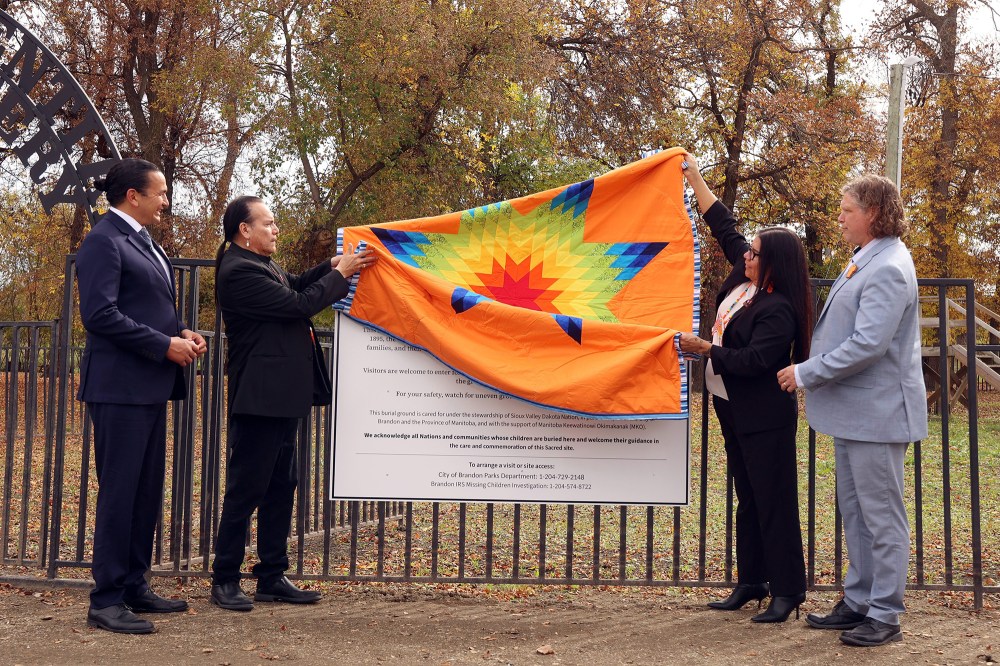
“This is years of work and advocacy, not even just Sioux Valley, but Manitoba Keewatinowi Okimakanak and the City of Brandon,” Bone said. “The announcement is a huge step towards reconciliation.”
The premier is expected to make the formal announcement on Wednesday.
» cmcdowell@brandonsun.com
» With files from