
Former cocaine dealer who turned life around sentenced to four years
Advertisement
Read this article for free:
or
Already have an account? Log in here »
We need your support!
Local journalism needs your support!
As we navigate through unprecedented times, our journalists are working harder than ever to bring you the latest local updates to keep you safe and informed.
Now, more than ever, we need your support.
Starting at $15.99 plus taxes every four weeks you can access your Brandon Sun online and full access to all content as it appears on our website.
Subscribe Nowor call circulation directly at (204) 727-0527.
Your pledge helps to ensure we provide the news that matters most to your community!
To continue reading, please subscribe:
Add Brandon Sun access to your Free Press subscription for only an additional
$1 for the first 4 weeks*
- Enjoy unlimited reading on brandonsun.com
- Read the Brandon Sun E-Edition, our digital replica newspaper
*Your next Free Press subscription payment will increase by $1.00 and you will be charged $20.95 plus GST for four weeks. After four weeks, your payment will increase to $24.95 plus GST every four weeks.
Read unlimited articles for free today:
or
Already have an account? Log in here »
A mid-level interprovincial cocaine dealer will serve four years in prison after he skipped his 2021 sentencing and was unlawfully at large for more than two years while positively rebuilding his life.
Commercial cocaine traffickers typically receive a sentence within a five-to-eight-year range, but provincial court Judge Geoffrey Bayly said he wasn’t persuaded that period of custody would adequately reflect Allan Dengler’s post-offence rehabilitation.
Dengler, 38, from Young, Sask., pleaded guilty to possessing a significant quantity of cocaine for the purpose of drug trafficking in January 2020 after he was arrested by RCMP in Dauphin two years earlier.
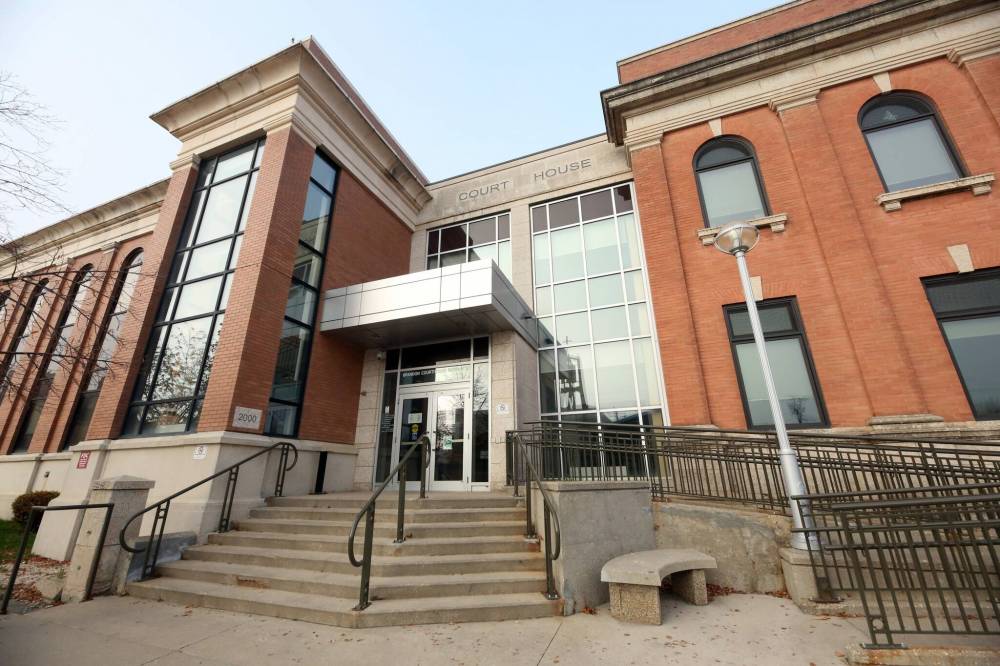
The Brandon courthouse entrance on 11th Street. (Matt Goerzen/The Brandon Sun files)
“The commercial distribution of cocaine causes significant harm to individuals and communities and remains a serious threat to public safety and community well-being,” Bayly said in a written decision delivered on Sept. 17.
“Although this sentence falls below the conventional range, it appropriately recognizes Mr. Dengler’s post-offence progress, while remaining sufficiently severe to denounce his conduct and to communicate the importance of general deterrence in cases of this nature.”
Dengler was found in possession of two plastic bags containing a combined total of 189.9 grams of cocaine, with one weighing 35.2 grams and the other 154.7 grams, on June 5, 2018.
RCMP were surveilling a Dodge Ram pickup truck parked at the Canway Inn in Dauphin that was registered to a Saskatchewan woman who was wanted in that jurisdiction.
Police followed the vehicle as it left the motel and pulled it over in a back alley. Officers smelled marijuana in the vehicle and arrested Dengler, who was driving, along with a female passenger.
The vehicle was later searched, and officers seized the cocaine, $4,600 in Canadian currency found inside the accused’s Louis Vuitton handbag, $140 in cash, digital scales and a contaminated plastic bowl.
Police analyzed Dengler’s cellphone, which showed he held a mid-level position within an ongoing cocaine trafficking network operating between Manitoba and British Columbia to capitalize on a “more lucrative market,” Bayly said.
“The communications demonstrated his involvement in obtaining kilogram quantities of cocaine, collecting drug debts, and supplying narcotics to lower-level dealers, all for significant financial gain.”
The operation showed planning and sophistication designed to reduce the risk of being caught, Bayly said.
While profit was the primary motivation for the offending, Dengler’s serious cocaine addiction contributed to his involvement in the drug trade, the decision said.
The accused has no prior criminal record. He was raised on a farm and had a mostly stable upbringing despite parental conflict and separation.
After he graduated high school, he worked in the oil and gas industry before moving to B.C. where he got involved with a negative peer group and began using cocaine.
By 2018, Dengler reported that his recreational cocaine use had progressed to a severe addiction with monthly expenditures of $8,000 to $10,000. His addiction, a lack of employment and a fire that destroyed his home led to bankruptcy and his participation in the drug trade, Bayly said.
“While I accept that the offender experienced significant financial difficulties during this period, the hardship he describes is difficult to reconcile with certain objective circumstances at the time of his arrest,” he said, noting that Dengler possessed thousands in cash and a luxury handbag.
“These facts suggest that, despite his addiction and financial setbacks, he retained access to significant financial resources and was not living in the degree of economic hardship he claims.”
After Dengler pleaded guilty, he failed to attend his sentencing hearing in August 2021, resulting in a warrant issued for his arrest. The warrant remained outstanding until March 2024.
During that time, the accused returned to his family farm in Saskatchewan and sought support from a mentor and his family. He recognized the destructive impact of his addiction and has remained sober since 2022, Bayly said.
He built a family and re-established himself as a self-employed directional driller working full time.
The judge received reference letters filed on Dengler’s behalf, describing him as someone who has “regained the trust and respect of those closest to him and is committed to his family, recovery and community,” the decision said.
A pre-sentence report showed he poses a low risk to re-offend and has severed ties with his previous criminal lifestyle.
“Despite these significant rehabilitative efforts, the offender took no steps to address the outstanding warrant or to fulfil his obligation to appear before the court for sentencing,” Bayly said.
Crown attorney Julian Kim argued that neither Dengler’s lack of a criminal record nor his positive post-offence progress justified a reduced sentence and suggested five years in custody was warranted.
Defence lawyer Andrew Hitchcock said a conditional sentence of two years less a day should be granted as an exceptional circumstance given Dengler’s rehabilitation.
“Maintaining sobriety, securing stable employment, supporting one’s family and living a law-abiding life are all positive and commendable achievements,” Bayly said.
“However, such conduct is not rendered exceptional merely because it follows a period of criminality, addiction or personal instability,” he said, adding that Dengler’s rehabilitation occurred when he was avoiding sentencing.
Although denunciation and deterrence are paramount in cases of commercial drug trafficking, the judge acknowledged rehabilitation is fundamental in reducing the risk of recidivism.
Bayly imposed the four-year sentence, followed by a 10-year weapons prohibition.
» tadamski@brandonsun.com