
International doctors face ongoing harassment, discrimination: report
Advertisement
Read this article for free:
or
Already have an account? Log in here »
We need your support!
Local journalism needs your support!
As we navigate through unprecedented times, our journalists are working harder than ever to bring you the latest local updates to keep you safe and informed.
Now, more than ever, we need your support.
Starting at $15.99 plus taxes every four weeks you can access your Brandon Sun online and full access to all content as it appears on our website.
Subscribe Nowor call circulation directly at (204) 727-0527.
Your pledge helps to ensure we provide the news that matters most to your community!
To continue reading, please subscribe:
Add Brandon Sun access to your Free Press subscription for only an additional
$1 for the first 4 weeks*
- Enjoy unlimited reading on brandonsun.com
- Read the Brandon Sun E-Edition, our digital replica newspaper
*Your next Free Press subscription payment will increase by $1.00 and you will be charged $20.95 plus GST for four weeks. After four weeks, your payment will increase to $24.95 plus GST every four weeks.
Read unlimited articles for free today:
or
Already have an account? Log in here »
WINNIPEG — Discrimination and harassment are a serious concern for international doctors in Manitoba, a new report by the College of Physicians and Surgeons says.
The report titled “Strengthening Integration into Practice,” shows 64 per cent of international doctors reported some form of discrimination or harassment in the workplace, both from patients and their families, and from other physicians.
In response to feedback from international doctors and surveys, the College formed a working group to look into the issue further and develop policies and training to guide new and practicing physicians.
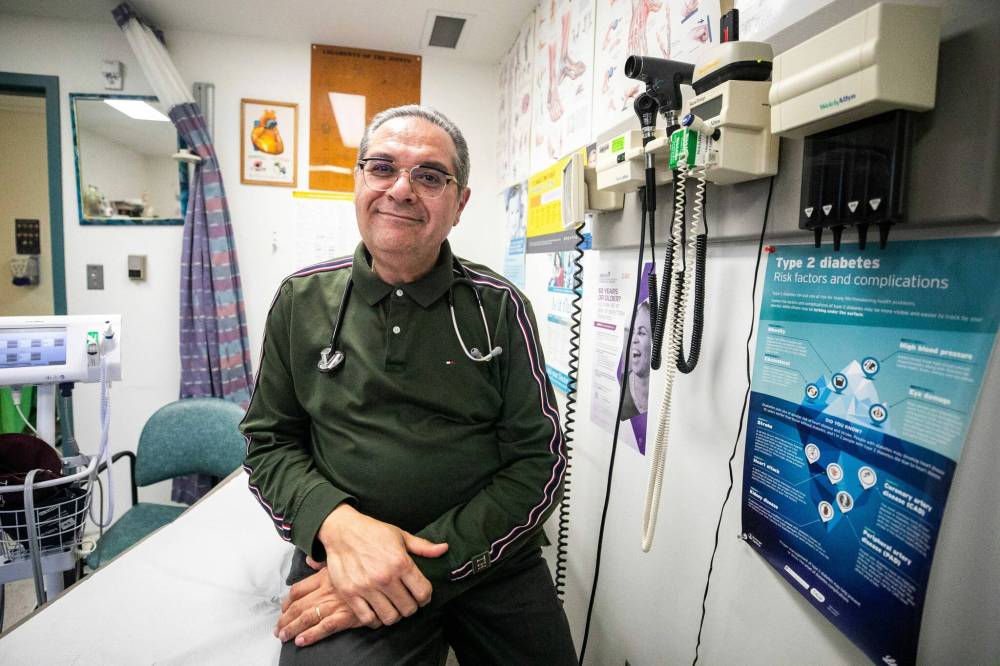
Dr. Nader Shenouda, seen at his family practice in Oakbank on Monday, said some of his colleagues have received discriminatory comments from both patients and colleagues. (Mikaela MacKenzie/Winnipeg Free Press)
The College conducted a survey on the issue last fall. Most of the respondents who reported discrimination or harassment cited those attitudes were based on race, ethnicity, place or origin and religion.
Internationally educated respondents also overwhelmingly said their education and skills have not been recognized equally to colleagues with the same skills and education levels.
Nader Shenouda moved to Manitoba from Egypt in 2007. He chose the province because at the time it was one of the only jurisdictions in Canada to offer pathways to practise programs for internationally trained physicians.
After finishing his program he began working in Arborg, where he says he dealt with comments about his accent.
“Patients would complain that they couldn’t understand me, or ask if there was another Canadian graduate here in the clinic,” Shenouda said.
He says, however, some have it worse. Many of his patients in Arborg and other remote communities he worked in felt lucky to have access to a doctor, whereas some of his colleagues working today have received discriminatory comments from both patients and colleagues.
From 2025 to 2026, 216 new physicians with international medical degrees were registered in Manitoba, making up 61 per cent of all new registrations last year.
A 2023 survey of health-care professionals that was developed by a Shared Health working group found that 56 per cent of Indigenous, Black and racialized respondents reported experiencing racism in the previous year.
International medical graduates account for 37 per cent of Manitoba’s physicians, the College’s final report says.
The report says that group of physicians noted difficulty with social expectations and unwritten rules, as well as lack of opportunities to get to know colleagues and a lack of peer support.
The College recognizes physicians trained in the United Kingdom, Ireland, the U.S., New Zealand and Australia have the same training as Canadian doctors, and can be eligible for streamlined pathways to licensure.
Doctors from other countries, Shenouda said, can face discrimination.
“They have different training and the way they practice, and that information is sometimes understood by some people and they take this very well, and some people take it really badly,” he said. “Some of the comments reflect racial discrimination.”
The College’s working group also formed an orientation program for doctors arriving in Manitoba. The mandatory two-day session covers professional standards, patient-centred care, cultural safety, documentation and workplace culture.
“There were people coming forward indicating concerns they had with entering in practice, and we were seeing a lot of them having the same experiences, so there was this idea there was some gaps in orientation, gaps in onboarding, gaps in education about entering and adapting to practice in Manitoba because they weren’t equipped with certain types of information early on when they were entering practice,” said Jeremy de Jong, the College’s registration director.
The College has hosted two orientations since January. After its third session, which begins Tuesday, it will have put more than 50 doctors through the new training.
Support gaps in the registration process could have contributed to some harassment and discrimination, De Jong said, but there are other factors to consider.
He said there is talk of mandating the training for all new physicians entering the workforce in Manitoba, including local graduates.
“I think onboarding and orientation and giving people a sense of cultural expectations in the province is extremely beneficial to learn about,” he said. “And people in the province to learn about internationally trained physicians or people from other cultures and ethnicities I believe is extremely beneficial.
“But we do have evidence that it’s important to all physicians entering practice.”
The working group also resulted in new standards of practice which are designed to support registrants entering practice in Manitoba.
With more international doctors being recruited by the province to address the current shortage, De Jong said the College sees the orientation and new standards as crucial. He said it will help with doctor retention, which has also experienced a dip in recent years.
The 2025 survey said 17 per cent of respondents were considering leaving Manitoba within the next five years. The most cited reasons included poor work environments, including interpersonal issues and under-resourced settings, burnout and dissatisfaction with leadership.
A Doctors Manitoba report released last week shows 658 doctors are considering leaving Manitoba or retiring in the next three years. The data showed 158 doctors left during the last fiscal year, up from 138 a year earlier.
Health Minister Uzoma Asagwara was not made available for an interview. In a prepared statement, the minister said the province needs international doctors and wants them to stay in Manitoba, citing the province’s work through the recruitment and retention office.
» Winnipeg Free Press