
Protection order against accused bully to face legal test
Advertisement
Read this article for free:
or
Already have an account? Log in here »
We need your support!
Local journalism needs your support!
As we navigate through unprecedented times, our journalists are working harder than ever to bring you the latest local updates to keep you safe and informed.
Now, more than ever, we need your support.
Starting at $15.99 plus taxes every four weeks you can access your Brandon Sun online and full access to all content as it appears on our website.
Subscribe Nowor call circulation directly at (204) 727-0527.
Your pledge helps to ensure we provide the news that matters most to your community!
To continue reading, please subscribe:
Add Brandon Sun access to your Free Press subscription for only an additional
$1 for the first 4 weeks*
- Enjoy unlimited reading on brandonsun.com
- Read the Brandon Sun E-Edition, our digital replica newspaper
*Your next Free Press subscription payment will increase by $1.00 and you will be charged $20.95 plus GST for four weeks. After four weeks, your payment will increase to $24.95 plus GST every four weeks.
Read unlimited articles for free today:
or
Already have an account? Log in here »
WINNIPEG — Allegations of bullying involving two elementary school students have sparked a lengthy legal battle in Manitoba after a court official granted a Winnipeg boy a protection order against another child accused of targeting him.
A Winnipeg mother said years of bullying accusations, repeated pleas to school officials and growing fears for her son’s safety left her no choice but to obtain the protection order, which was granted in October 2025 by a provincial judicial justice of the peace under Manitoba’s domestic violence and stalking legislation.
Her son was 10 years old at the time the order was granted, while the other boy was 11 years old.
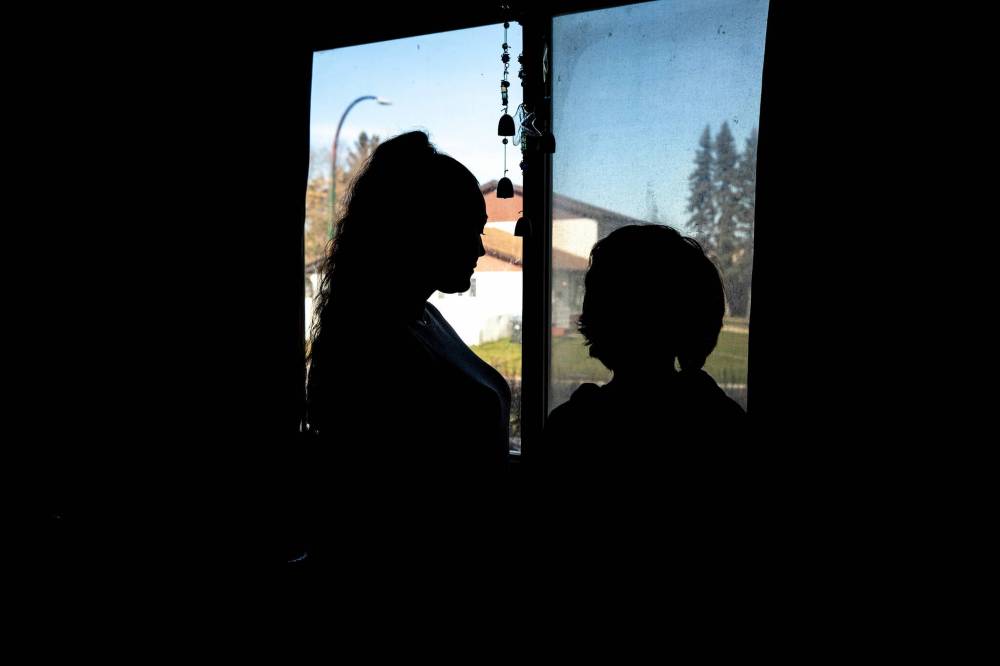
The mother and son, who obtained a protection order against another child accused of bullying the son, are shown in their home on Wednesday. (Mikaela MacKenzie/Winnipeg Free Press)
The case ultimately reached the Court of King’s Bench, where a justice ruled in August that the protection order issued against a child under 12 was constitutional.
In December, another King’s Bench justice will hear an application to cancel the order from the boy accused of bullying his former classmate.
The mother said the legal fight could have been avoided if school officials had intervened.
“We had to go all the way to the court because no one was helping us,” she told the Winnipeg Free Press.
The mother, whose identity is being withheld to protect the identities of the children involved, said her son’s troubles began during the 2022-23 school year, when he was in Grade 2.
The Free Press is using pseudonyms for the boys to protect their identities.
What initially appeared to be ordinary schoolyard behaviour escalated into physical assaults, threats and intimidation, the mother said.
She described an incident in which “John” allegedly assaulted her son “Steven” with a plastic knife in a classroom, followed by years of escalating harassment that extended beyond school grounds and into their neighbourhood. In one incident, she said, John and several other children surrounded the family’s home.
The mother said she repeatedly contacted police, but was told officers could not intervene because John was under 12 years old. She said police investigated the classroom knife incident after a group of children surrounded her home in September 2025 — long after the alleged stabbing incident — but she believes the investigation was inadequate.
Steven became fearful of attending school, she said, and the family began taking additional precautions to keep him safe.
“He doesn’t want to go to school. He can’t play in his own backyard,” she said.
The mother said she began driving Steven to and from school, got him a cellphone for his safety and sought professional help after he developed a stutter she attributes to stress.
She estimated that she sent about 50 emails to education officials over several years, raising concerns with teachers and administrators across two schools in the Pembina Trails School Division.
Frequent changes in leadership at her son’s former elementary school meant she repeatedly had to explain what Steven had been experiencing, she said.
“I put all of our faith in the school system to deal with it as they should,” the mother said. “Incidents happen at the school. It should be dealt with by the school.”
She said she also contacted police, child welfare officials, school trustees, the provincial education minister and the Manitoba ombudsman before turning to the courts after, she alleges, her son’s middle school put the two children in the same class, despite knowing about the boys’ history.
The school division disputed the suggestion it failed to respond.
In a statement, the division is complying with the protection order and had immediately responded to the issue. The division otherwise refused comment.
The mother maintains she had little choice but to seek legal intervention.
“I didn’t think I was going to get it at all, but I’m grasping at straws here,” she said of her decision to pursue a protection order.
She obtained the order on behalf of her son against John last year, when both boys were Grade 5 classmates.
The order barred John from following, contacting or being anywhere within 50 metres of Steven.
Steven and his mother testified in front of a judicial justice of the peace, who determined that the requirements to grant an order under the Domestic Violence and Stalking Act had been met.
“We had to go all the way to the court because no one was helping us.”– Mother who obtained a protection order for her son
The civil legislation does not define whether its stalking provisions are meant to apply to children under 12. John’s lawyers have argued it should not, given children are presumed by criminal justice officials to have less mental capacity and be less morally responsible for their actions than adults.
John did not provide evidence at the October 2025 hearing, as is standard in no-notice protection order hearings. John’s lawyers argued such hearings, when an order is sought against a youth, should hear evidence from all parties.
Prompted by a motion from John’s lawyer in November last year, a hearing is scheduled in front of another King’s Bench justice in December to decide whether the order should be dismissed.
John, who has repeatedly denied threatening or assaulting the boy but admitted to throwing eggs at his home, was forced to change schools, according to court documents. John’s family has argued the bullying allegations have been exaggerated.
The 50-metre restriction had affected John’s ability to play in a park near both of the boys’ homes and harmed his mental health, his lawyer argued.
His lawyer also challenged the validity of two sections of the stalking legislation in a notice of constitutional question filed in February.
The notice asked the Court of King’s Bench to determine whether it is constitutional for a court, using the provincial Domestic Violence and Stalking Act, to find that a child under 12 could stalk another child in a proceeding at which the other child did not give evidence.
It argued that John’s Charter right to security of the person was violated and that such a violation cannot be justified in a free and democratic society, under the Charter.
The notice asked the court to issue a declaration that protection orders against children under 12 are unconstitutional.
Court of King’s Bench Justice Joan McKelvey dismissed those questions in an August decision, finding that any rights violations were reasonable.
“In no way does the (Domestic Violence and Stalking Act) offend the principles of fundamental justice, and if it did, such an infringement is reasonable and can be demonstrably justified in a free and democratic society,” reads McKelvey’s decision.
Before McKelvey decided on the constitutionality of the legislation and order, the protection order was partially stayed by King’s Bench Justice Shawn Greenberg in April.
Greenberg partially suspended the order on the condition that John not attend the same school as Steven, that he not communicate with Steven — directly or through social media — and that he not approach him if he sees him in the community, ahead of the December hearing.
Greenberg, who was aware of the notice of constitutional question, said in her decision that although the relevant provincial law does not include any age restrictions on who it can be applied to, “a review of the legislative history makes it difficult to believe it was intended to apply to schoolyard bullying.”
Allison Fenske, clinical counsel at the University of Manitoba’s law school, said she was aware of the case and the constitutional challenge.
“Youth protection orders are unusual, but they do occur and seem to be occurring with increasing frequency,” she said.
Manitoba’s legislation is unique in that it deals with stalking separately from family violence, which creates a legal pathway for the court to address allegations of stalking unconnected to family or domestic violence through protection orders, Fenske said.
“Nunavut is the only other jurisdiction in Canada that separates stalking from family violence in legislation equivalent to Manitoba’s (legislation), but in Nunavut they prohibit children under the age of 14 from being subject to a protection order,” she said.
The legal expert said the conditions of the protection order in the case are “quite a bit more onerous” than what a child might face if subject to a probation order after a criminal conviction.
Fenske said the Youth Criminal Justice Act recognizes that children have less moral responsibility for their actions than adults, but in the constitutional challenge over the particular protection order, the King’s Bench justice was not prepared to apply those criminal justice system principles to the civil court case.
For the mother, the ruling provided a measure of validation. She said her lawyer was uncertain whether the constitutional challenge would succeed.
“We were blown away,” she said.
Scott Newman, a Winnipeg defence lawyer, said protection orders involving children are not uncommon and mostly involve issues at school and failed romantic relationships.
“When the subject of the order is under 12 years old, they cannot be criminally charged, rendering the order unenforceable, ceremonial and pointless.” – Manitoba defence lawyer Scott Newman
He called protection orders against children under 12 “ludicrous.”
“As a lawyer, I am uncomfortable with how commonly these orders are granted,” he said.
“These orders were originally meant to protect individuals at risk of serious injury or death.”
Newman said justices of the peace often “err on the side of caution” when granting protection orders.
“When the subject of the order is under 12 years old, they cannot be criminally charged, rendering the order unenforceable, ceremonial and pointless,” he said.
But the mother believes the decision in her son’s case could have implications for other families who feel schools and other authorities have failed to adequately respond to serious allegations of bullying.
“It’s not only amazing for my son, but it’s also amazing for any other kid who’s going to go through the same thing,” she said.
The mother acknowledged the protection order has had consequences for John, but maintained the restrictions were necessary to protect her son.
She said she remains concerned about the possibility of the order being overturned next month.
“Oh, it would be bad. The retaliation would be horrendous,” she said, adding the experience has fundamentally changed her confidence in the school system.
“These people are in charge of keeping your children safe. And they have a duty of care to do that.”
Tracy Vaillancourt, a University of Ottawa professor who holds the Canada Research Chair in Youth Mental Health and Violence Prevention, said the situation reflects a broader frustration with school responses to persistent bullying, which can have lasting consequences for children.
“I’ve certainly heard of cases like this,” she said. “These kids are pretty young. Usually, it’s something you see in high school, and then with adults.”
She said it is a “colossal mistake” to put students in the same class when there’s a documented history of bullying, adding that schools should recognize the likelihood of repeated behaviour.
However, Vaillancourt acknowledged the challenges schools face in managing the behaviour of students. She said privacy laws can limit what schools disclose about disciplinary measures.
“So they’re probably doing things, and we’re just never privy to knowing what they’ve done,” she said, adding that expulsions and suspensions don’t work.
The mother advised other parents facing similar circumstances to document everything.
“Because if you don’t have documentation, then … you might not even be able to get any help down the road if you need it,” she said.
» Winnipeg Free Press