
AMM resolution on tap to restart basin group
Advertisement
Read this article for free:
or
Already have an account? Log in here »
We need your support!
Local journalism needs your support!
As we navigate through unprecedented times, our journalists are working harder than ever to bring you the latest local updates to keep you safe and informed.
Now, more than ever, we need your support.
Starting at $15.99 plus taxes every four weeks you can access your Brandon Sun online and full access to all content as it appears on our website.
Subscribe Nowor call circulation directly at (204) 727-0527.
Your pledge helps to ensure we provide the news that matters most to your community!
To continue reading, please subscribe:
Add Brandon Sun access to your Free Press subscription for only an additional
$1 for the first 4 weeks*
- Enjoy unlimited reading on brandonsun.com
- Read the Brandon Sun E-Edition, our digital replica newspaper
*Your next Free Press subscription payment will increase by $1.00 and you will be charged $20.95 plus GST for four weeks. After four weeks, your payment will increase to $24.95 plus GST every four weeks.
Read unlimited articles for free today:
or
Already have an account? Log in here »
The City of Brandon is calling on the Association of Manitoba Municipalities to lobby the province to reinstate funding for Assiniboine River Basin Initiative.
Brandon and 12 other municipalities in the Westman region are set to debate a proposed resolution on Thursday at the AMM fall convention that urges the province to re-establish the ARBI board.
The board — which disbanded in 2024 after $50,000 in provincial funding was cut — oversees issues related to flooding, drought and water quality for the Assiniboine, Qu’Appelle and Souris sub-basins.
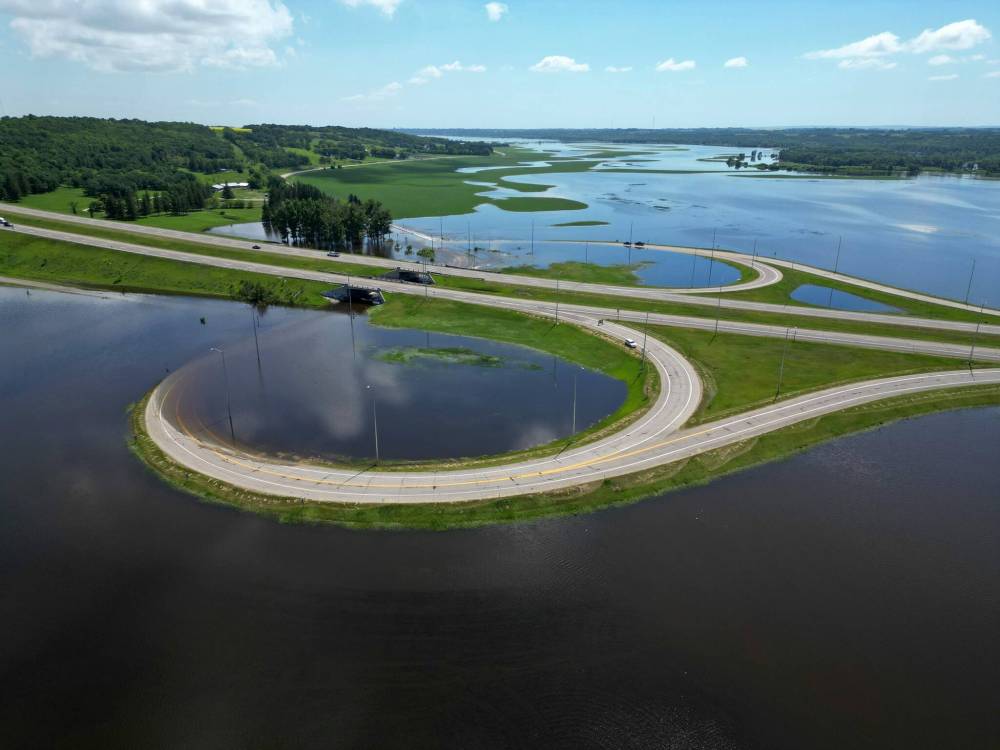
Grand Valley Road and on- and off-ramps for the Trans-Canada Highway sit submerged in floodwaters from the swollen Assiniboine River in mid-July. (Tim Smith/The Brandon Sun files)
The three sub-basins make up the overall Assiniboine River Basin, which spans western Manitoba, eastern Saskatchewan and northern North Dakota. The board was comprised of 51 delegates from the three regions.
Mayor Jeff Fawcett says there is “great value” for the city to be part of the ARBI board.
“We feel there’s a value to it and that’s why we brought it back to the AMM,” Fawcett said in an interview on Monday.
“Just because we disbanded the board doesn’t mean that water’s not coming through across borders. So, we need to be working with Saskatchewan, we need to be working with North Dakota as part of this watershed,” he said.
The board was first established in November 2014 in response to the historic flooding in Manitoba in 2011 and 2014.
According to a 2019 annual report by the ARBI board, roughly 1.5 million people live across the basin that covers 162,000 square kilometres.
Fawcett said council was “surprised” when the province pulled funding for the board, and he’d like to see it re-established after the floods Brandonites experienced over the summer.
“We had a big water issue this year again,” Fawcett said.
“If we just want to manage it in a micro level inside the city, then that’s not going to work. We know that. So, we have to be part of the broader collective,” he said.
Brandon city council voted last week to approve the expansion of the Central Assiniboine Watershed District to include the Municipality of North Norfolk, situated west of Portage la Prairie. Under provincial legislation, all existing members of a watershed must support an expansion.
Coun. Deveryn Ross (Ward 2) said he wants the local watershed district to look at the future of water conservation in the area.
“We need to have a dialogue that ensures, first and foremost, that the communities already on the Assiniboine have access to a reliable supply of drinking water, but then beyond that, we’ve got to look at it from an economic standpoint,” Ross said Monday afternoon.
Ross said re-establishing the ARBI board could save the city from being “blindsided” in the future.
“We absolutely have to work with them because we need to ensure that we have a stable supply of water,” he said.
The Assiniboine River begins in Saskatchewan and ends in Winnipeg, so pollutants, contamination or changing water levels in Saskatchewan could impact communities on the river in Manitoba.
“We can’t afford to have the water supply jeopardized by communities and individuals in Saskatchewan and North Dakota,” Ross said.
During the meeting, Ross referred to a Canadian Press article from Nov. 15 that said the country’s supply of fresh water is under pressure that could impact Canada’s “long-term security and prosperity.”
According to an internal memo prepared for Environment Minister Julie Dabruisin that was obtained by The Canadian Press, Canada has 20 per cent of the world’s surface fresh water and only one-third of it is salt-free and replaced through precipitation.
The Assiniboine River is heavily influenced by snowmelt which can trigger spring flooding.
Climate change has caused less snow predictability and more variability, which can affect watersheds and flooding, said James Beddome, executive director of Manitoba Eco-Network.
“It can be quite unpredictable,” Beddome said Monday.
“On the one hand, there’s less snow now and it’s starting late, but then also sometimes we get more late-season blizzards or snowstorms, too,” he said.
“You get a late blizzard … and then it all melts at once, and then it’s too much. It’s so fast and can’t be handled.”
Beddome said “it’s hard to put in words how much of a difference” cross-network organizations, like the ARBI board, have on the environment.
“What the (resolution is) highlighting here is a lot of work dealing with flooding, wetland reclamation and restoration with flooding,” he said.
“To co-ordinate across borders with Saskatchewan and North Dakota would seem to be very relevant when we’re talking about this Assiniboine River watershed,” Beddome said.
The ARBI board re-establishment resolution is slated for discussion on Thursday morning — the final day of AMM’s fall convention.
» rgerrard@brandonsun.com