
AMM votes to push for improved paramedic service in rural areas
Advertisement
Read this article for free:
or
Already have an account? Log in here »
We need your support!
Local journalism needs your support!
As we navigate through unprecedented times, our journalists are working harder than ever to bring you the latest local updates to keep you safe and informed.
Now, more than ever, we need your support.
Starting at $15.99 plus taxes every four weeks you can access your Brandon Sun online and full access to all content as it appears on our website.
Subscribe Nowor call circulation directly at (204) 727-0527.
Your pledge helps to ensure we provide the news that matters most to your community!
To continue reading, please subscribe:
Add Brandon Sun access to your Free Press subscription for only an additional
$1 for the first 4 weeks*
- Enjoy unlimited reading on brandonsun.com
- Read the Brandon Sun E-Edition, our digital replica newspaper
*Your next Free Press subscription payment will increase by $1.00 and you will be charged $20.95 plus GST for four weeks. After four weeks, your payment will increase to $24.95 plus GST every four weeks.
Read unlimited articles for free today:
or
Already have an account? Log in here »
Spurred on by 14 Westman municipalities, the Association of Manitoba Municipalities will lobby the province for better paramedic coverage in rural areas.
On the final day of the AMM fall convention at the Keystone Centre in Brandon, more than 500 municipal delegates presented and debated a total of 38 resolutions.
Of the 241 votes cast for the rural paramedic resolution, 163 delegates voted in favour of lobbying the province to address emergency service shortages and to ensure that minimum ambulance coverage is maintained.
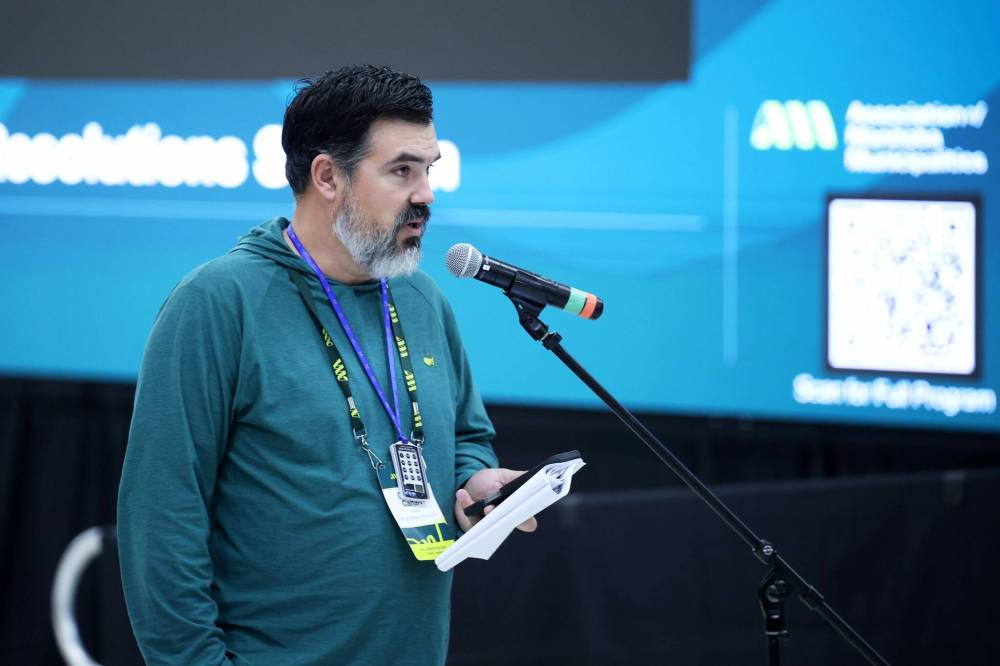
Clayton Canart, reeve for the Rural Municipality of Wallace-Woodworth, presents the rural paramedic resolution on the third day of the Association of Manitoba Municipalities fall convention at the Keystone Centre on Thursday. (Tim Smith/The Brandon Sun)
Gage Wood, president of the Brandon Firefighter Paramedics Local 803 union, said a “united front” is the best solution for advocacy.
“It is very exciting from my perspective to see AMM moving forward with something like this,” Wood said.
“Because at the end of the day, this is about saving lives. It’s not about politics. It’s about making sure that an ambulance is available when somebody needs it.”
RM of Wallace-Woodworth Reeve Clayton Canart opened the debate during the resolution session on Thursday afternoon.
“This resolution is being brought forward with the broader intent to call upon Shared Health to undertake a comprehensive review of the inter-facility transfer process,” Canart said to the delegates and AMM resolution committee during his speech.
The resolution specifically calls on Shared Health to discuss protocols and review staffing requirements, resource allocation and the “impact on emergency response coverage in the rural community,” Canart said.
“The goal is to ensure that inter-facility transfer process is adequately resourced and that appropriate balance is maintained between patient transfer needs and the rural emergency response covered,” he said.
In March, Shared Health reported a 43 per cent vacancy rate for primary care paramedics in western Manitoba at the end of last year.
The 14 Westman municipalities sponsoring the resolution want the province and Shared Health to “address EMS staffing shortages,” the AMM resolution booklet said.
Wood said he wasn’t surprised Westman municipalities were leading the charge for better access to paramedics.
“I definitely understand what the rural communities are going through and I don’t think that it’s any coincidence that the majority of these municipalities are from the west zone,” Wood said in a phone interview on Thursday.
Wood is a longtime firefighter-paramedic based in the Wheat City, but it’s not uncommon for him to spend more time on a highway outside Brandon.
“I’ve personally done a call in Boissevain responding from Brandon. That’s a 45-minute plus response time and we were literally the closest available unit. That kind of just shows that there are huge holes in the coverage area,” he said.
Wood said a big problem for the Westman area is the distance to Winnipeg.
“There are definitely times when people need to go to Winnipeg for live-saving care, but what we are finding in Brandon is that these transfers are going so often that it actually is affecting our ability to respond to 911 calls,” he said.
When an ambulance transports someone to a Winnipeg hospital from Brandon, it means a six- or seven-hour round trip, which not only impacts 911 response times in Brandon, but in other rural communities, too, Wood said.
“We’re in a situation where we could have three, four or five Brandon ambulances in Winnipeg and there’s that trickle-down effect to the rural communities where now we’re drawing in their limited resources.”
“Like, if Virden comes in to do a call in Brandon, and a Brandon ambulance becomes available and there’s a call in Virden — well now the ambulance is responding for (Virden) … We kind of get caught in a mess here,” Wood said.
Paramedic coverage and response times in rural communities were frequently discussed at the fall convention, which began on Tuesday with a speech from Premier Wab Kinew and a ministerial forum.
Melita Deputy Mayor Camiel Serruys said Tuesday during the forum that southwestern Manitoba is “facing a health-care crisis that cannot continue to be overlooked.”
He told the premier and panel of ministers that his town and surrounding communities have “unreliable access” to emergency medical services and asked when the region “will finally be a priority.”
Both Kinew and Health Minister Uzoma Asagwara assured delegates on the first day of the convention that “rural health care is a top priority” for the NDP government.
Melita was also one of 20 municipalities advocating for the province to request that the College of Paramedics revisit its curriculum that requires 312 training hours for an emergency medical responder.
In 2022, the College of Paramedics and the province increased the required training hours for emergency medical responders from 120 hours to 312 hours — the equivalent of 13 days.
The resolution called on the province and college to be “flexible” on the required hours, “so more trainees can be recruited, and rural Manitoba can get more ambulances on the road sooner.”
It passed in a landslide vote, with 244 out of 251 delegates, or 97 per cent, voting in favour.
The resolutions passed on Thursday are categorized as Category 1 resolutions — meaning they have the potential to impact a majority of municipalities across the province — and were approved during district meetings.
Adopted resolutions are part of the AMM’s provincial advocacy and lobbying efforts.
» rgerrard@brandonsun.com