
STARS brings medical simulation to BU
Advertisement
Read this article for free:
or
Already have an account? Log in here »
We need your support!
Local journalism needs your support!
As we navigate through unprecedented times, our journalists are working harder than ever to bring you the latest local updates to keep you safe and informed.
Now, more than ever, we need your support.
Starting at $15.99 plus taxes every four weeks you can access your Brandon Sun online and full access to all content as it appears on our website.
Subscribe Nowor call circulation directly at (204) 727-0527.
Your pledge helps to ensure we provide the news that matters most to your community!
To continue reading, please subscribe:
Add Brandon Sun access to your Free Press subscription for only an additional
$1 for the first 4 weeks*
- Enjoy unlimited reading on brandonsun.com
- Read the Brandon Sun E-Edition, our digital replica newspaper
*Your next Free Press subscription payment will increase by $1.00 and you will be charged $20.95 plus GST for four weeks. After four weeks, your payment will increase to $24.95 plus GST every four weeks.
Read unlimited articles for free today:
or
Already have an account? Log in here »
Hey there, time traveller!
This article was published 30/01/2020 (2463 days ago), so information in it may no longer be current.
Inside an RV parked at the Health Studies Complex at Brandon University, a 19-year-old man is fighting for his life after being assaulted outside a bar.
He has a knife lodged in his ribs and possibly a fractured skull. The third-year nursing students working on him are doing their best to stabilize the situation and save his life.
It’s not real, though. The 19-year-old is actually a realistic, high-tech dummy the students are training on as part of a simulation put on by STARS Air Ambulance.
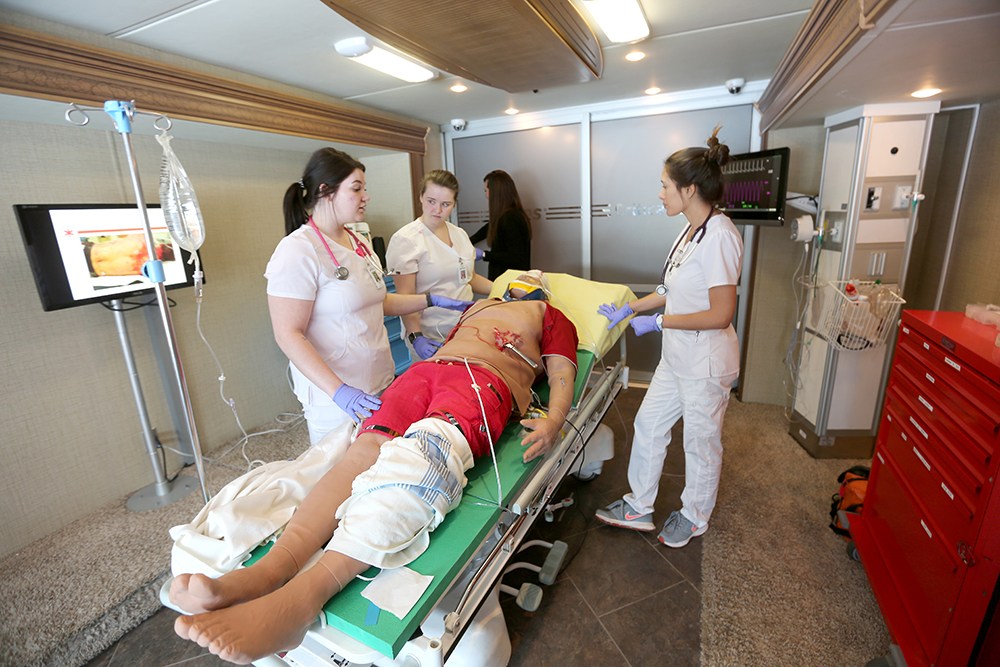
The session is part of a program run by STARS to bring realistic training sessions to rural areas and universities, said Brent Bekiaris, a paramedic and the organization’s mobile education lead. The STARS Mobile Education Units lets medical staff train on more than 150 scenarios ranging from assaults, to heart attacks, to scenarios with children.
“These students, a lot of them will be potentially in rural facilities across Manitoba, and I hope we offer them a knowledge base and the tools here to equip them when they’re in that real world and that real setting that they’ll draw back on some of that experience in the simulation,” he said.
The dummy, affectionately called “Stan,” bleeds, has a realistic tongue and skin, and can adjust its eyes. It can even “vomit” creamed corn. Stan lets the paramedics replicate a range of medical problems and complex procedures.
At one point, one of the students asks whether the “patient” is experiencing pain. It can respond back through a microphone.
“Here we can provide an environment that’s safe, we always strive to tell people that it’s like Vegas — what happens in here stays in here. We hope they feel that it’s safe and it’s a learning environment in here with the simulations,” he said.
While the bus is at Brandon University, the program can train up to 48 students each day. Bekiaris said it’s a useful experience for students to practise in a simulation for their exams, but also might help them when dealing with patients in the real world.
“We’ve had a lot of feedback, especially with the pediatrics where people feel a lot more comfortable following a pediatric simulation in here, whether it’s drawing up medications, which is really stressful for people,” he said.
The retrofitted RV is the second in STARS Manitoba’s fleet of mobile education vehicles and the trip to Brandon University was its maiden voyage. Bekiaris said there is a huge demand for the program, so the second vehicle means STARS can train even more medical staff.
“The demand that’s there for these outreaches — we can meet those requests and it doubles our reach and the participants that are going the coming through, it’s fantastic,” he said.
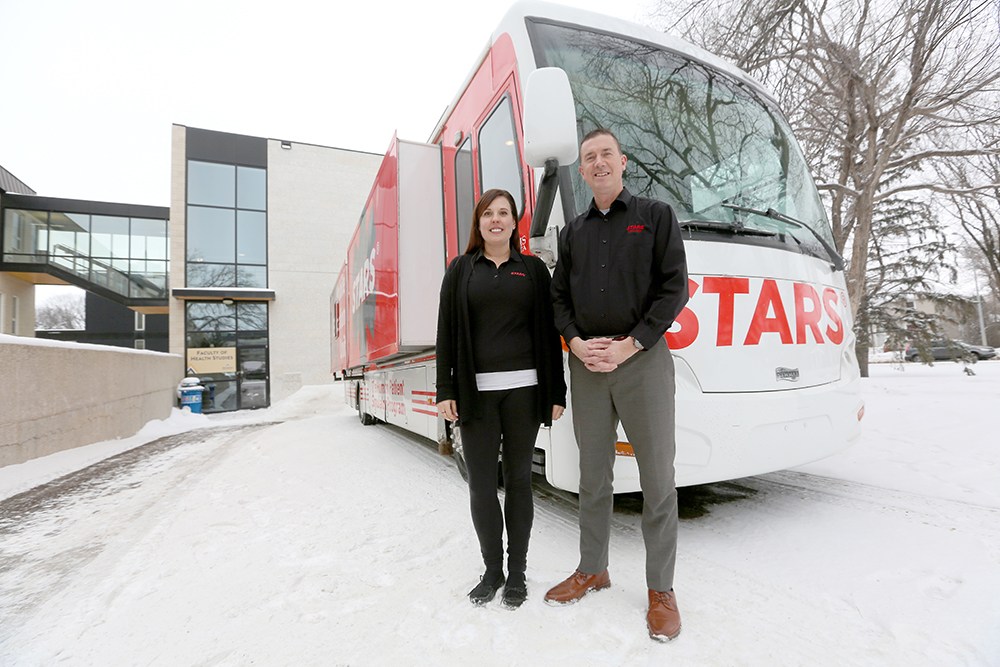
STARS also runs an air ambulance service out of Winnipeg. Helicopters can be dispatched to get people injured in rural areas to the hospital more quickly than a traditional ambulance.
The organization doesn’t charge for mobile education sessions, so rural hospitals and organizations don’t have to worry about the cost of the training.
Sarah Painter, a flight nurse who helped supervise the students during the simulation, said it also helps keep doctors and nurses in rural communities up to date with the latest medical techniques.
“We spend so much time doing the really, really sick, critical care folks and so we have that opportunity to do a lot of volume and stay abreast of really contemporary information, and so this becomes a bus where you can take that thinking, that new knowledges new skills that are coming out and get that information flowing into the communities.”
» dmay@brandonsun.com
» Twitter: @DrewMay_