
Stefanson makes history
Advertisement
Read this article for free:
or
Already have an account? Log in here »
We need your support!
Local journalism needs your support!
As we navigate through unprecedented times, our journalists are working harder than ever to bring you the latest local updates to keep you safe and informed.
Now, more than ever, we need your support.
Starting at $15.99 plus taxes every four weeks you can access your Brandon Sun online and full access to all content as it appears on our website.
Subscribe Nowor call circulation directly at (204) 727-0527.
Your pledge helps to ensure we provide the news that matters most to your community!
To continue reading, please subscribe:
Add Brandon Sun access to your Free Press subscription for only an additional
$1 for the first 4 weeks*
- Enjoy unlimited reading on brandonsun.com
- Read the Brandon Sun E-Edition, our digital replica newspaper
*Your next Free Press subscription payment will increase by $1.00 and you will be charged $20.95 plus GST for four weeks. After four weeks, your payment will increase to $24.95 plus GST every four weeks.
Read unlimited articles for free today:
or
Already have an account? Log in here »
Hey there, time traveller!
This article was published 01/11/2021 (1788 days ago), so information in it may no longer be current.
Manitoba’s first female premier and first female Progressive Conservative leader will be Heather Stefanson.
The former minister of justice, health, families, deputy premier and Tuxedo MLA was selected to lead the Progressive Conservative party by grassroots party members in a mail-in vote.
Stefanson garnered a slim majority in votes, 8,405, to rival Shelly Glover’s 8,042.
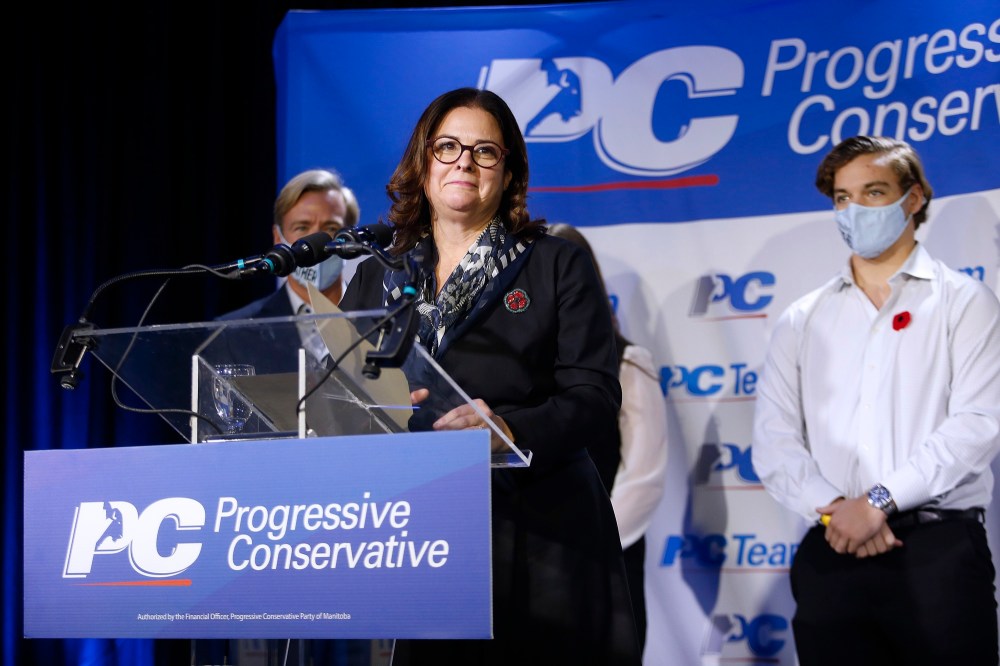
She promised a more conciliatory tone from the Tory government, which sank in opinion polls under former premier Brian Pallister before he stepped down in September.
“I heard loud and clear that (Manitobans) want to see us take a much more collaborative approach when it comes to working with other levels of government and with stakeholders in our community,” Stefanson said in her victory speech.
While the party immediately recognized Stefanson’s win, Glover said she would hold back until she could analyze the results.
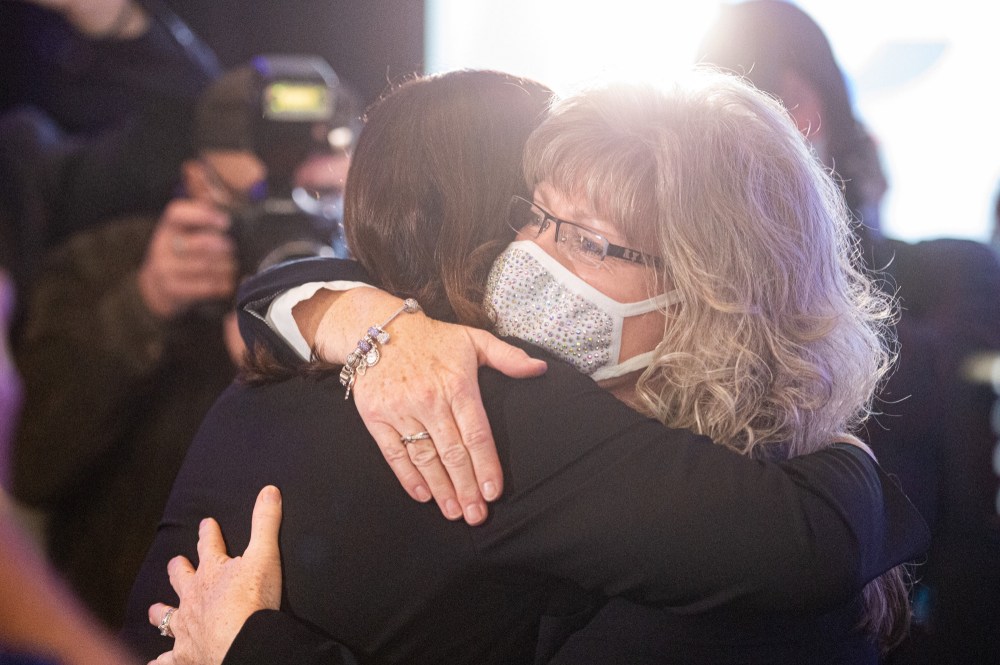
“I really can’t concede until I do the homework,” said Glover, who hugged Stefanson immediately after the results. She would not say when she would make a decision.
Early on after Pallister announced his retirement at the Dome Building in Brandon in August, Stefanson established herself as the establishment candidate after securing endorsements from most of her caucus colleagues.
That support included Brandon’s three provincial Tory representatives — Brandon East MLA Len Isleifson, Brandon West MLA Reg Helwer and Spruce Woods MLA Cliff Cullen.
“It’s always exciting when you win an election,” Isleifson told the Sun by phone from Winnipeg after the results were announced.
“With the increase in memberships and the members of the party, it gives us an optimistic future, that’s for sure.”
Isleifson said Manitobans will be getting a leader who listens, cares and wants to know what’s going on so that the province and its municipalities can build a better place to live.
“I think they’re really getting someone who is looking forward to making things better in Manitoba and doing it as a team,” he said.
During her campaign, Stefanson was hesitant to directly criticize Pallister’s actions, but pitched a more conciliatory way of running the province.
Over this summer, Pallister was roundly criticized for his handling of the COVID-19 pandemic, making comments about colonization that upset Indigenous leaders and for appointing a new minister of Indigenous reconciliation who downplayed the harms of residential schools in his first media availability after taking over the portfolio from Agassiz MLA Eileen Clarke, who resigned over what Pallister had said and his leadership style.
Stefanson received criticism of her own during the pandemic’s fourth wave, when Manitoba’s intensive care units became so full that patients had to be transferred to other provinces and not everyone came back.
Asked by the Sun during her campaign what people in Westman were most concerned with, Stefanson said multiple times that she’d heard from business owners that they were having a hard time finding workers to fill vacant positions.
She said she was interested in enacting some small tweaks to the province’s provincial nominee immigration plan to bring in additional workers from outside the province.
One note that Stefanson and Glover — a former federal cabinet minister under Stephen Harper — differed on was on vaccine policy.
Glover expressed frustration in an interview with the Sun last week that her belief that workers who aren’t comfortable with taking the COVID-19 vaccine should be accommodated under public health orders has led some to brand her as an anti-vaxxer, despite being fully vaccinated herself and believing in the science behind the vaccines.
Stefanson, by comparison, has offered support for the province’s current approach to vaccine mandates where front-line workers who interact with the public must either be fully immunized against COVID-19 or be tested for the virus through antibody tests three times a week.
Master of ceremonies George Orle described it as a momentous occasion, but also touched on elements of discord.
He said there were “quite a few demonstrators out front” of the Victoria Inn in Winnipeg, where the event was held, though he said they were yelling at each other and eventually ran out of steam.
Orly said that you wouldn’t see any singing or balloons flying around like other leadership races because it was a working occasion for the party and its members.
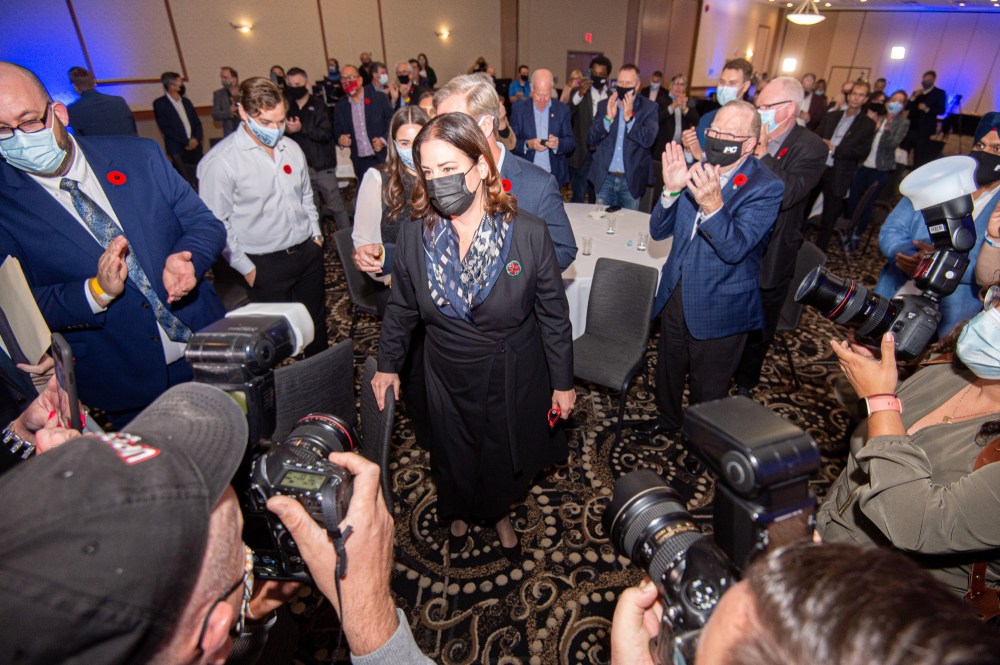
Interim Premier Kelvin Goertzen, who has led the party and the province during the leadership race, was introduced as a guest speaker before the announcement of results to loud applause from the party faithful.
“We are ecstatic for what our future holds,” he said before thanking volunteers and staff for their hard work throughout the race. “We all know how difficult it is to be involved in any election and a leadership election is itself unique. But both candidates and their teams have worked hard connecting with Manitobans and our members. The democratic system does not happen by default, it happens because people answer the call, they give up their time, they give up their resources and they get involved.”
Goertzen also emphasized that progress in Manitoba can only happen by continued collaboration with First Nations, Métis and Inuit peoples and their leaders. He also spoke positively of his interactions with Manitoba’s mayors during his short term, including Brandon Mayor Rick Chrest.
“I have not spoken about our political opponents because tonight is not about them or what they do as a government or what they might plan to do as an opposition,” Goertzen said. “It really isn’t about them. The future of Manitoba and all of its promise does not land of the hands of the NDP or the Liberals tonight, it rests in your hands. Tonight you will elect the first female premier in the history of Manitoba.”
Despite this historic first for the party and the province and Goertzen calling for party members to leave the event united, problems with the race threaten to overshadow the end result.
In the week leading up to Saturday’s vote count, Glover, former leadership candidate Shannon Martin and former PC cabinet minister Len Derkach were among voices calling for an extension to the voting process after reports of hundreds to thousands of ballots not reaching party members at the same time.
Both party brass and Stefanson have downplayed the issue.
In a statement sent to the Sun on Friday, a party spokesperson wrote that additional steps had been taken to ensure that all members received their ballots in time to mail them back and that polling stations had been set up in Brandon, Dauphin, Carman, Oakbank, Gimli and Winnipeg to give members one final chance to vote.
However, in an interview with the Sun on Thursday, Derkach said that the polling stations were being set up in locations that were difficult to reach for members in rural communities and that they were being set up during the workday when it was hard for members to make the trip to vote.
For her part, Stefanson said that every leadership race has challenges, and her campaign was focused on making sure her supporters had their votes in.
Fifteen minutes before the results were announced, Orle said he wanted to dispel claims that members had been disenfranchised and that the campaign was poorly organized.
He said when the leadership campaign started, the party had approximately 5,500. Within three weeks, the party had more than 25,000 members.
“We didn’t take these and stick them in a bag,” he said of the applications. “Every one of these had to be placed in our database. We worked overtime, we hired additional staff and we inputted every one of these memberships. Now you remember, when you input, you are only able to input what you have. We did not have the resources to second guess or to go through these memberships, we got them into our database in time.”
Then, he said, the party hired a distribution company to take the data and determine that they had the right addresses through Canada Post information. Envelopes addressed to each member contained a second pre-paid envelope containing a ballot and a PIN were sent out.
Through this process, according to Orle, the party had a 96 per cent success rate in getting these out.
“The problem is that we are in a time of COVID and it has restrictions that are placed upon people,” Orle said. “We didn’t start getting the return-to-sender envelopes until almost a week after we’d sent them out, and they came in without any ability to address how quickly we were able to get them or where we got them from.”
Only recently, the party received an envelope marked undeliverable from its first batch that were mailed out. Lost ballots like this had to be manually checked with the campaign and Orle said every single undeliverable ballot went out again.
He also denied claims of ballots going missing or not being distributed, saying a security firm was hired to make sure ballots received got where they needed to be.
Additionally, he said work was done to make sure every member who had reported not receiving their ballot had the non-receipt of their ballots by the party confirmed and more than 1,000 ballots went out again after this on top of the polling places that were set up on the campaign’s last day.
“That’s not being disorganized,” Orle said.
However, Orle later admitted that not all people entitled to ballots received them because they didn’t end up in the party’s database.
“No system is perfect, but ours was very far away from inept or disorganized and that there was no one who was deliberately disenfranchised through this process,” he said.
Asked if he was concerned that some might not find the results of the race legitimate, Isleifson wasn’t worried.
“With over 16,000 ballots being returned, yeah it’s unfortunate that things happened and some got missed, I think it evens out on both sides of the campaign,” he said. “I think if, for example, there were 100 more ballots out there, it could have easily gone 50-50, so I don’t think it would have (changed) the outcome of the leadership race.”
In the comments of the YouTube livestream of the event, a couple of viewers expressed frustration that their preferred candidate, Ken Lee, was not approved by the party to be on the final ballot.
Frustration over the pandemic also boiled over at points. “Go get your sixth booster Karl,” one user wrote, to which another replied “go take more horse dewormer Chad.”
Apart from the leadership race, the Progressive Conservatives are currently facing sagging poll numbers after 19 months of managing the COVID-19 pandemic and bringing in controversial policies like the now-dead Bill 64, which would have eliminated the province’s elected school boards and reshaped the education system.
The new leader has approximately two years to reverse their party’s fortunes as the Manitoba NDP look to take advantage of the situation and return to power after losing the 2016 provincial election.
Beyond the lingering effects of the COVID-19 pandemic, the leader will also have to tackle labour issues with the University of Manitoba’s faculty threatening to strike and the Pallister-era public sector wage freeze getting reinstated by a federal court.
On climate change, the new leader will need to decide how to proceed after a federal court ruled against Manitoba’s challenge to the federal government’s carbon tax backstop.
Earlier this week, Stefanson indicated that she would not seek to appeal the result and instead seek a more collaborative solution with the federal government.
Helwer, who endorsed Stefanson, declined to comment, writing in an email to the Sun “I think it is the premier-elect’s day, so I will leave the comments to her.”
The Sun requested to speak with the premier-designate, but a spokesperson said it would have to wait until Stefanson’s next media availability, which would likely be early in the upcoming week.
While Manitoba Liberal Leader Dougald Lamont congratulated Stefanson on becoming the first female premier, he pointed out that the Liberals first had a female leader 35 years ago and have had several over the years.
“While having a woman Premier is historic for Manitoba, we have seen no indication of any meaningful change in direction from a party that voted in total lockstep with the former Premier,” Lamont wrote in a statement.
“Our health-care system and our public finances are in a shambles, the PCs burned bridges with Indigenous people, and every single PC MLA was a cheerleader for Bill 64, which would have ruined our public school system. Under Brian Pallister, the PCs drove our province into a ditch, to routine standing ovations from Heather Stefanson and the rest of the PC caucus. They have a lot to answer for, and it’s clear they’re not willing to accept responsibility for everything they’ve bungled over the last six years.”
» cslark@brandonsun.com, with files from The Canadian Press
» Twitter: @ColinSlark