
A second chance at life
Brandon man's spinal injury recovery a physical and mental battle
Advertisement
Read this article for free:
or
Already have an account? Log in here »
We need your support!
Local journalism needs your support!
As we navigate through unprecedented times, our journalists are working harder than ever to bring you the latest local updates to keep you safe and informed.
Now, more than ever, we need your support.
Starting at $15.99 plus taxes every four weeks you can access your Brandon Sun online and full access to all content as it appears on our website.
Subscribe Nowor call circulation directly at (204) 727-0527.
Your pledge helps to ensure we provide the news that matters most to your community!
To continue reading, please subscribe:
Add Brandon Sun access to your Free Press subscription for only an additional
$1 for the first 4 weeks*
*Your next subscription payment will increase by $1.00 and you will be charged $20.00 plus GST for four weeks. After four weeks, your payment will increase to $24.00 plus GST every four weeks.
Read unlimited articles for free today:
or
Already have an account? Log in here »
Hey there, time traveller!
This article was published 18/12/2021 (1475 days ago), so information in it may no longer be current.
As Trevor Thompson lies paralyzed and face-first in the dirt a few feet from his mountain bike, the father of three pictures his daughter Faith’s high school graduation, less than a year away.
The soul-crushing reality sinks in as he fails to move or feel his legs: he won’t be able to dance with her on her special day. It’s one of many spiralling thoughts accompanying a three-and-a-half-hour wait for medical or divine intervention on a remote trail.
Thompson woke up in his camper at Riding Mountain National Park set to hit an advanced mountain bike trail just hours earlier. He has been riding every day and is in his best physical shape in years. That is, until one corner with a ditch, which he braked at the sight of, sending himself over his handlebars and head-first toward the ground, snapping his neck backward.
With his face dripping blood on the trail he’s helplessly unable to lift himself off of, the darkest thoughts hit.
He’ll be a paraplegic or quadriplegic for the rest of his life. He won’t return to work. He’ll depend on friends and family to take care of every aspect of his life, including feeding and bathing.
“That’s not a life I want to live. If I had to make the choice, right there on the spot, I didn’t want to live,” says Thompson, 44, peeling apart a pistachio muffin in a Coffee Culture booth that he walked to.
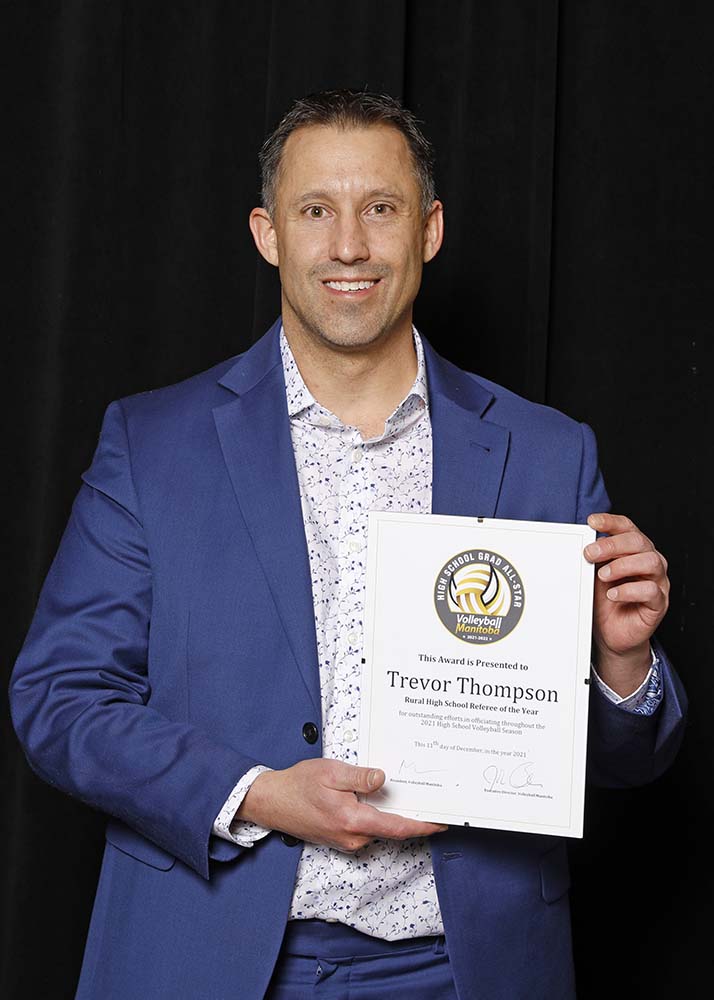
It’s a cold December Wednesday in Brandon, 16 months into an incredible recovery and about 72 hours before he’ll make the two-and-a-half-hour drive to Winnipeg to accept Volleyball Manitoba’s rural referee of the year award for 2021.
What limits Thompson’s accident to a detour on his journey through life, not the final destination, is a combination of knowledge, determination and love from dozens of remarkable people.
Rescue mission
The rescue began as Arron Taylor caught up on his bike to find Thompson face down on the ground. While Taylor had no first-aid training, Thompson had St. John Ambulance certification and knew what to do.
Thompson instructed Taylor to loosen the straps of his backpack full of gear and remove it. Thompson was partially in the ditch he tried to avoid, so Taylor carefully moved him to flatter ground and supported his neck.
While they didn’t have cell phone reception, two other bikers came along and connected with a park employee, who called 911.
In the meantime, Thompson had Taylor check his vitals, touching his body from fingers to toes for feeling and taking detailed notes on any changes to help paramedics and Shock Trauma Air Rescue Service (STARS) when they arrived.
But the STARS helicopter wouldn’t be able to land on the trail, so paramedics and Parks Canada transported him on a spinal board on the back of an eight-wheel Argo utility vehicle to a parking lot.
The STARS ride to the Health Sciences Centre in Winnipeg, as opposed to a regular ambulance, was vital, Thompson said.
“If I had to take an ambulance with bumpy roads, gravel roads — my spinal cord was really swollen and pressing up against my vertebrae, so any more bumping, it would have pressed harder and harder and caused more nerve damage,” he said.
Dr. Michael Goytan, an orthopedic surgeon, had to carve a few of Thompson’s vertebrae to alleviate pressure from his swollen spinal cord. Goytan fused his neck and back from vertebrae C3 (mid-upper neck) down to T1 (upper back).
And now we wait
Thompson couldn’t move when he woke up post-operation. He wasn’t sure how much he ever would.
“They didn’t promise me anything,” Thompson said. “There is no amount of hard work that increases your chance of recovery of spinal-cord injury … your spinal cord heals itself.”

While there was a chance he’d walk again, Thompson and his wife, Sandra, were told to prepare for less optimal outcomes. Staff advised them to take measurements and photos of their house. They would need a ramp and a bathroom renovation to make it wheelchair-accessible and more changes totalling an estimated $50,000.
Thompson wasn’t convinced he would need the renovations, but he knew if they didn’t make plans swiftly, the house wouldn’t be ready when he returned. His and Sandra’s friend Tracy Wray set up a GoFundMe page for people to donate toward the project.
In the meantime, Thompson had compression leggings working to maintain blood flow while he was bedridden. Attempts to sit up or step caused a “pins and needles” sensation. He had to wear splints to keep his hands open, as the muscles involuntarily tried to contract and form a fist he wouldn’t be able to open.
After a few days, however, he progressed to a large wheelchair with support right up to his head, to a regular one. While he couldn’t use his hands and arms, he was slowly able to navigate it with his feet, Flintstones style.
Family matters
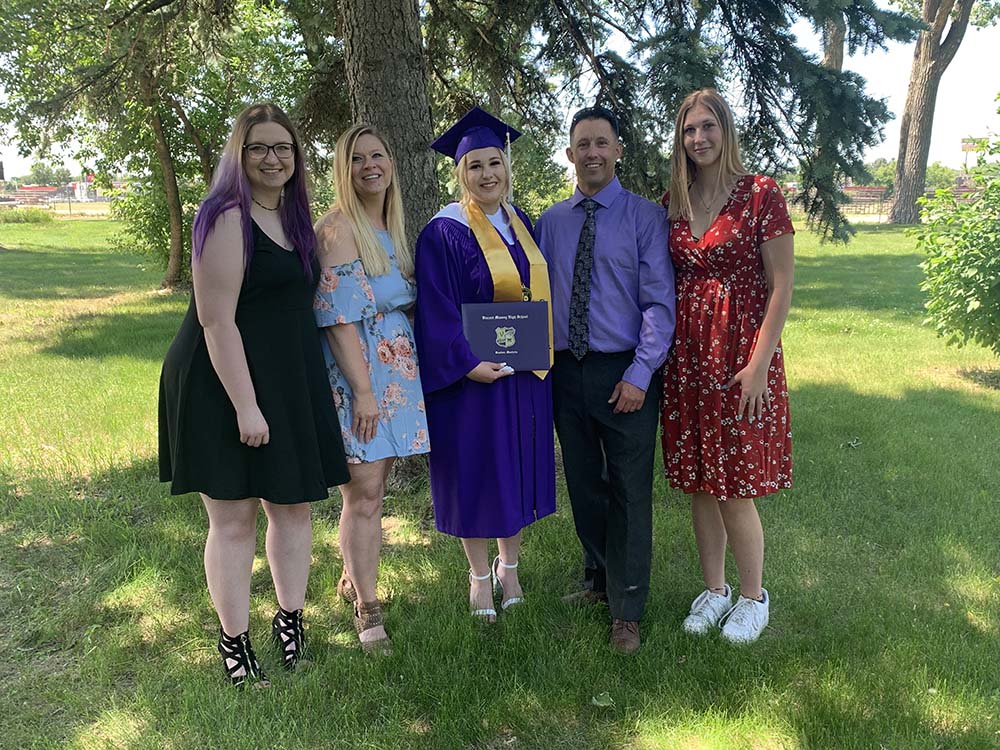
He was allowed just two unique visitors due to COVID-19 regulations but didn’t want to choose between his three daughters — Taylor, 20; Faith, 18; and Bella, 15 — so his wife, Sandra, was the only one.
She stayed at his side every day, from morning to night, until she had to set up her classroom back in Brandon a couple of days before HSC released him.
“She was my nurse,” Thompson said with a grin. “They actually thought she was a nurse because of the way she took care of me.”
Sandra was there, of course, on the day the family longed for.
The first steps after a spinal cord injury like this are arguably more special than those of a child since they aren’t guaranteed.
Just 10 days after the surgery, Thompson rose from his chair and took a step with his right foot. His eyes welled up on the third stride.
“My mind went straight to dancing with [Faith] at her grad,” Thompson said. “From there, I just kept pushing every day. I had pictures of my family in front of me at the rehab gym, and if things got difficult, my therapist would hold up the photo. I’d stare at it, and it’d give me the motivation to continue.”
Though the COVID-19 pandemic and subsequent restrictions prevented a second traditional graduation night in a row, the father-daughter dance was a motivating factor.
Thompson and Faith danced to “Butterfly Kisses” by Bob Carlisle in their living room.
“It was pretty emotional,” he said. “Brought back a lot of memories. All my three daughters and my wife were all crying.”
Behind once unopenable doors
Rehab for a spinal cord injury involves the nervous system essentially rebuilding pathways after original ones were damaged. It’s most definitely not like riding a bike.
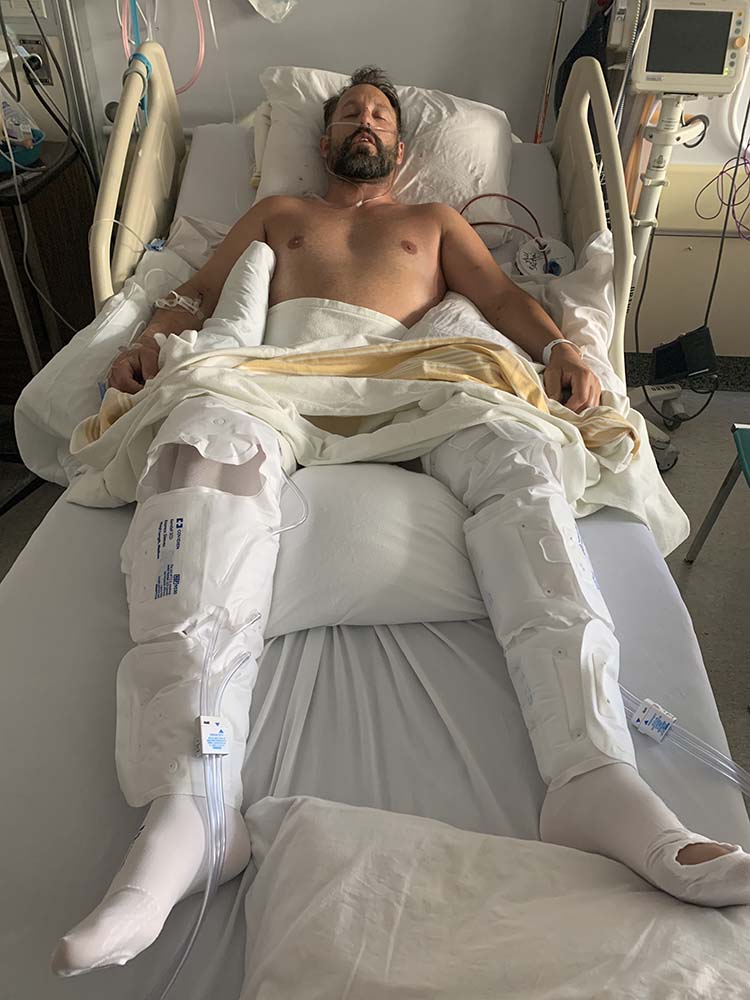
Thompson’s days featured physiotherapy in the morning and occupational therapy (OT) after lunch.
The physiotherapy was focused on his lower-body movement to get in and out of a chair or bed.
Occupational therapy had him lift his shoulders and practise fine motor skills like typing and feeling objects in his fingers. Tasks as simple as screwing a nut onto a bolt can be painstakingly tough.
Thompson said the early stages of OT were like trying to operate a cellphone with his mind.
“You get frustrated really fast because you just did this a few weeks prior. Now you can’t do anything,” Thompson said. “You cry lots. You get mad. You quit. You get encouraged to continue. You see the person beside you going through the same things and sometimes that motivates you to not be like that and keep trying.
“You just focus minute by minute. That’s all I could do. I never looked at it as ‘Will I be running again? Will I be biking?’ Of course, I thought that, but it was never the focus.”
But he progressed. He regained his mobility faster than most. While mountain biking ultimately led to the accident, staff told him the regular activity played a role in his strength and stability.
Thompson started walking with a walker but would carry it when (he thought) no one was watching.
In the end, he didn’t need his house rebuilt.
The months following his discharge from HSC, however, just three-and-a-half weeks after entering, included plenty of trips back to Winnipeg for private physiotherapy and massage that went beyond his coverage from work.
The recovery process is quick for the first three to six months and slows down afterward, Thompson said. He regained use of his legs, arms and hands, but doesn’t have much feeling and describes it as a “delayed sensation.” It’s worse in his lower body, where he doesn’t feel extreme temperatures or experience the pain of a cut or impact like most.
The entire rehab process is gruelling, in part, because it’s not just an hour or two of the day. It’s every function.
“When you’re paralyzed and learning how to walk or feed yourself, bathe yourself, it’s a daily focus,” Thompson said. “It’s the time you get up to the time you go to bed and sometimes during the night just to roll over because you’re in pain.
“You just put your mind in a place where you focus on getting through every minute of the day and don’t think about, ‘Is my time at the gym done?’ or ‘What do I have to do next?’ Just one minute at a time.”
Taking the stand
Physiotherapists make a point of structuring rehab around activities patients did previously and hope to return to.
Refereeing volleyball was near the top of Thompson’s list.
He was able to simulate climbing a referee stand with a ladder. He couldn’t feel the sides with his arms at first and was worried about his stability. Furthermore, he’d have to look in all directions to follow the ball and has limited mobility in his neck. His lateral movement is fine since his C1 and C2 vertebrae aren’t fused, but craning his neck to the ceiling simply won’t happen.
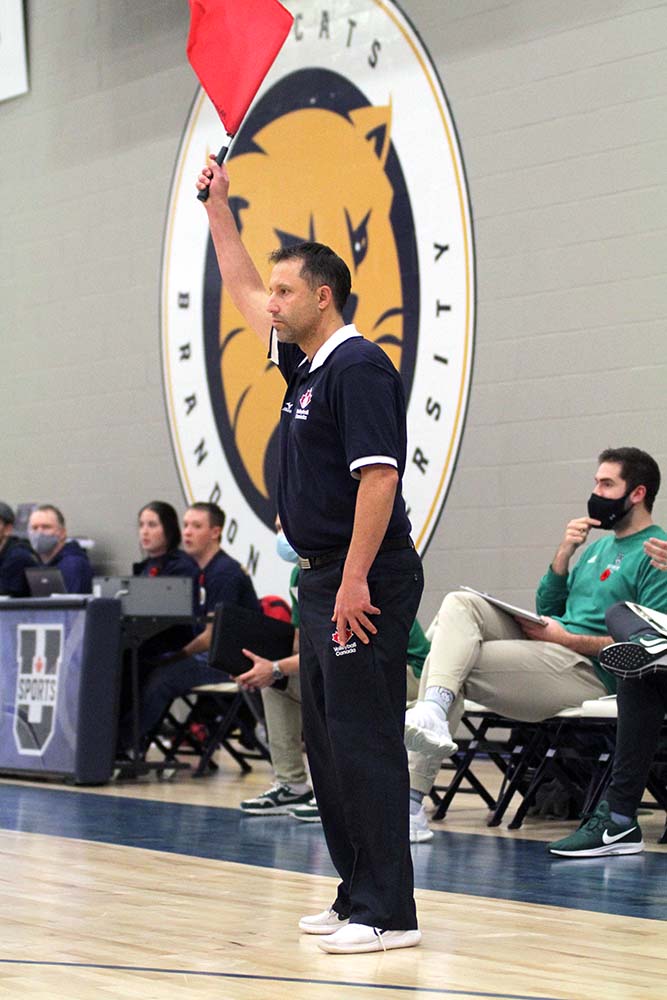
It turned out a non-issue, however, and Thompson returned to the reffing scene without skipping a beat as the 2020-21 season was cancelled.
Thompson has been off work with Manitoba Public Insurance since the accident — he’s on track to return in January — but someone recommended he return to refereeing for the mental benefits.
“When you’re up on the stand, all you’re focusing on is the players and the ball. When you’re coaching, same thing,” Thompson said. “Even though my body’s in a lot of pain, I can focus on that.”
Thompson worked a lighter schedule, in part to ease back into the mental and physical challenge of officiating and also due to COVID-19 limiting the number of matches and tournaments. He also took the chance to give back and mentor some of Westman’s younger officials.
For that and his remarkable return, Westman Volleyball Officials Association assignor Bev Workman nominated Thompson for the rural referee of the year award he accepted last Saturday.
“I worked so hard with my recovery to get back to doing something I really love being part of,” Thompson said. “I love being around the players and coaches, and [the award] just felt special.”
He realized, perhaps, the largest step in his recovery when he returned to high school and university gymnasiums. While it took a few weeks to settle into the volleyball scene, when people asked about his recovery, he was able to talk about it. That certainly wasn’t the case earlier on.
Mental battle
The sound of the rotor blades whirring outside Thompson’s HSC room window sent him into panic attacks.
While STARS saved his life on Aug. 12, 2020, seeing the helicopter touch down on the landing pad took him back to the initial hours of anguish. The battle he faced to return to something resembling normalcy is far from just a physical one.
Months later, people who knew him and heard about the accident would see him walking and say, “You look so good.” Thompson noted he wasn’t offended by such comments, but realized that focus on outward appearance didn’t serve him. It didn’t match his internal pain or mental well-being. In retrospect, he said he’d rather have people ask how he’s feeling.
At first, he didn’t want to talk to anyone anyway. He’d rather be left alone to focus on his family and recovery.
Thompson started to suffer from post-traumatic stress disorder (PTSD) and struggled for months. Just entering a doctors’ office triggered flashbacks and panic attacks. He’d start to shake and drop to the floor.
“It was even hard for me to drive by work … I didn’t want people asking me a million questions,” Thompson said. “For the first several months, a conversation like we’re having, I’d be crying, emotional, I probably couldn’t finish a conversation. Through therapy, though, I’m able to deal with it a lot better.”
When friends told him to get help, he sought employee assistance program (EAP) counselling through work but didn’t find it useful. A visit with a psychologist for PTSD therapy helped him finally turn the corner, along with an enlightening moment about three months ago.
Thompson returned to HSC for a followup appointment. He toured the hospital, the rehab ward and common areas and tried not to get emotional.
He bumped into a few other spinal-cord patients there. Most were there due to automobile accidents and would never walk again.
“They could not believe I was in a wheelchair at one time along with them,” Thompson said. “We shared stories, and they were actually having some really bad days, suffering from depression and PTSD themselves, and it gave them hope and motivation. It made me feel so good, I was so excited when I left the hospital.”
Regardless of whether any patient walks again, Thompson said it’s instilled from Day 1 of recovery that you have to strive for as much independence as possible.
While it’s human nature to step in and help someone who appears in need, it’s best to step back and only assist if called upon.
“Don’t touch me, don’t cut my food, don’t brush my teeth,” Thompson said. “I will do it, and if I can’t do it after many tries, I’ll ask for help.”
Moving forward
Thompson was the guest speaker when STARS unveiled its new $13-million helicopter on Sept. 7 in Winnipeg. He spoke about the importance of the air ambulance on his road to recovery.
He was a regular at Frederickson Performance Centre before the accident, but training is still a massively difficult task. He said a 45-minute workout brings on the soreness a multi-hour session would have. He has to take exercise slow and light.
He stays in touch with Taylor, who helped him on the trail, more these days. A life-altering moment will bring people together more than a couple of bike rides per summer does.
Thompson said his co-workers were supportive and stayed in contact during his time away. He joined them for a meeting via Zoom on Dec. 8 and is looking forward to returning to work in the new year.
He may soon return to the coaching scene as well, as he helped out a couple of club volleyball programs before the pandemic.
He’ll still have the scars — physical and emotional — reminding him of Aug. 12, 2020. But just as powerful are the recollections of those first steps, that graduation dance and a lifetime of more memories ahead. It’s those moments that leave Thompson undoubtedly grateful for everyone who gave him his second chance at life — one he wasn’t sure he wanted that day.
“Even after surgery when I could finally feel some pain, and it was a lot of pain … looking back at it, I’m glad I didn’t have to have a choice, obviously,” Thompson said.
“I’m more appreciative of everyone around me: family, friends, co-workers. I’m doing everything I want to do in my life.”
» tfriesen@brandonsun.com
» Twitter: @thomasmfriesen