
Budget extends COVID-19 aid until fall
Advertisement
Read this article for free:
or
Already have an account? Log in here »
We need your support!
Local journalism needs your support!
As we navigate through unprecedented times, our journalists are working harder than ever to bring you the latest local updates to keep you safe and informed.
Now, more than ever, we need your support.
Starting at $15.99 plus taxes every four weeks you can access your Brandon Sun online and full access to all content as it appears on our website.
Subscribe Nowor call circulation directly at (204) 727-0527.
Your pledge helps to ensure we provide the news that matters most to your community!
To continue reading, please subscribe:
Add Brandon Sun access to your Free Press subscription for only an additional
$1 for the first 4 weeks*
- Enjoy unlimited reading on brandonsun.com
- Read the Brandon Sun E-Edition, our digital replica newspaper
*Your next Free Press subscription payment will increase by $1.00 and you will be charged $20.95 plus GST for four weeks. After four weeks, your payment will increase to $24.95 plus GST every four weeks.
Read unlimited articles for free today:
or
Already have an account? Log in here »
Hey there, time traveller!
This article was published 20/04/2021 (1978 days ago), so information in it may no longer be current.
OTTAWA — The first federal budget in more than two years extends Ottawa’s COVID-19 “lifeline” for those still struggling after a difficult year — including aid for laid-off workers — another few months as it aims to pull Canada through the pandemic once and for all.
Finance Minister Chrystia Freeland’s first crack at a budget plan is also widely viewed as a pre-election platform. There is more than $100 billion in new spending over the next three years targeting a wide variety of voters. There are promises for seniors and their caregivers, working parents, students and business owners.
“This budget is about finishing the fight against COVID,” Freeland said Monday in her speech in the House of Commons.
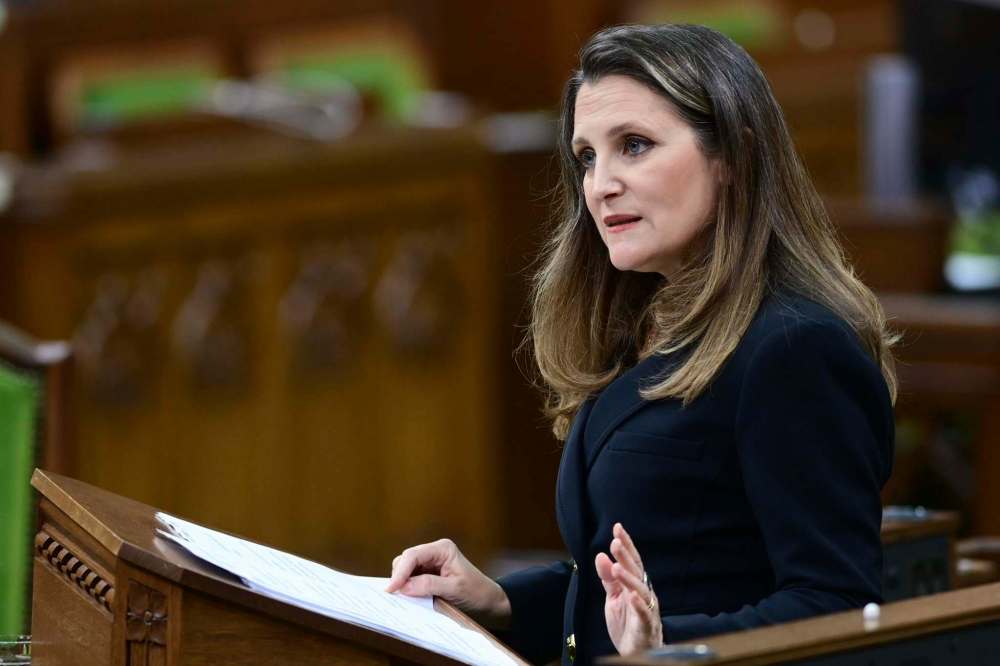
“It’s about healing the economic wounds left by the COVID recession. And it’s about creating more jobs and prosperity for Canadians in the days and decades to come.”
Freeland is also looking ahead to the post-pandemic Canada the Liberals want to see, one that has $10-a-day child care, the ability to produce its own vaccines, national standards for long-term care homes and small- and medium-sized businesses equipped with the workers and technology they need to survive.
Canada’s net debt is now more than $1 trillion for the first time ever, after a $354-billion deficit for the pandemic year that just ended. It is expected to keep climbing with deficits of nearly $155 billion this year, and $60 billion in 2022-23.
That is driven in part by $101.4 billion in new spending over the next three years, including costs to maintain federal wage and rent subsidies and employment benefits until September, rather than cutting them off in June. The raging third wave of the COVID-19 pandemic has prompted many parts of the country to revive or renew restrictions.
Geneviève Tellier, a political scientist at the University of Ottawa, said the budget is a bit more clearly an election plan than she expected.
“If you are elderly, if you are a student, if you are a worker that has lost your job, if you are a worker that has a job, if you are a small-business owner, there’s something probably for you with that budget,” she said. “So in that sense, it’s very ‘electoraliste,’ as we say in French.”
The budget’s marquee entry is what Freeland calls a “generational investment” in child care — $30 billion over five years that will first try to cut fees for regulated child care spaces in half by the end of 2022, aiming for them to be $10 a day within five years. The program will have a long-term annual cost of almost $9 billion.
It also seeks to address some of Canada’s biggest nightmares of the pandemic, namely vaccine production and long-term care. Freeland is proposing to invest another $2.2 billion in life sciences and vaccine manufacturing over the next seven years, and $3 billion over five years to help the provinces implement national standards in long-term care.
The Liberal government is waiving interest payments on federal student loans for another year, expanding sick leave benefits under employment insurance, and boosting the tax credit for low-income workers.
Tellier said that last tax credit is the closest the Liberals have come to a guaranteed livable income.
The Liberals are also offering some aid for small- and medium-sized businesses to invest in new technology and hire young people trained in how to implement it.
There is also the promise of a greener, cleaner Canada, with a promise of more than $17 billion in climate change programs, much of it in the form of incentives to encourage heavy industry to curb their emissions and grow Canada’s clean technology sector.
All of it comes with a pandemic-sized asterisk that things could still change drastically if vaccine supplies are delayed or they prove not to work that well against emerging variants of the virus. The budget includes alternative scenarios that show where the fiscal picture might go if the worst-case scenarios of the pandemic play out.
Those risks seem even more real as the country is battling the worst wave of the pandemic yet, with record hospitalizations and patients in critical care, and doctors and nurses warning repeatedly of a health-care system on the brink of collapse.
Freeland acknowledged the weight the pandemic continues to bear on Canadians.
“We are all tired, and frustrated, and even afraid,” she said. “But we will get through this.”
Whether Canada gets through it without a federal election is the next question to be asked. Opposition parties all rejected the idea of going to the polls for now, but NDP Leader Jagmeet Singh seems to be the one under the greatest pressure.
Singh said earlier this year he would support the government because a pandemic election is in nobody’s best interest, and maintained that stance Monday.
“We are not going to make an irresponsible decision,” he said.
Singh’s biggest criticism of the budget was the lack of any new taxes to go after the “ultra rich,” corporations and elite business owners who have made millions of dollars while millions of Canadians suffered.
The closest the budget got to Singh’s request is a tax on luxury purchases.
Reached by phone, Dauphin-Swan River-Neepawa Conservative MP Dan Mazier said he was “generally disappointed” in the federal budget while his colleague, Brandon-Souris Conservative MP Larry Maguire, said it was “pretty concerning.”
“I’ve never really seen a budget that burdens our future generations so much,” Mazier said about the deficit incurred over the last year and the future deficits projected going forward. “The spending is quite a bit, insurmountable. You know the saying there’s no such thing as a free lunch? The reality is, someone will have to pay for Justin Trudeau’s unsustainable spending.”
Recent survey results released earlier this month by MNP stated that 53 per cent of Canadians are on the brink of financial insolvency. Mazier believes this budget will make that number climb even higher.
“I know a lot of my constituents remember Justin Trudeau’s father took the exact same approach in the ‘80s,” Mazier said. “We all remember those 20 per cent interest rates. We’re seeing a lot of similar things happening today. Home prices are rising, lumber prices are rising and gas prices are rising. This is unsustainable for the people I represent.”
Maguire said he expected a large deficit, but he was hoping for more of a plan on how to restore the country’s economy after the pandemic.
“They don’t intend to balance the budget for what looks like decades,” he said. “It’s just that lack of planning that I think is the biggest thing. We are looking at new spending with zero planning to pay for it.”
He didn’t believe there was a single most egregious example of uncontrolled new spending, instead saying that he thought it was spread around several different areas.
“Interest payments are going to be around $40 billion in the next few years,” he said. “In 2019, the whole deficit was $19 billion. These are big numbers we’re talking about.”
On the subject of the proposed $15-an-hour federal minimum wage, Mazier wasn’t sure why it was introduced.
“To what end?” he asked. “Did they consult the provinces? What are the wanted outcomes of that? Again, it’s more reckless spending. It’s more of not (planning). It just creates animosity for Canadians instead of actually knowing what is a priority.”
It wasn’t all disapproval from Mazier, though. The MP was glad to see $1 billion in funding was put aside to get rural and remote communities to get broadband internet.
“That’s one thing I’ve been trying to get this government to pay more attention, that connectivity fix for rural Canada,” he said. “Can you believe what the government is proposing? I don’t know, but it was good to see the mention.”
His colleague was happy to see mention of a carbon tax rebate for grain drying for farmers, a subject his party has been trying to rectify with a bill that would exempt grain drying for the carbon tax completely. Maguire said he and his party have also been supportive over extensions for the wage subsidy and rent subsidy for businesses and he was glad to see them included.
Also a disappointment for Maguire was a lack of funding for resource development and extraction.
When it comes to the child care funding announced, Mazier said the Liberals have been trying to get a national child care program off the ground for 20 years and have yet to succeed.
Mazier believes promises like that made in the budget are a potential prelude to a federal election at some point this year, though he noted that he believes the Liberals want an election but not his own party.
“They’re going to promise it and it’s just going to go away again,” he said. “I just don’t believe a word they say.”
While the budget mentioned investments in improving Canada’s vaccine manufacturing capabilities, Mazier was disappointed that there wasn’t any specific mention of improving the slow acquisition of COVID-19 vaccine doses that has hampered the country’s fight against the virus. Maguire believes the rent and wage subsidies and some of the other pandemic-related spending are a result of the governing Liberals being unable to procure vaccine doses in a timely enough manner.
“We’ll be proposing some amendments. I’m sure there will be lots of suggestions we’ll have, especially as it gets us back focusing on jobs, “ Mazier said.
Manitoba Metis Federation president David Chartrand praised Métis-specific programs in the budget as well as the government’s post-COVID-19 recovery plans.
“We know this federal government is committed to working with Canada’s Indigenous peoples on a nation-to-nation, government-to-government basis,” Chartrand stated in a media release.
“This budget demonstrates that commitment, through Métis-specific funding packages for early learning and child care, justice, environmental sustainability, Métis entrepreneurs and businesses, and a significant investment in Métis women, to name a few. We are also pleased to see the plans for an inclusive, sustainability-minded COVID-19 economic recovery plan. However, we will need to do a lot of work to understand what the funding impacts are for Métis Nation amongst the Indigenous allocations.”
Conservative Leader Erin O’Toole and Bloc Québécois Leader Yves-François Blanchet both presented amendments they intend to demand to garner their support. For O’Toole, it was an overhaul of the planned child-care program, and Blanchet wants more money for provincial health transfers and additional aid for seniors.
Both also said Singh had taken any pressure off them to vote for the budget to avoid an election.
» The Canadian Press, with files from Colin Slark