
Ceremony to spotlight missing, murdered Indigenous people
Advertisement
Read this article for free:
or
Already have an account? Log in here »
We need your support!
Local journalism needs your support!
As we navigate through unprecedented times, our journalists are working harder than ever to bring you the latest local updates to keep you safe and informed.
Now, more than ever, we need your support.
Starting at $15.99 plus taxes every four weeks you can access your Brandon Sun online and full access to all content as it appears on our website.
Subscribe Nowor call circulation directly at (204) 727-0527.
Your pledge helps to ensure we provide the news that matters most to your community!
To continue reading, please subscribe:
Add Brandon Sun access to your Free Press subscription for only an additional
$1 for the first 4 weeks*
- Enjoy unlimited reading on brandonsun.com
- Read the Brandon Sun E-Edition, our digital replica newspaper
*Your next Free Press subscription payment will increase by $1.00 and you will be charged $20.95 plus GST for four weeks. After four weeks, your payment will increase to $24.95 plus GST every four weeks.
Read unlimited articles for free today:
or
Already have an account? Log in here »
Hey there, time traveller!
This article was published 03/05/2022 (1612 days ago), so information in it may no longer be current.
Community advocates will be honouring the Missing and Murdered Indigenous Women and Girls National Day of Awareness Thursday with a special ceremony at Princess Park.
The event, called “An Afternoon of Honouring the Red Dress Campaign,” will take place from noon to 1:30 p.m., calling on the community to address the ongoing crisis of missing and murdered Indigenous women and girls (MMIWG) in Canada.
The number of MMIWG in the country is around 4,000, according to the Native Women’s Association of Canada. But incomplete data makes the true number difficult to determine. The RCMP reported in 2014 that more than 1,000 Indigenous women and girls were killed or went missing between 1980 and 2012.
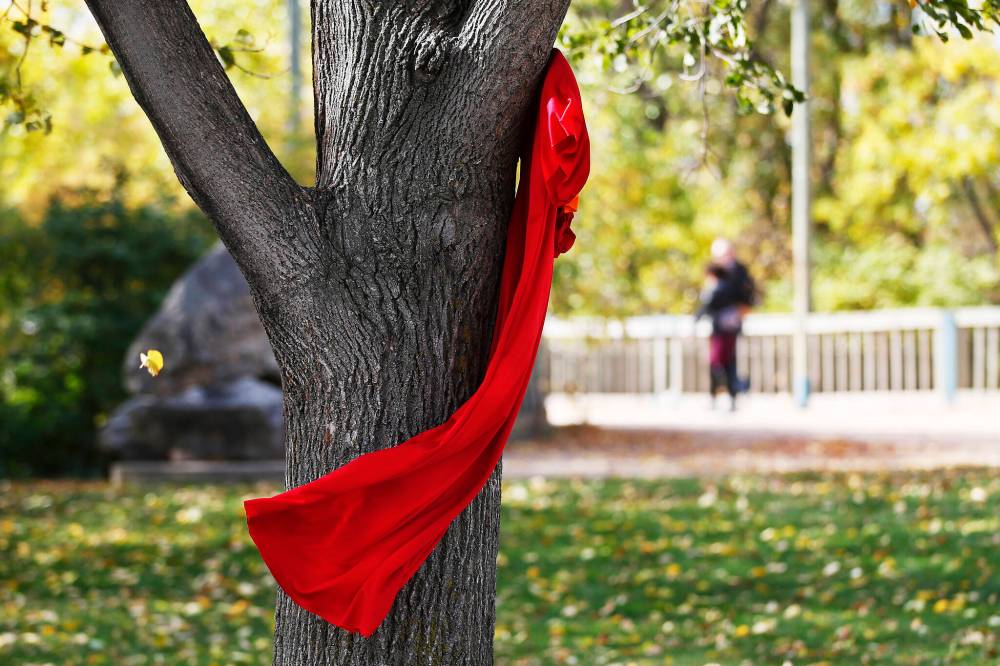
Thursday’s event is designed to raise awareness around MMIWG, said Debbie Huntinghawk, co-ordinator of the Brandon Friendship Centre ’60s Scoop programming. The ceremony is part of the Red Dress campaign and serves as a call to action to the greater community.
Red Dress Day was established by Indigenous artist Jamie Black to recognize the violence Indigenous women face. Black began the tradition with an art installation in Winnipeg; red dresses were hung up as a reminder of those who have gone missing because of domestic and sexual violence.
Indigenous women represented 10 per cent of the total number of missing women in Canada between 1980 and 2014, according to the federal Department of Justice. Sixteen per cent of 6,849 police-reported female homicide cases were Indigenous women — a rate six times higher than non-Indigenous women in Canada.
The national MMIWG day serves to honour the memory of those who are missing and murdered and show action is being taken to address the crisis, Huntinghawk said.
Organizers of this event want to inspire systemic changes to meet the needs of the communities that are most vulnerable.
“We want to create awareness about how it’s getting worse,” Huntinghawk said. “We’re still not taking the time to find these women when they are missing.”
Community collaboration supporting vulnerable people and embracing Indigenous perspectives remains imperative in addressing the MMIWG crisis, said Lisa Noctor, co-ordinator for Brandon GAP youth outreach.
GAP — Gakina Abinoojiyag (All Children in Ojibway) — is a youth homelessness prevention program working with youth between the ages 13 and 29 to help mitigate systemic barriers young people face and provide wrap-around support.
“It is a lifetime series of events, series of circumstances, series of systemic problems and issues that walk people down that road,” Noctor said.
The violence Indigenous women face is a difficult topic to talk about, she said, but needs to be acknowledged in the community.
“There is a lot of sexual assault in Brandon. There are a lot of unsafe places in Brandon. There is domestic violence,” Noctor said. “It is often. It is ongoing. It is a regular, consistent current in our community.”
The Brandon Police Service recorded 101 reported sexual assaults in 2021, 123 in 2020, 140 in 2019, 135 in 2018 and 91 in 2017. The federal Department of Justice estimates only five per cent of sexual assaults are reported.
“It’s not enough to just find a safe space. It’s not enough to just plunk somebody down and then walk away and leave them alone — we have to do our heart work,” Noctor said.
GAP works to connect clients with clinical support and natural helpers to create better outcomes. This includes building natural helpers — family, friends and community — to foster healthy connections.
“If we can build those connections, build those relationships earlier, then we can walk the road beside them. We can not only mitigate system barriers, but we can tinker with the systems,” Noctor said. “We can meet young people where they are at.”
People are acknowledging the complexity of the MMIWG crisis, she said, but this does not always lead to tangible actions. To make a lasting systemic change, there is a need for daily work to address the factors that have led to the ongoing crisis.
“Whose boots are on the ground? Whose boots are asking those questions? Who is actually acting?” Noctor said. “The way we approach intervening and preventing missing and murdered Indigenous women, girls, boys, men and people are we meet them where they are at … we focus on the youth voice and the youth choice about what are their goals.”
Youth may have intersectional needs, including poverty, lack of engagement in academics, post-traumatic stress disorder or substance use. They may be ready to take on all these challenges at once, she said, but GAP can work with them to meet their interests and get them on the healing path.
The focus is on empowerment by letting them make choices instead of being told what they need to.
“We’re just trying to guide them on a safe path forward, and that safer path forward eventually in the long, grand scheme of things changes this, changes this conversation, changes this narrative,” Noctor said. “We’re involved in MMIWG every single day, every single conversation, every single decision.”
» ckemp@brandonsun.com
» Twitter: @The_ChelseaKemp