
Chiefs demand long-term flood mitigation
Advertisement
Read this article for free:
or
Already have an account? Log in here »
We need your support!
Local journalism needs your support!
As we navigate through unprecedented times, our journalists are working harder than ever to bring you the latest local updates to keep you safe and informed.
Now, more than ever, we need your support.
Starting at $15.99 plus taxes every four weeks you can access your Brandon Sun online and full access to all content as it appears on our website.
Subscribe Nowor call circulation directly at (204) 727-0527.
Your pledge helps to ensure we provide the news that matters most to your community!
To continue reading, please subscribe:
Add Brandon Sun access to your Free Press subscription for only an additional
$1 for the first 4 weeks*
- Enjoy unlimited reading on brandonsun.com
- Read the Brandon Sun E-Edition, our digital replica newspaper
*Your next Free Press subscription payment will increase by $1.00 and you will be charged $20.95 plus GST for four weeks. After four weeks, your payment will increase to $24.95 plus GST every four weeks.
Read unlimited articles for free today:
or
Already have an account? Log in here »
Hey there, time traveller!
This article was published 20/05/2022 (1612 days ago), so information in it may no longer be current.
Chief Glenn Hudson is demanding a long-term solution.
The chief of Peguis First Nation called on the provincial and federal governments Friday to support Manitoba’s largest First Nation community in long-term flood mitigation efforts by raising the quality of its critical infrastructure.
For decades, Peguis First Nation has been caught in the middle of a “political football game” between the federal and provincial government about who will claim financial responsibility for improvements to housing, roads, drainage systems, dikes and diversions in and around the community, Hudson said.
“For us, it doesn’t matter on the jurisdiction.
“It’s a solution that’s needed for us as First Nations people.”
Hudson said he believes the community could’ve had a long-term flood mitigation system in place a long time ago.
He recalled 2011’s devastating flood running up more than $24 million for response and recovery. Much of those fixes, like ones provided before and since by the provincial and federal governments, were Band-Aid solutions, he said.
“I would have rather seen that $24 million spent on capital infrastructure to prevent flooding.”
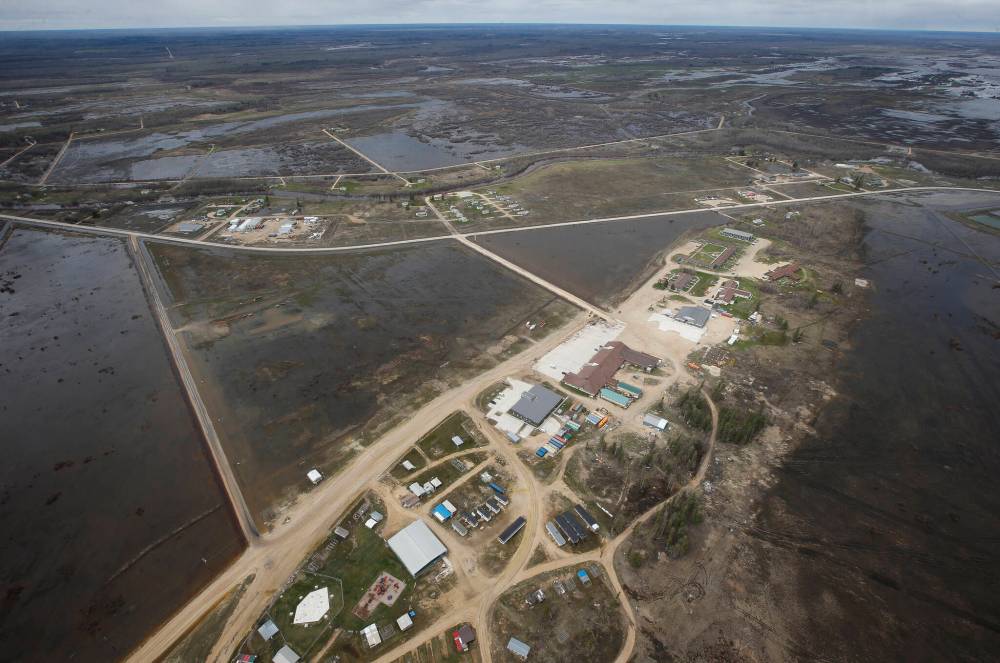
Many of the major roadways, including Highway 224, which runs through Peguis and reaches two other First Nations communities, are washed out and have collapsed, leaving tens of millions of dollars of damage to be fixed, he said.
Grand Chief Jerry Daniels of the Southern Chiefs’ Organization accompanied Hudson on Friday’s call for action.
He said the provincial government hasn’t taken the same proactive approach to mitigating floods in Peguis First Nation as it has in the rest of the province, asserting it represents a string of discriminatory practices against First Nations communities.
The same funding that was provided to southern municipalities to prepare for spring flooding was not extended to Peguis, he said.
“I think it’s important that the leadership within the province starts to re-examine and re-evaluate their relationship [with First Nations communities] and their mitigation efforts going forward, because that’s what reconciliation is,” Daniels said.
“It comes down to taking responsibility for the inaction and leaving Peguis in a place where it is at a strategically disadvantaged point.”
While Transportation and Infrastructure Minister Doyle Piwniuk was unavailable for an interview Friday, his office provided this statement:
“The levels on the Fisher River this year have reached record levels and the issues in this area are very complex and therefore require flood infrastructure to meet the needs of these complexities. This spring’s run-off event will prompt further review including information attained during this event. Review will have to be done post-flood with First Nations, surrounding communities and with the Federal government.
“The province would need to work in collaboration with the communities and the Federal government to assist them in providing long term flood mitigation improvements. As river levels are now coming down significantly in the area, the province is assessing damages to provincial infrastructure.”
The largest flood in its history, according to a press release from Peguis First Nation and Southern Chiefs’ Organization, and the 11th in the past 20 years, has forced more than 1,800 residents to flee Peguis First Nation for safer grounds in Brandon, Winnipeg, Selkirk, Gimli and Portage La Prairie.
In Brandon, nearly 200 evacuees are occupying the Victoria Inn and Clarion hotels for a fourth week, with many of them growing restless.
It’s nothing new for most of the evacuees, as some had just returned home from floods that date back as far as 2009.
Still, the impact of being displaced again has been grave for some evacuees.
Since evacuating, one woman has overdosed in her hotel room, multiple youth have been exploited and numerous elders have experienced serious health issues, according to Hudson.
“Things like this can reintroduce past traumas.”
Though evacuees are itching to get home, Hudson said they are at least four to six weeks away from greenlighting a return while his team continues to evaluate damages.
Despite the water slowly receding from the bloated Fisher River, Hudson still assessed the risk being “medium.”
The water could come back up if hefty rainfalls continue.
“This flood has impacted things that were never hit in the past,” said William Sutherland, director of emergency management and housing for Peguis First Nation.
Sutherland hasn’t left Peguis since disaster struck. He built up his house three and a half feet following the flood in 2014, but said the swollen waters have easily surpassed that cushion.
“It’s something that has impacted me my whole life,” he said.
Sutherland has been fighting the deep water for three weeks, using a canoe to transport sandbags to vulnerable homes.
Roads have collapsed while some flooded areas were untreatable for a long time because they were inaccessible. Most of the unreachable homes resided in the north end — the least protected — part of the community.
“A lot of people are frustrated,” he said.
“[The federal and provincial government] just has to sit down with us. We can have a day where Peguis First Nation receives a record amount of rain but is happy to report zero flooding.”
» jfrey-sam@brandonsun.com
» Twitter: @jfreysam