
CP Rail strike could trigger global shortfalls
Advertisement
Read this article for free:
or
Already have an account? Log in here »
We need your support!
Local journalism needs your support!
As we navigate through unprecedented times, our journalists are working harder than ever to bring you the latest local updates to keep you safe and informed.
Now, more than ever, we need your support.
Starting at $15.99 plus taxes every four weeks you can access your Brandon Sun online and full access to all content as it appears on our website.
Subscribe Nowor call circulation directly at (204) 727-0527.
Your pledge helps to ensure we provide the news that matters most to your community!
To continue reading, please subscribe:
Add Brandon Sun access to your Free Press subscription for only an additional
$1 for the first 4 weeks*
- Enjoy unlimited reading on brandonsun.com
- Read the Brandon Sun E-Edition, our digital replica newspaper
*Your next Free Press subscription payment will increase by $1.00 and you will be charged $20.95 plus GST for four weeks. After four weeks, your payment will increase to $24.95 plus GST every four weeks.
Read unlimited articles for free today:
or
Already have an account? Log in here »
Hey there, time traveller!
This article was published 21/03/2022 (1682 days ago), so information in it may no longer be current.
The CP Rail strike has set an already beleaguered Canadian economy further on its heels and combined with the war in Ukraine is creating critical operational scenarios across several sectors.
Industry groups are putting pressure on the federal government to resolve the work stoppage quickly as many fear it will add another layer of unreliability, damaging the potential for future investments.
The timing of the rail stoppage with war raging in Ukraine, a major agricultural commodities exporter, will cause shortfalls in the global agricultural supply chain, driving those commodity prices — and food prices — even higher.
One grain marketing expert said the rail stoppage combined with the active war situation in the Eastern European bread basket could send agricultural prices soaring.
Neil Townsend, senior market analyst at Farmlink Market Solutions, said: “There is a high probability that grain and oil-seed prices will reach new records in 2022 and 2023 and there is a chance they might hit levels that are significantly above previous records.”
At least one local manufacturer is already making plans to shut down part of its operations because it has been told it won’t be receiving a critical rail load of raw material — in this instance, paper — needed for its finished product.
An official with Richardson International said the CP strike will be very disruptive to grain exporters, who have already experienced all sorts of setbacks after a drought last year and flooding in B.C. that caused rail disruptions last year.
Concerns about fertilizer supplies — much of the nitrogen fertilizer comes in by rail from the U.S. — and the supply of livestock feed for both hogs and cattle will shortly become critical.
Tyler Fulton, president of the Manitoba Beef Producers and a national board member of the Canadian Cattlemen’s Association, said the CP strike is creating a dire situation.
“We need back-to-work legislation,” he said. “We simply don’t have the time line needed to negotiate this thing out.”
Even before the strike was announced on Sunday grain shippers had been complaining about poor service. Hauling grain represents about 20 per cent of CP’s revenue.
Wade Sobkowich, executive director of the Western Grain Elevators Association — which represents the interests of the six largest grain handling companies active in Western Canada — said his members were getting fewer than half their orders filled on a weekly basis.
“We feel it is unconscionable for CP management and the union to be forcing us to this set of circumstances right now given everything that is going on in the world and using the current difficult circumstances that people are facing as a lever to pull for their own benefit,” Sobkowich said.
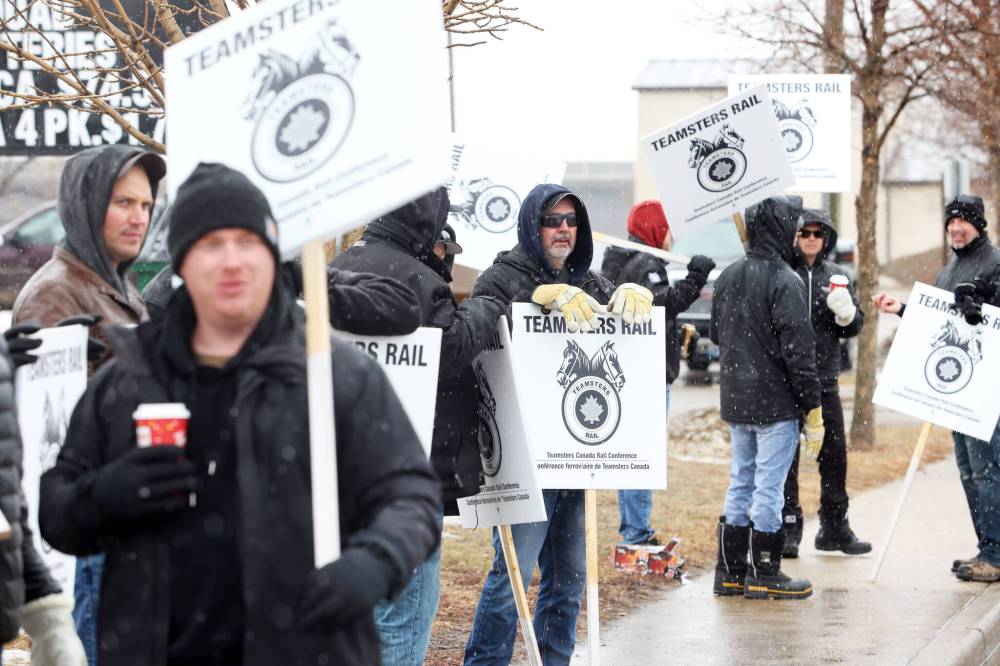
Approximately 3,000 conductors, engineers and train and yard workers with CP Rail were off the job over the weekend. The company and the union representing the workers, the Teamsters Canada Rail Conference, both blamed each other for causing the work stoppage, though both also said they were still talking with federal mediators.
Those talks continued Monday in Calgary. Federal Labour Minister Seamus O’Regan was also on site.
“I don’t intend to leave until we have an agreement,” O’Regan said Monday. “I am optimistic, with people at the table and not leaving, that we will reach the deal that Canadians demand and want as soon as possible.”
The House of Commons resumed Monday following a two-week break, so back-to-work legislation could come immediately if the federal government so chooses.
However, O’Regan indicated over the weekend that the government believes the best deal is reached at the bargaining table. And while business and industry voices are calling on the government to use all tools at its disposal to bring an end to the work stoppage, labour advocates say talks need to be allowed to progress.
“We hope that the negotiations will be allowed to continue with mediation and that we avoid intervention by government,” said Bea Bruske, president of the Canadian Labour Congress, which has been calling for CP Rail to “negotiate in good faith” with the Teamsters.
“Let me be clear, back-to-work legislation is not needed.”
NDP Leader Jagmeet Singh told reporters in Ottawa on Monday that employing back-to-work legislation in a “cavalier” way interferes with the right of workers to use the ability to strike as a negotiation tool to improve working conditions.
“The fact that it’s already something that’s being raised before workers have a chance to negotiate sends a message to employers that they don’t have to negotiate,” Singh said. “And that’s wrong.”
Peggy Nash, senior adviser with Ryerson University’s Centre for Labour Management Relations, said if a negotiated agreement between the two parties can’t be reached, some form of binding arbitration could be another possible solution that could prevent the need for a federally mandated back-to-work order.
“But this is only day two, and the fact that the two sides have indicated they would like to keep talking is a hopeful sign,” said Nash, a former NDP MP.
“There’s a great deal of pressure right now on all sides, and this kind of pressure can focus the mind in a way that months-long bargaining might not.”

After already having gone through the demands of meeting COVID regulations in order to operate some, like Ron Koslowsky of the Canadian Manufacturers and Exporters, are calling on government to take strong and swift action to get the railroad back on the rails.
“In my view government needs to send a strong signal,” he said. “You don’t shut down an emergency hospital just because of a labour dispute. Don’t shut down the lifeblood of the economy when there are no options in terms competition. If there was seven different rail lines they could just go to another. We don’t have that option.”
And with on-going truck shortages caused by cross border vaccine mandates, some companies are not able to secure trucks instead of shipping by rail.
While the size of last year’s grain harvest was hurt by the drought, there are still plenty of farmers with scheduled deliveries to grain elevators right now.
There are road restrictions in the spring that prevent heavy trucks on certain roads during the thaw and after a certain point that could cause further supply chain problems.
“There are delivery contracts in March for a reason,” said Bill Campbell, president of Keystone Agricultural Producers.
Although it is still more than a month before seeding fertilizer needs to be in position for farmers to be able to access it.
“The worry filters down,” he said. “It means another level of concern about when will this be resolved. The elevator I deliver to expected a train on the weekend, I don’t think it showed up. If it’s full I cannot deliver.”
Industry groups say the stakes are particularly high, given that the CP Rail shutdown comes at a time when many businesses are already dealing with supply chain difficulties caused by the pandemic, extreme weather, and the recent blockades of border crossings by protesters.
“We’re asking for all parties to find a very, very quick resolution,” said Brian Kingston, president and chief executive of the Canadian Vehicle Manufacturers’ Association.
“We appreciate the fact that they’re back at the table today … That said, if it becomes evident that there is simply no negotiated outcome possible, we would encourage the government to look at other options.”
Fertilizer Canada chief executive Karen Proud warned that with just a month to go before spring seeding gets underway, a rail shutdown means farmers may not get all the fertilizer they need.
She said that could cause food prices to spike given the war in Ukraine and the impact it’s already had on global fertilizer supplies as well as the prices of wheat and other grains.
Proud said the fertilizer industry believes it’s time to introduce back-to-work legislation.
“We certainly respect the collective bargaining process, but clearly these two groups haven’t been able to reach an agreement. And now the government needs to act immediately,” she said.
Saskatchewan Premier Scott Moe said the work stoppage could affect the province’s reputation as a commodity exporter. He called on the federal government to draft back-to-work legislation and to classify railworkers as an essential service.
“If there is that lengthy protracted service disruption, that will cause Saskatchewan … some reputational damage of being a sustainable supplier of potash, uranium, and agri-food products, and that’s a problem for us,” Moe told reporters.
— with files from The Canadian Press
» Winnipeg Free Press