
Fate of federal ridings in commission’s hands
Advertisement
Read this article for free:
or
Already have an account? Log in here »
We need your support!
Local journalism needs your support!
As we navigate through unprecedented times, our journalists are working harder than ever to bring you the latest local updates to keep you safe and informed.
Now, more than ever, we need your support.
Starting at $15.99 plus taxes every four weeks you can access your Brandon Sun online and full access to all content as it appears on our website.
Subscribe Nowor call circulation directly at (204) 727-0527.
Your pledge helps to ensure we provide the news that matters most to your community!
To continue reading, please subscribe:
Add Brandon Sun access to your Free Press subscription for only an additional
$1 for the first 4 weeks*
- Enjoy unlimited reading on brandonsun.com
- Read the Brandon Sun E-Edition, our digital replica newspaper
*Your next Free Press subscription payment will increase by $1.00 and you will be charged $20.95 plus GST for four weeks. After four weeks, your payment will increase to $24.95 plus GST every four weeks.
Read unlimited articles for free today:
or
Already have an account? Log in here »
Hey there, time traveller!
This article was published 09/05/2022 (1663 days ago), so information in it may no longer be current.
Some Manitobans may find themselves in a new federal riding when the next election is called.
Every 10 years, commissions appointed for every province re-examine Canada’s federal electoral districts and decide whether their boundaries need to be changed, or if changes in population require the addition or subtraction of seats in the House of Commons.
The last revision to Canada’s electoral districts took place in 2012. Work to review the current ridings is underway in each province and territory.
In Manitoba, the three-person commission in charge of reviewing and proposing a new set of boundaries is made up of Brandon University political scientist Kelly Saunders, University of Manitoba professor emeritus in political studies Paul G. Thomas and Justice Diana M. Cameron, a judge for the Manitoba Court of Appeal who is serving as chair.
Instrumental to the work will be the results of last year’s census, which will show the commission how the population of each riding has changed since the last review.
Late last year, Canada’s chief electoral officer announced Ontario and British Columbia will gain one seat each in the House of Commons, Alberta will add three and Quebec will lose one.
That means at the end of the process, Manitoba will still elect 14 representatives to Parliament even if the ridings those representatives serve change shape.
In an interview with the Sun on Monday, Cameron said a proposed set of new electoral boundaries will be released in June. After gathering public feedback after that release and during a set of public hearings held in early to mid-September, a final electoral map will be submitted to Parliament in December.
According to her, the commission’s work began in November 2021 when it was established by an order-in-council and she was appointed chair by the chief justice of Manitoba.
The commission receives assistance from Elections Canada in the form of a secretary and a geographic specialist who can explain population movements and voter parity.
Voter parity, which is listed as one of the commission’s guiding principles, means having each district’s population be within five per cent of the provincial average across the 14 ridings.
“That is historic for Manitoba in 1992, 2002, 2012,” Cameron said.
“We’ve decided to continue with that plus or minus five per cent guideline. That’s the first thing we consider. The concept of voter parity is also referred to in the case law and the Electoral Boundaries Readjustment Act.
“However, we also are taking into account population growth projections as close as we reasonably can to ensure that the population going forward over the next 10 years is going to be plus or minus five per cent. Then it’s also keeping communities together as much as reasonably possible.”
Though submissions for the first round of feedback closed on April 14, Cameron is still hoping members of the public will continue reaching out with their thoughts over the rest of the process.
She couldn’t confirm that Brandon will hold one of the public hearings on the proposed boundaries later this year, but said the goal is to hold one in the Wheat City. However, she said no matter where a public hearing is held during that process, guests are welcome to provide feedback on any riding.
Another key aspect of the decision-making process is feedback from the public. On the redistribution website run by the federal government, 12 letters sent to the Manitoba commission with commentary on which changes should or should not be made have been published.
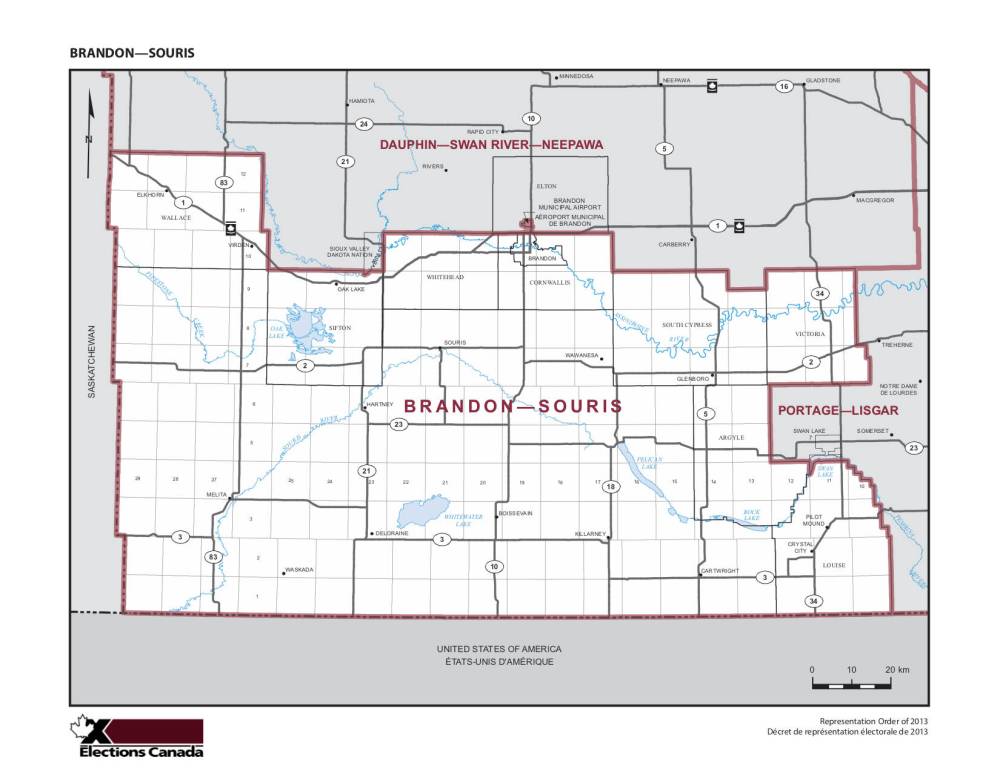
That includes a letter co-signed by Conservative MPs Larry Maguire (Brandon-Souris) and Dan Mazier (Dauphin–Swan River–Neepawa) as well as another letter they co-signed as part of the Manitoba Conservative Caucus.
In their letter, Maguire and Mazier advocate for the boundaries of their ridings to remain the same. In both aforementioned letters, they ask for the electoral district of Churchill–Keewatinook Aski to remain the same “due to the northern and remote communities of interest in an already large geographical area.”
The letter from the Tory caucus requests growth rates be factored into any decision, for communities of interest to be grouped together, for economic trading areas to be factored in and for no rural municipalities to be divided between two or more ridings.
Another letter from Swan River Mayor Lance Jacobson expresses hope the town will remain in its current district due to its similar successes and challenges to the communities of Dauphin and Neepawa.
“Our mayor and council are strong on the position that the Dauphin–Swan River–Neepawa electoral boundary does not change, and that Swan River would like to remain in the ‘southern’ electoral district,” Jacobson wrote.
In an interview late last week, Mazier explained why he’d like to see his riding’s boundaries stay put. He said considering his and Maguire’s shared agricultural and rural backgrounds, it makes sense for the people in the ridings as they currently stand to be represented by people who understand their concerns.
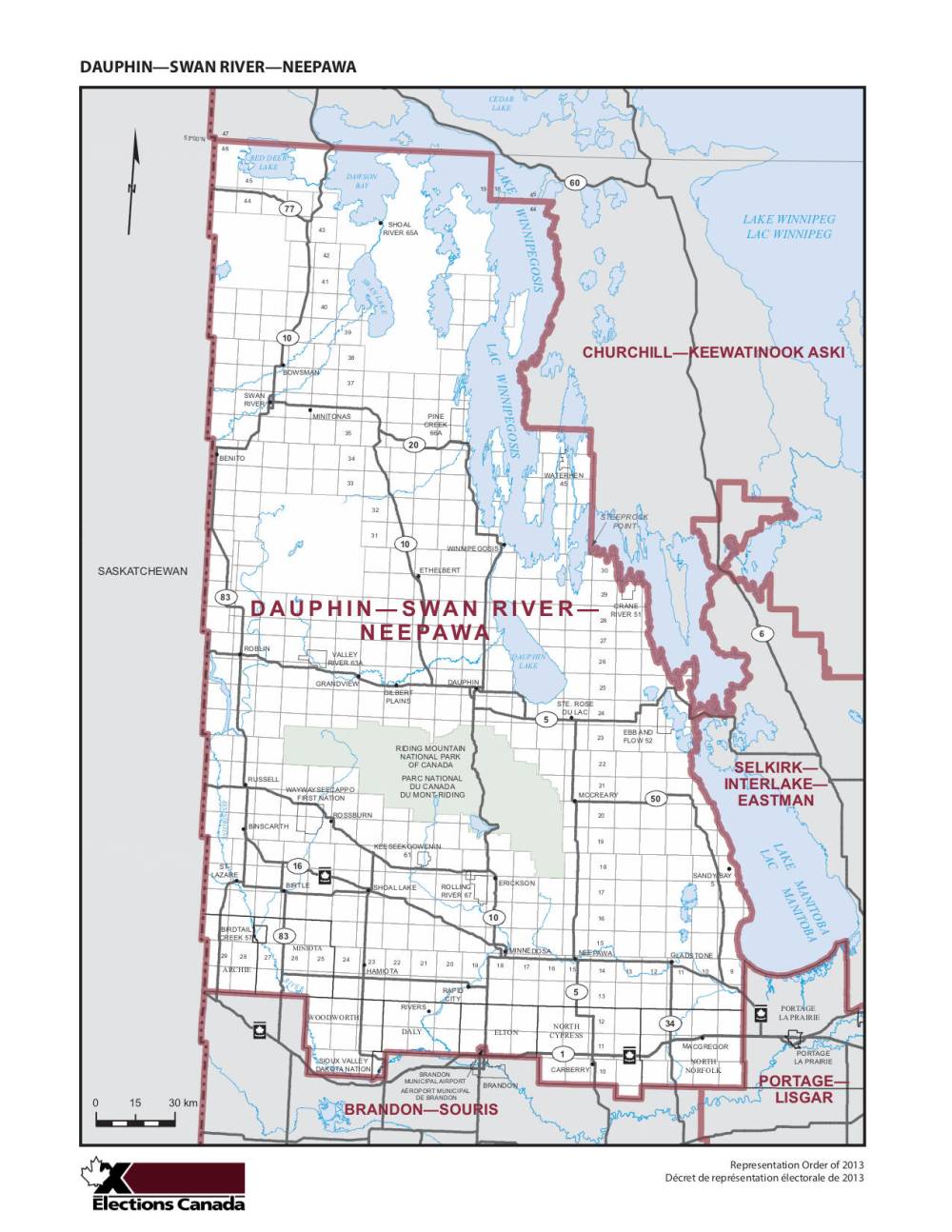
Dauphin–Swan River–Neepawa is a dynamic place with agriculture, forestry and established trade routes and patterns that Mazier believes should be kept together.
“I was reading that Swan River wants to remain in the riding, which makes sense,” Mazier said. “All their goods go down to the United States, and their spruce products come down to feed Saskatchewan, Ontario and the rest of the province. It doesn’t make sense for them to start trading with Thompson because all of a sudden, you get into mining and all sorts of other things.”
The Sun was unable to reach Maguire for comment.
Manitobans interested in reaching the Federal Electoral Boundaries Commission for Manitoba to provide feedback can call 1-855-747-7226 toll-free or email MB@redecoupage-federal-redistribution.ca.
» cslark@brandonsun.com
» Twitter: @ColinSlark