
Gerrard hears concerns over hospitals, EMS stations
Advertisement
Read this article for free:
or
Already have an account? Log in here »
We need your support!
Local journalism needs your support!
As we navigate through unprecedented times, our journalists are working harder than ever to bring you the latest local updates to keep you safe and informed.
Now, more than ever, we need your support.
Starting at $15.99 plus taxes every four weeks you can access your Brandon Sun online and full access to all content as it appears on our website.
Subscribe Nowor call circulation directly at (204) 727-0527.
Your pledge helps to ensure we provide the news that matters most to your community!
To continue reading, please subscribe:
Add Brandon Sun access to your Free Press subscription for only an additional
$1 for the first 4 weeks*
- Enjoy unlimited reading on brandonsun.com
- Read the Brandon Sun E-Edition, our digital replica newspaper
*Your next Free Press subscription payment will increase by $1.00 and you will be charged $20.95 plus GST for four weeks. After four weeks, your payment will increase to $24.95 plus GST every four weeks.
Read unlimited articles for free today:
or
Already have an account? Log in here »
Hey there, time traveller!
This article was published 22/02/2018 (3156 days ago), so information in it may no longer be current.
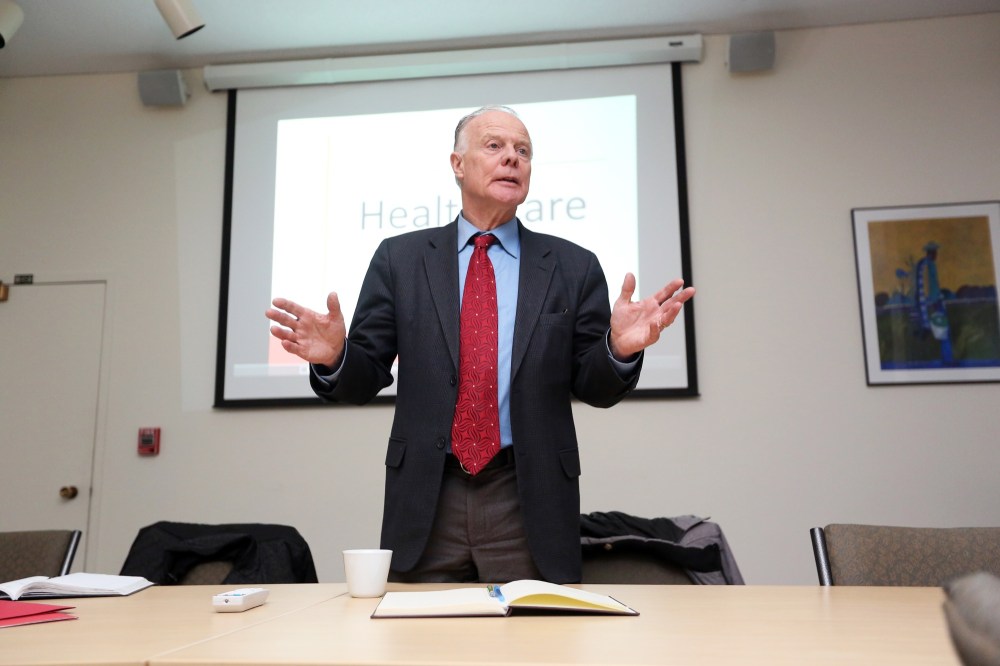
With the province’s public health-care system his focus, Manitoba Liberal Party health critic Jon Gerrard hosted a public consultation meeting at Brandon University on Wednesday night.
It was the first in a series of six such meetings he plans on hosting throughout the province in the coming days, kicking things off with an audience of about 30 people interested in sharing their insights.
Among those in attendance was Brandon East Progressive Conservative MLA Len Isleifson, who prior to the meeting said he is always keen on hearing from constituents.
Community member Leslie Dzogan said her chief concern regarding the province’s health-care system is the closure of emergency rooms in Winnipeg.
She said her 93-year-old father-in-law was taken to St. Boniface Hospital a few weeks ago after experiencing heart attack-like symptoms. Once there, he was forced to remain in an crowded emergency department due to capacity issues.
In the end, his family determined that he was better off returning home than remaining in the hospital.
While the role that the province’s retooling of emergency services might have played remains unclear in this case, Dzogan said she nonetheless wanted to bring it forward to Gerrard.
David Bell attended the meeting to share the story of his father, George, who died approximately three years ago after being repeatedly sent home from the hospital.
Dissatisfied with the level of service his father was provided, Bell said he’d like to see physicians allotted more time with each of their patients.
Elizabeth Tardiff attended the meeting to express her concern about the reconfiguring of rural EMS stations.
The EMS situation is expected to be one of the top concerns brought up during the meeting Gerrard will host tonight in Grandview, where the EMS station has been slated for closure.
While Gerrard came to Wednesday’s meeting with a number of criticisms regarding the state of the province’s health-care system, he also presented some positives.
CancerCare Manitoba offers a network of tightly knit specialized professionals throughout the province via outreach centres and electronic charts that put professionals on the same page with international protocols of the highest quality, he said.
“As a result of this effort, people often go into Winnipeg for diagnosis and initial treatment, but they can go back to the community … and get follow-up chemotherapy and treatment, so you’re able to deliver to more care locally,” Gerrard said, adding that he’d like to see this model expanded to encompass other areas of health care.
Gerrard isn’t the first health critic to host a public meeting in Westman, with Manitoba NDP health critic Andrew Swan joining his party’s leader, Wab Kinew, in hosting a similar such tour last month.
A majority of those to speak up at the Manitoba NDP’s health-care meeting in Brandon steered the conversation in the direction of the city’s methamphetamine crisis.
It’s an issue Gerrard said is very much on the Liberals’ radar.
During the Association of Manitoba Municipalities Annual Convention in Brandon a couple of months ago, Gerrard joined Manitoba Liberal Leader Dougald Lamont in meeting with local community activist Kim Longstreet to discuss the meth crisis.
In general, Gerrard said the health-care structures currently in place in Manitoba have failed to adequately address the fact that meth addiction needs to be treated differently than most other addictions, such as opioids and alcohol.
On this front, Gerrard is in agreement with Longstreet’s assertion that Brandon needs a detox centre that specializes in treating meth addicts.
More specifically, he said Brandon and other communities need drug stabilization units, which hold addicts safely until such time as the drug they are addicted to can be eased out of their system.
Those addicted to meth can experience violent psychosis, so this is an important first stage in any treatment regime, Gerrard said, adding that the next stop would be a home-like setting within a detox centre, followed by additional supports to help addicts along their road to recovery.
It’s “sad and disappointing” how little progress the provincial government has made in addressing its meth crisis, Gerrard said. “There’s been talk, but there’s been virtually no action to date.”
Those who missed Wednesday’s meeting, or are unable to attend one of Gerrard’s subsequent five meetings, can submit their opinions and stories online through his website at jongerrardmla.ca.
Gerrard said he’s primarily looking for personal stories from individuals, which he said serves two purposes.
One, he said, is that they allow him as an MLA to help individuals, which he said is an important role for any MLA
to fulfil.Further to that, individual cases might point beyond anecdotal and toward systemic issues within the province’s health-care system that need to be remedied.<t$>
» tclarke@brandonsun.com
» Twitter: @TylerClarkeMB