
Groups lend hand to Brandon’s most vulnerable
Advertisement
Read this article for free:
or
Already have an account? Log in here »
We need your support!
Local journalism needs your support!
As we navigate through unprecedented times, our journalists are working harder than ever to bring you the latest local updates to keep you safe and informed.
Now, more than ever, we need your support.
Starting at $15.99 plus taxes every four weeks you can access your Brandon Sun online and full access to all content as it appears on our website.
Subscribe Nowor call circulation directly at (204) 727-0527.
Your pledge helps to ensure we provide the news that matters most to your community!
To continue reading, please subscribe:
Add Brandon Sun access to your Free Press subscription for only an additional
$1 for the first 4 weeks*
- Enjoy unlimited reading on brandonsun.com
- Read the Brandon Sun E-Edition, our digital replica newspaper
*Your next Free Press subscription payment will increase by $1.00 and you will be charged $20.95 plus GST for four weeks. After four weeks, your payment will increase to $24.95 plus GST every four weeks.
Read unlimited articles for free today:
or
Already have an account? Log in here »
Hey there, time traveller!
This article was published 31/12/2021 (1775 days ago), so information in it may no longer be current.
Services supporting Brandon’s vulnerable downtown population are rallying to provide help to those in need as COVID-19 cases in the province continue to rise.
An important community has been established at the Blue Door Project, said Ask Auntie Brandon co-ordinator Florence Halcrow. The strong community ties established at the warming shelter are helping people identify if someone is experiencing mental duress or showing symptoms of the COVID-19 virus.
“Everybody knows where everybody is with this community atmosphere,” Halcrow said.
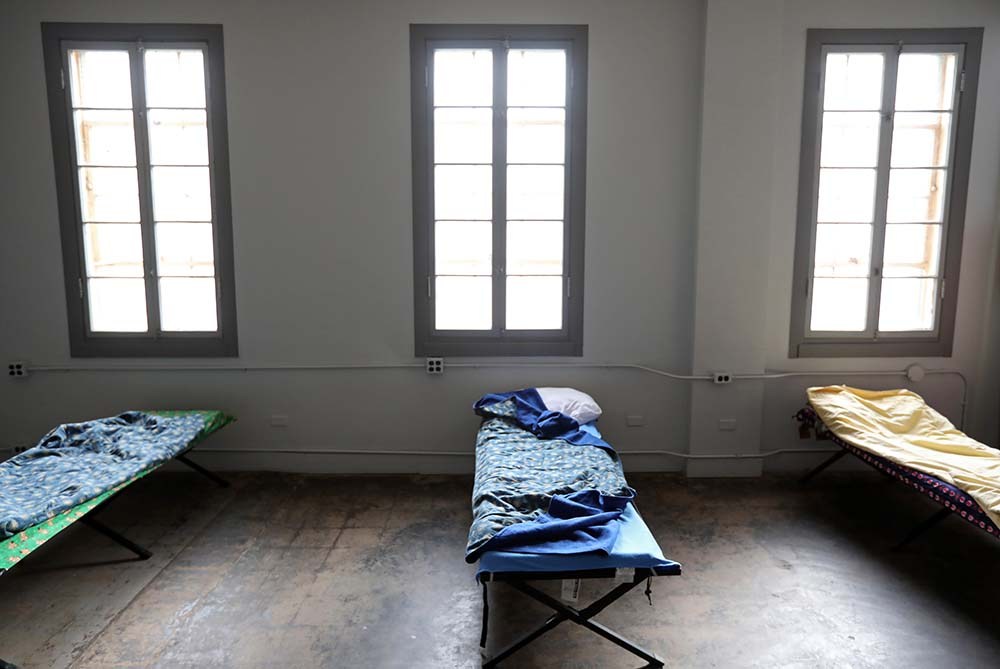
The warming shelter recently had a regular face at the Blue Door who became sick. Halcrow said everyone was able to communicate and ensure they were looked after and received the care they needed.
These actions have largely been made possible through the ability to partner and communicate with other local organizations such as the Safe and Warm Shelter.
The Blue Door Project has personal protective equipment available, she said, and support provided by Prairie Mountain Health (PMH) has been essential.
PMH has helped administer the COVID-19 vaccines and rapid tests at the Blue Door.
“Without the rapid tests, it’s really hard to sit and think, ‘well, do they have COVID or do they have pneumonia?’” Halcrow said. “I’m very pleased with us being able to get the rapid tests. Now if they have symptoms, we can do the test and half an hour later we are good to go.”
She added another critical aspect at the Blue Door has been helping unhoused people with their personal identification, including proof of vaccination QR codes, using a community mailbox. A community ID bank is also on site.
It is not easy navigating COVID-19 while being unhoused, Halcrow said, especially if there is ever a need to isolate.
In 2020, the Brandon Neighbourhood Renewal Corporation helped create alternative isolation accommodation spaces for those needing to quarantine. Unhoused individuals would be able to stay in a unit for the duration of their time in quarantine.
Halcrow said they knew the rooms were needed and worked to get them running as soon as possible initially at the Redwood Motor Inn, Colonial Inn and Motel 6.
“Thank goodness, they were able to let us use those rooms,” Halcrow said. “We know where they are. We used it in 2020. They have their own space.”
The alternative isolation accommodation spaces are now located solely at the Redwood.
It was a challenging time to navigate based on determining who had COVID-19 and who had been exposed to the virus and could potentially test positive.
These issues have been alleviated by the Blue Door Project, she said, allowing for better communication and care of the vulnerable people living in Brandon’s downtown.
“They have a place to go during the day, and now we can watch if they have symptoms. We can get rapid tests for them and test them ourselves,” Halcrow said. “If they have COVID or if they are close contact, we call Prairie Mountain Health and then they put them into the Redwood.”
She added the project also works with the 7th Street Access Centre, the Safe and Warm Shelter, Brandon Bear Clan and other organizations to provide wrap-around supports and services.
If someone tests positive, they will be provided RAM services, clothes, food hampers and other essential items needed to survive two weeks in quarantine.
“I like that we have the rapid tests and I like that we have the community, because without the community, I found that people were having a lot of mental health issues,” Halcrow said. “This is helping a lot of people.”
It was incredibly concerning to see the spike in languishing mental health in January due to the increased isolation people were experiencing, she said. This loss of connection was keenly felt by Indigenous communities because there was a need to be together to offer support during challenging times.
“That’s their family,” Halcrow said.
Samaritan House Ministries Inc. executive director Barbara McNish said she appreciates the Blue Door Project because now there is only half an hour where Brandonites do not have a warm place to go in the Wheat City between the project and the Safe and Warm Shelter.
The project has been a great addition to the city, offering important coverage through everyone working together to make sure nobody is left out in frigid temperatures during the height of winter.
“That’s our greatest strength, is to be able to rally around and support one and other,” McNish said.
The Safe and Warm Shelter remains open, and the organization is actively screening for the virus and working with public health and PMH to help manage the fourth wave of the pandemic.
“We’ve got some plans in effect, and we’re just doing what we’re supposed to be doing,” McNish said. “The shelter right now, I have no concerns about it. We know it’s out there, so we are doing all the things we possibly can do.”
McNish was unable to comment on case numbers, but said anyone who needs to be tested is being referred to PMH.
The shelter is practising public health measures and recommendations, including physical distancing, to help protect the 30 individuals who use the space each night.
“The groups of people that come in are families … they are friends and they are therefore family, and they take care of each other. It’s really important that they manage. They don’t want their family to be sick any more than you or I do,” McNish said.
As a shelter, they appreciate the support provided by the community, the City of Brandon, PMH, the province and other agencies.
As COVID-19 cases continue to rise in the province, the measures and practices at Safe and Warm have gone largely unaffected, McNish said, but the Samaritan House Food Bank has been forced to pivot.
The food bank is currently providing more than 100 food hampers each day and has gone to a once-a-month double hamper delivery to limit people gathering for the month of January. The number of people allowed in the food bank at a time is currently limited to six.
The hours at the non-profit have been extended to 10 a.m. to 3 p.m to ensure they can provide hampers in a safe method.
“Right now, we’re managing, so I’m just waiting to see what the need might be down the road — it’s good,” McNish said.
A PMH spokesperson provided written comments regarding COVID-19 supports and cases at the Blue Door and Safe and Warm Shelter.
The regional health authority was unable to confirm if any or how many cases have been reported in these communities. The spokesperson said in an email statement that in December 2020, there was an increase in cases or contacts in Brandon’s vulnerable population. They noted 2021 has been different, as PMH’s vaccination outreach has helped protect the vulnerable people in the community.
Clients who are COVID-19 positive or close contacts are provided accommodations and services that may include primary care, public health and mental health services at an alternate isolation unit. Clients are checked on at least daily and provided meals and other services they require.
“The pandemic creates additional challenges for more vulnerable clients who may not have a safe place to isolate, and PMH works in partnership with community stakeholders to provide alternate isolation accommodations and additional supports to meet client needs,” said the spokesperson.
» ckemp@brandonsun.com
» Twitter: @The_ChelseaKemp