
Human rights complaint may drag out two years
Advertisement
Read this article for free:
or
Already have an account? Log in here »
We need your support!
Local journalism needs your support!
As we navigate through unprecedented times, our journalists are working harder than ever to bring you the latest local updates to keep you safe and informed.
Now, more than ever, we need your support.
Starting at $15.99 plus taxes every four weeks you can access your Brandon Sun online and full access to all content as it appears on our website.
Subscribe Nowor call circulation directly at (204) 727-0527.
Your pledge helps to ensure we provide the news that matters most to your community!
To continue reading, please subscribe:
Add Brandon Sun access to your Free Press subscription for only an additional
$1 for the first 4 weeks*
*Your next subscription payment will increase by $1.00 and you will be charged $20.00 plus GST for four weeks. After four weeks, your payment will increase to $24.00 plus GST every four weeks.
Read unlimited articles for free today:
or
Already have an account? Log in here »
Hey there, time traveller!
This article was published 04/11/2021 (1609 days ago), so information in it may no longer be current.
A Brandon man says he is “disgusted” at a two-year wait to have his complaint investigated by the Manitoba Human Rights Commission, but new legislation is aimed at speeding things up at the agency.
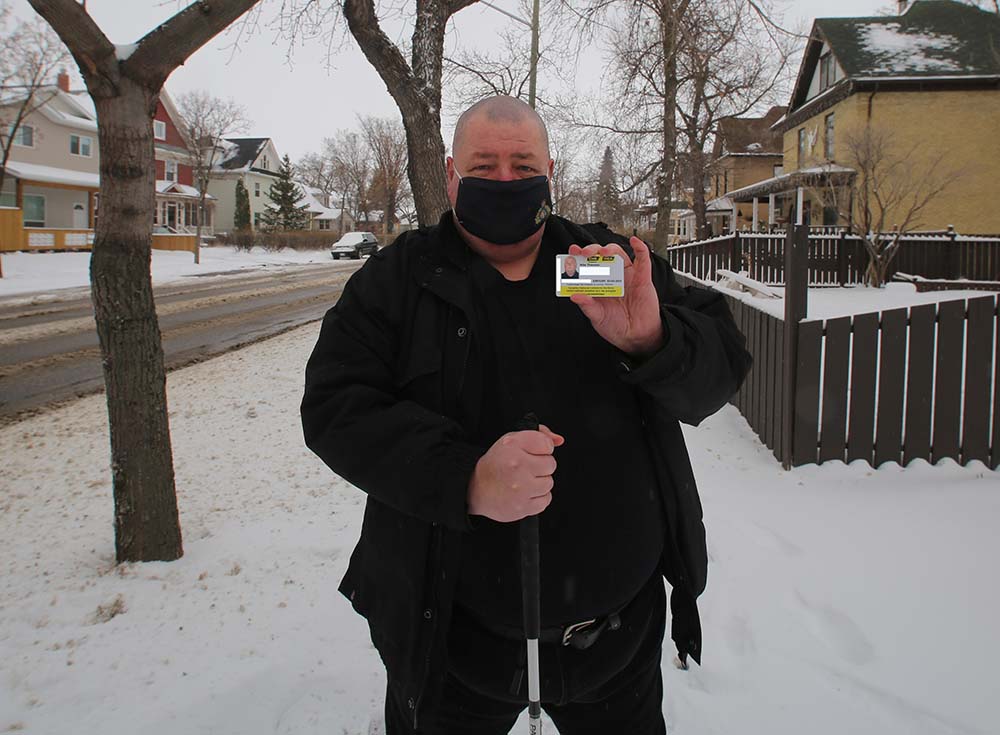
Mike Thiessen filed a complaint in April over his CNIB ID not being accepted at provincial Liquor Mart locations. When he followed up two weeks ago, he said he was told he would have to wait up to 24 months before an investigator could look at the file.
“Our system is broken,” he said.
“That’s how I felt about it. There is no legitimate argument that can be made that a two-year wait is OK. Why [are] the human rights of the citizens of Manitoba in such a low part of government movement that it’s a two-year waiting list?”
The CNIB card — provided by the CNIB Foundation, a national non-profit organization that offers programs and advocacy that “empower people impacted by blindness” — gives holders benefits like discounts and services from governments, businesses and community partners, according to its website. The ID is similar to a drivers’ licence, containing much of the same information, including a photo of the person, their name and address.
On Tuesday, the province announced it had proclaimed The Human Rights Code Amendment Act, which was passed by the legislature earlier this year.
The bill aims to speed up the complaints process and sets a cap of $25,000 on general damages that can be awarded. Currently, it can take up to six years for a complaint to move through the commission, according to a provincial press release.
Justice Minister Cameron Friesen said in the release the delays compromise access to justice and public confidence in the human rights complaints process.
The changes also allow the commission to dismiss complaints if they are outside its jurisdiction, or if they have already been addressed elsewhere.
Thiessen, who says he is completely blind in his left eye and only has 25 per cent eyesight in his right eye, uses his CNIB ID card as his main form of identification. He filed a complaint with the Human Rights Commission of Manitoba after he was denied entry to a Brandon Liquor Mart location as the system used to scan IDs does not recognize CNIB cards.
Despite this, he said he can use the ID to vote in elections, shop at cannabis stores and pick up mail from Canada Post. While he could use other forms of ID to buy alcohol, he said it is an accessibility issue for him and others with a visual impairment.
“I had to provide [Liquor Mart] with two forms of identification, which to me felt like I was less worthy being visually impaired than someone who has their visual acuity and only has to provide ID with one form of ID,” he said.
While it could be a two-year wait for the investigation to begin, the wait for a decision after that could be longer.
The amendments will speed up the human rights complaints process “considerably,” said the commission’s acting executive director, Karen Sharma. While it’s too soon to say how much quicker the process will get after the legislation takes effect on Jan. 1, the commission is currently triaging files already in the system.
The goal is to have no wait times for files within a year and a half of the new legislation taking effect, she said.
“We have known for quite a long time that this system has not been operating as efficiently or timely as Manitobans need and deserve, so we’re really looking forward to being able to implement new processes that will help streamline the system and make it more efficient.”
The amendments are based on recommendations in an independent review by Allan Fineblit. The changes will also give adjudicators the ability to mediate complaints and set time limits to make sure hearings and decisions are within a set time frame.
» dmay@brandonsun.com
» Twitter: @DrewMay_