
Labour shortages choking Brandon businesses
Advertisement
Read this article for free:
or
Already have an account? Log in here »
We need your support!
Local journalism needs your support!
As we navigate through unprecedented times, our journalists are working harder than ever to bring you the latest local updates to keep you safe and informed.
Now, more than ever, we need your support.
Starting at $15.99 plus taxes every four weeks you can access your Brandon Sun online and full access to all content as it appears on our website.
Subscribe Nowor call circulation directly at (204) 727-0527.
Your pledge helps to ensure we provide the news that matters most to your community!
To continue reading, please subscribe:
Add Brandon Sun access to your Free Press subscription for only an additional
$1 for the first 4 weeks*
- Enjoy unlimited reading on brandonsun.com
- Read the Brandon Sun E-Edition, our digital replica newspaper
*Your next Free Press subscription payment will increase by $1.00 and you will be charged $20.95 plus GST for four weeks. After four weeks, your payment will increase to $24.95 plus GST every four weeks.
Read unlimited articles for free today:
or
Already have an account? Log in here »
Hey there, time traveller!
This article was published 10/06/2022 (1556 days ago), so information in it may no longer be current.
More Brandon businesses are falling into a stranglehold induced by the country’s lowest unemployment rate since at least 1976, forcing many to scramble to maintain work efficiency and implement more drastic hiring strategies.
Canada’s job vacancy rate dropped another tick in May to 5.1 per cent after the economy added 40,000 jobs. The gain in jobs came as the number of full-time positions grew by 135,000, while part-time employment dropped by 96,000, according to Statistics Canada.
In Manitoba, the unemployment rate sits at five per cent, according to a report by StatCan in April.
Yet, Brandon is still contending with mass vacancies; businesses in hospitality, service and skilled trades are experiencing the depth of the labour shortage, according to Tanya LaBuick, president of Brandon Chamber of Commerce.
“It’s an issue facing Brandon and our province. And from everything I’ve read, it’s a global issue,” LaBuick said about the labour shortage. “It’s been on our agenda for a while.”
LaBuick said the COVID-19 pandemic, which drastically halted the country’s immigration flow, also pushed many of those who were already contemplating retirement to jump ship from the workforce.
“We’ve been very vocal with [the provincial government] to increase our immigration,” she said.
“Businesses are employing different strategies [to recruit employees], reducing hours and the days they’re open and they’re also people who are hiring people they normally wouldn’t.”
Chuck Judd is down six employees right now.
His company, Jamieson-Judd Ltd., relies on educated tradesmen to fill out its apprentice and journeyman staff, meaning he’s unable to alter his hiring process.
“It narrows our field,” he said.
He’s feeling the brunt of the generational transition, as older employees have dipped into retirement, leaving Judd to hire younger workers. He takes on a few students each year from Assiniboine Community College’s construction electrician program, which pushes out 16 new electricians each year.
Those apprentices help manage the workload, but it’ll be a few years before they’re full-fledged journeymen, capable of running a job site.
Judd’s biggest problem right now, he said, is workflow and acquiring electronic goods and materials, which are months behind on shipping.
While his shorthanded crew has been able to stay busy with smaller jobs, his concern is for the near future when he has the material to resume bigger jobs.
“We’re getting kind of worried,” he said. “We know we have work coming up that we’re going to have a tough time getting done efficiently.
“The whole industry is changing now. The labour shortage — we were warned about this 20 years ago. Now it’s coming true.”
James Chambers, while he hasn’t seen his staff’s efficiency take a hit, has had to reduce the workload as a result of not having enough people to work.
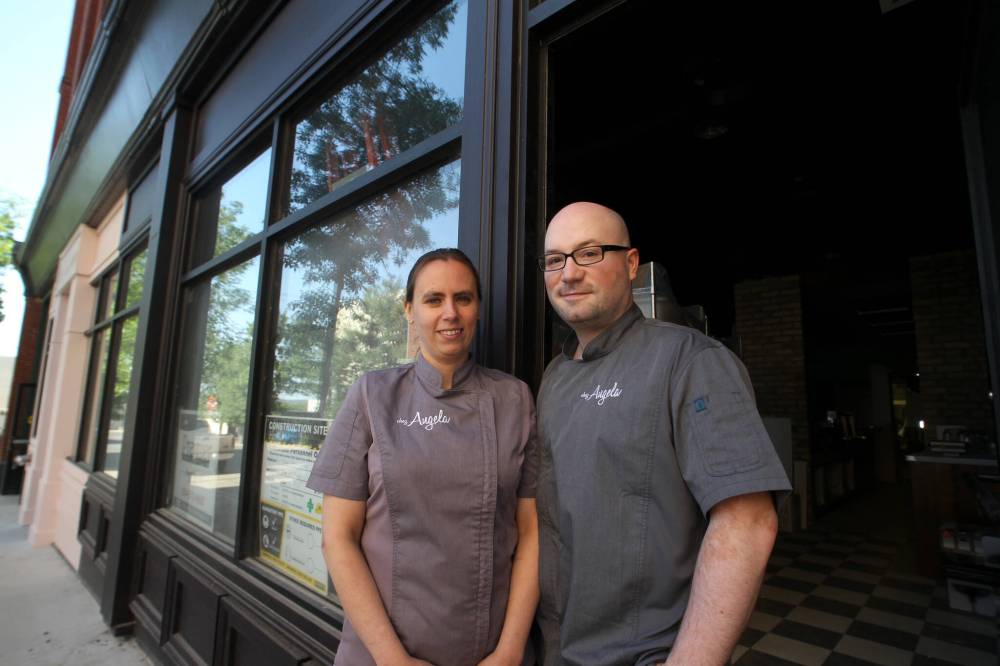
His restaurant, Chez Angela Bakery and Café, is closed on Mondays now and has reduced work and store hours, causing business to drop by up to 15 per cent.
He’s just three short of his baseline of 26 employees, but is also training five new staff, who have to get up to speed on the menu and workflow.
Chambers, the co-owner of Chez Angela Bakery and Café, said he could take on luncheon orders for up to 250 people pre-pandemic on as low as a 24-hour notice. Now, he asks that clients give him upwards of a week to prepare the food.
While his staff still works efficiently, they don’t have time to do necessary prep during down time, leaving them to scramble when large orders come in.
“Those pockets of time have pretty much dematerialized,” he said.
“When someone calls to say they need 100 sandwiches, we’re looking around like ‘we still have to roast the beef before we even think about cutting it.’”
Chambers has also had to change his hiring process.
More people are leaving and are less interested in the hospitality industry, he said, leaving a difficult hiring process.
When he posted a job opening before the pandemic, he had over 100 qualified applicants rush in within 10 days. Now, a job could stay posted for more than a month while seeing just a “handful” of qualified applications come through.
He’s had to re-strategize what he wants in an ideal employee.
“We’ve had to focus on different areas: a strong desire to work and a strong commitment to learning. Instead of looking within the industry for help, now we’re turning outside of the industry to recruit people.”
He said the province’s nation-low minimum wage is a reason for a decline in interest, and makes Manitoba less appealing to those outside of the province to join the hospitality industry.
Chambers has also noticed a generational difference from when he was looking for his first job versus teenagers and young adults now.
“I feel like there’s that entire demographic that is no longer interested in that first job until later in life.
“I don’t know when that changed but in times of looking for workers, it’s one of those painfully obvious things.”
Manitoba’s unemployment rate among 15- to 24-year-olds is 10.1 per cent, according to a Statistics Canada survey in April. That number is down 4.8 per cent since April 2021.
The pandemic didn’t help push teens to find work — many job opportunities dried up throughout the pandemic, and with little entertainment open at its peak, the incentive to make money may have diminished.
While Chambers hopes the pool of prospective employees refills, he’s focused on taking care of the ones already under his umbrella.
“We really feel like we have resilient staff. And we’re encouraging other small-business owners to make sure they’re taking care of their staff because of how essential they are to keeping a small business running,” he said.
“It’s the only thing you can do as an employer and I think we’re going to survive in the longer-term as a result.”
» jfrey-sam@brandonsun.com
» Twitter: @jfreysam