
Liberals, NDP strike confidence agreement
Advertisement
Read this article for free:
or
Already have an account? Log in here »
We need your support!
Local journalism needs your support!
As we navigate through unprecedented times, our journalists are working harder than ever to bring you the latest local updates to keep you safe and informed.
Now, more than ever, we need your support.
Starting at $15.99 plus taxes every four weeks you can access your Brandon Sun online and full access to all content as it appears on our website.
Subscribe Nowor call circulation directly at (204) 727-0527.
Your pledge helps to ensure we provide the news that matters most to your community!
To continue reading, please subscribe:
Add Brandon Sun access to your Free Press subscription for only an additional
$1 for the first 4 weeks*
- Enjoy unlimited reading on brandonsun.com
- Read the Brandon Sun E-Edition, our digital replica newspaper
*Your next Free Press subscription payment will increase by $1.00 and you will be charged $20.95 plus GST for four weeks. After four weeks, your payment will increase to $24.95 plus GST every four weeks.
Read unlimited articles for free today:
or
Already have an account? Log in here »
Hey there, time traveller!
This article was published 22/03/2022 (1672 days ago), so information in it may no longer be current.
The federal political landscape in Canada shifted Tuesday morning after Prime Minister Justin Trudeau and NDP Leader Jagmeet Singh announced they had signed a confidence and supply agreement until 2025.
Essentially, the deal means NDP MPs will vote with the Liberals on confidence votes and budgets in exchange for policy concessions in the current minority Parliament.
They will prioritize work on a dental-care program for low-income Canadians, national pharmacare, affordable housing, phasing out subsidies for fossil fuels, forbidding the use of replacement workers in federal industries during strikes or lockouts and supporting Indigenous communities that wish to undertake burial searches at the former sites of residential schools.
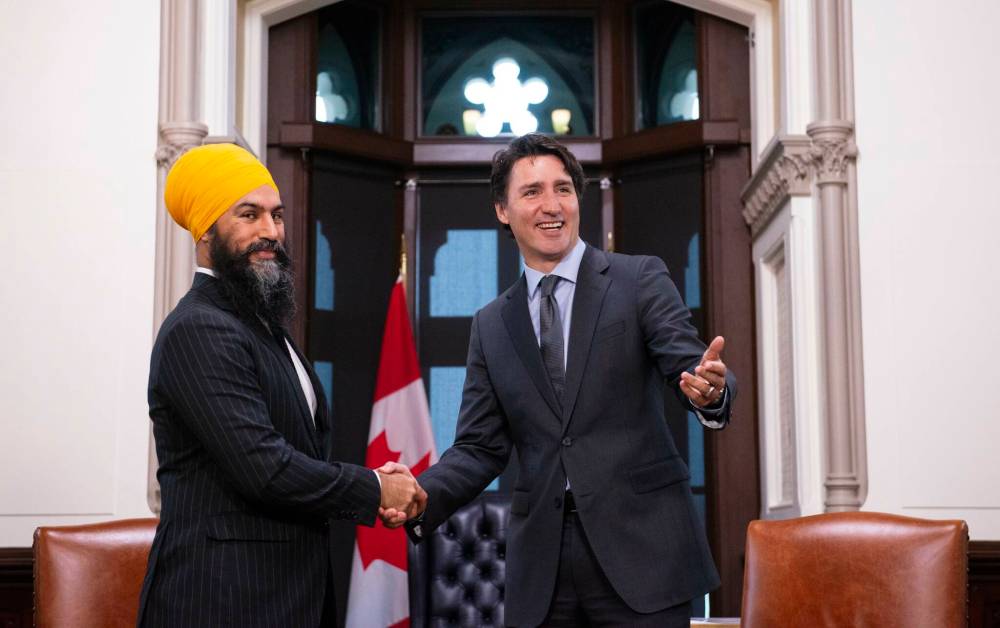
“The message from Canadians was as clear as the mandate they gave Parliament: work together to put people and families first, deliver results and build a better future,” Trudeau said. “What this means is that during this uncertain time, the government can function with predictability and stability, present and implement budgets and get things done for Canadians.”
Trudeau said the deal would focus on issues on which the parties agree rather than disagree. On areas where the Liberals and NDP do not agree, such as a potential increase in defence spending in response to Russia’s attack on Ukraine, the prime minister said such situations will be managed on a case-by-case basis.
“In the areas where there is no agreement, we will continue to do the things that the Liberal party was elected to do,” he said. “And we’ll look for support from other parties as necessary as we move forward.”
At a news conference of his own, Singh also underscored the importance of co-operation to help Canadians, saying on-again, off-again negotiations had been underway since the 2019 election, which handed the Trudeau Liberals their first minority.
“Everyone I talked to, people are telling me that they need help now,” he said. “And they expect politicians to deliver that help. And that’s exactly what we’re doing. We’re using our power to get help to people.”
In Westman, both Conservative members of Parliament came out against the agreement.
“The NDP proactively agreeing to support the next four Liberal budgets, without knowing what is contained within them, is an extraordinary move,” Brandon-Souris MP Larry Maguire told the Sun in an email.
“Particularly for an opposition party. While it may not be an official coalition, the end result is the same. The Liberals now have a working majority without needing to win a majority of the seats in the House of Commons.”
He said this agreement means the NDP is putting a lot of trust in the Liberals and the prime minister to keep their word. However, he has learned over the past six years that Trudeau’s actions and words don’t always align.
“They’ve basically done a backroom deal at the expense of democracy,” Dauphin-Swan River-Neepawa MP Dan Mazier said. “It’s terrible. It’s so in your face. It’s brazen.”
He said after question period on Tuesday, Conservative House leader John Brassard lobbied the Speaker to rule on how this will affect business in the House and in committees if the NDP is essentially no longer part of the opposition.
The agreement is unprecedented at the federal level, Mazier said. Even though similar deals have happened at the provincial level, this was a case of two party leaders in trouble trying to salvage their positions.
“There was a reason why the NDP were the third party in opposition,” Mazier said. “There was a reason why the Liberals didn’t get the popular vote.”
Though the Opposition Conservatives and interim party leader Candice Bergen have been saying the agreement means Canada now has a Liberal-NDP coalition government, Brandon University political science Prof. Kelly Saunders said that isn’t the case.
An actual coalition government would have seen NDP members of Parliament more closely integrate with the Liberals, taking up cabinet positions.
“The Conservatives know that,” Saunders said. “But they’re using that language to score some political points.”
A notable recent example in a similar parliamentary democracy was in the United Kingdom between 2010 and 2015, where the U.K. Conservatives and the Liberal Democrats forged a coalition after an election where no single party had a majority.
In that case, Conservative Leader David Cameron became prime minister while Liberal Democrat Leader Nick Clegg became deputy prime minister.
The current situation is more similar to what happened in British Columbia in 2017, when that province’s NDP and Green Party signed a confidence and supply agreement after the minority Liberal government was defeated in a confidence vote.
While the Conservatives have referred to the agreement as a power grab, Saunders doesn’t agree. She sees it as normal business for a minority government, especially since every political party’s goal is to earn and maintain power.
It is still the Liberal government and the executive branch, the prime minister and the ministers that introduce legislation that determines the budget.
“That being said, being in a minority situation — as we know — with confidence votes the party in power has to get over 50 per cent plus one [votes in the House of Commons] in order to stay in government.
“They don’t have enough votes from their own caucus, so that means that they’re always shopping for votes.”
Despite the agreement seemingly ensuring the Liberals will be able to govern a full term, Saunders said she believes the agreement is something the Conservatives can make hay out of.
In 2008, a failed attempt between the Liberals, NDP and Bloc Québécois allowed Stephen Harper to earn his party a majority in the subsequent election.
“That played really well for them,” Saunders said. “They won a massive majority in 2011, so they were able to really act on that.”
This agreement buys the Conservatives, whoever their next leader is, time to prepare and rebrand heading into the next election, she said.
» cslark@brandonsun.com, with files from The Canadian Press
» Twitter: @ColinSlark