
Manitoba receiving 900 doses of vaccine
Advertisement
Read this article for free:
or
Already have an account? Log in here »
We need your support!
Local journalism needs your support!
As we navigate through unprecedented times, our journalists are working harder than ever to bring you the latest local updates to keep you safe and informed.
Now, more than ever, we need your support.
Starting at $15.99 plus taxes every four weeks you can access your Brandon Sun online and full access to all content as it appears on our website.
Subscribe Nowor call circulation directly at (204) 727-0527.
Your pledge helps to ensure we provide the news that matters most to your community!
To continue reading, please subscribe:
Add Brandon Sun access to your Free Press subscription for only an additional
$1 for the first 4 weeks*
- Enjoy unlimited reading on brandonsun.com
- Read the Brandon Sun E-Edition, our digital replica newspaper
*Your next Free Press subscription payment will increase by $1.00 and you will be charged $20.95 plus GST for four weeks. After four weeks, your payment will increase to $24.95 plus GST every four weeks.
Read unlimited articles for free today:
or
Already have an account? Log in here »
Hey there, time traveller!
This article was published 10/12/2020 (2109 days ago), so information in it may no longer be current.
Ottawa approved one of two COVID-19 vaccines and enough doses for roughly 900 prioritized Manitobans will be headed this way as early as next week.
Critical care workers will be first in line.
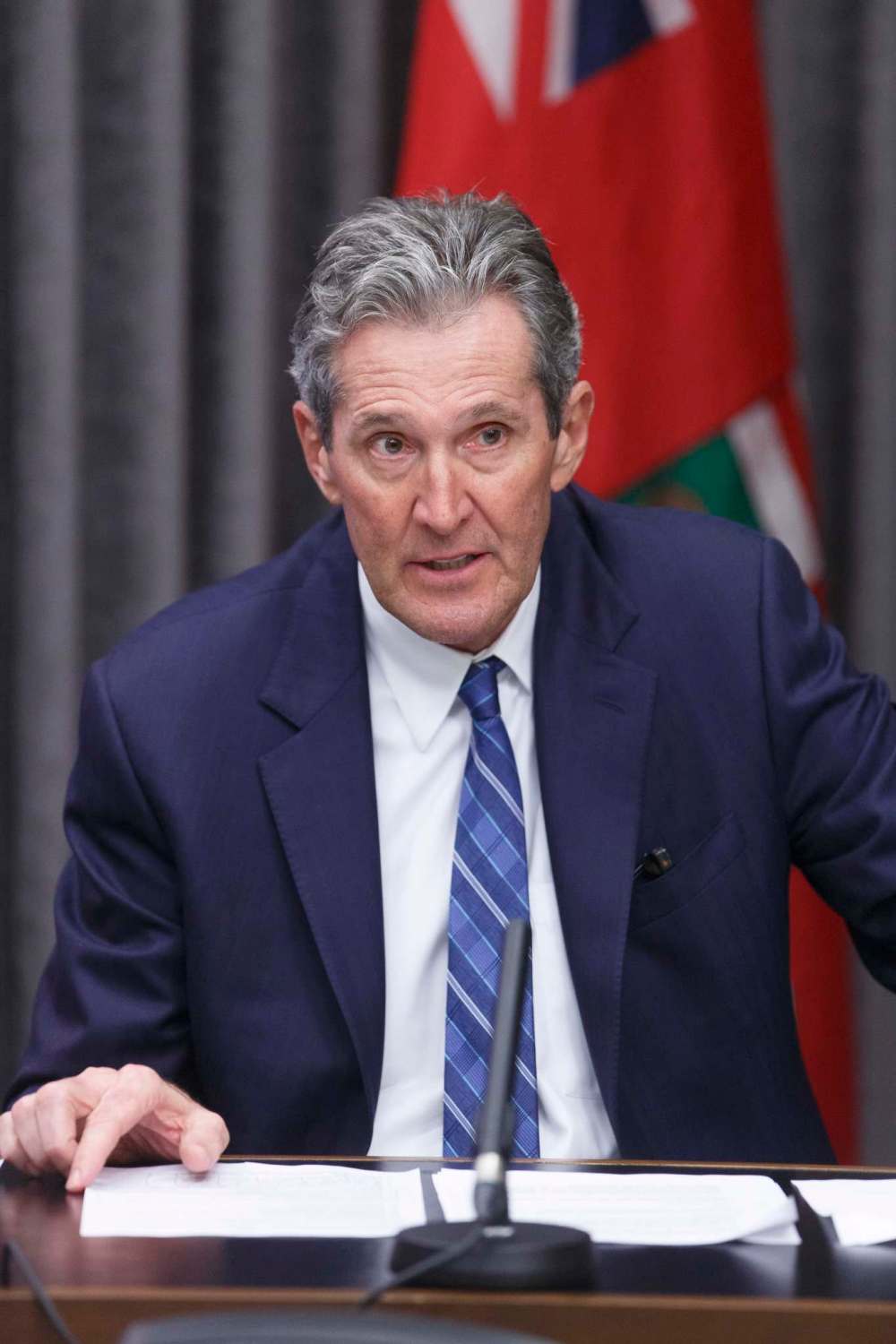
That’s according to Premier Brian Pallister and chief public health officer Dr. Brent Roussin at Wednesday’s daily COVID-19 update.
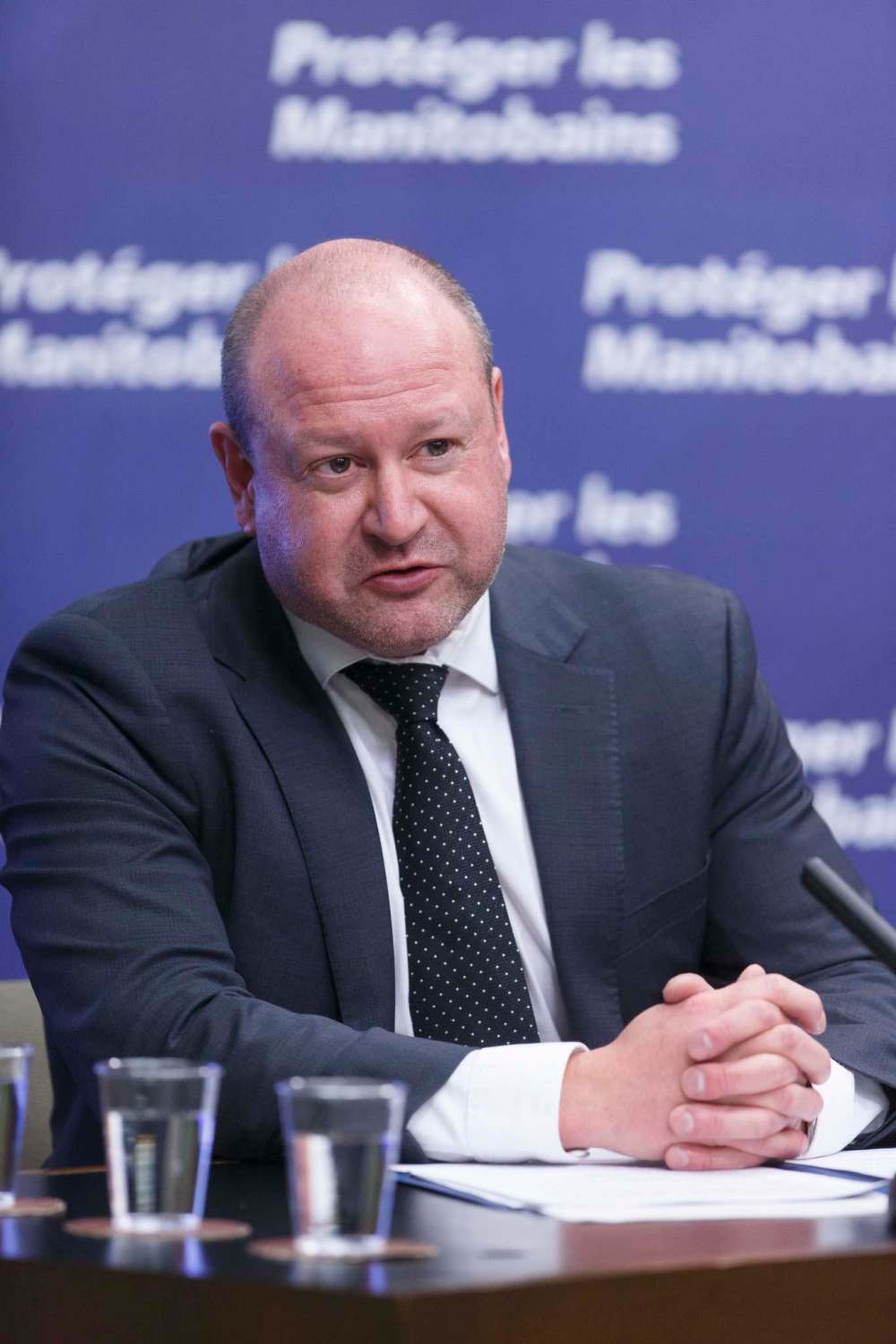
The first approved vaccine of choice is from Pfizer, which requires two doses three weeks apart. The approval was announced the morning of the Pallister-Roussin news conference. That vaccine requires storage at -80 C, and the province is set with the required equipment to ensure that storage.
Roussin said the province is slated to receive 1,950 doses. He hopes to get needles into arms within five days of delivery.
By January, the province should be equipped to store one million doses.
More shipments of vaccines, including the yet-to-be approved Moderna vaccine, are expected to arrive later this month or in early January. Reports indicate Moderna will also be ready to ship in December or January, depending on approval.
The first rollout looks to the end of March for those prioritized, and Manitoba is set to receive 228,000 during that period. That amounts to roughly 100,000 vaccinated. Roussin said 60 per cent of the population need to be vaccinated for “herd immunity.” That will require 821,400 Manitobans to be vaccinated.
The goal is to have every Manitoban who wants the vaccine to receive it by the end of 2021.
Priority groups, as recommended by the National Advisory Committee on Immunization, working with public health experts across the country through the Federal/Provincial/Territorial Special Advisory Committee on COVID-19, include:
• health-care workers most directly involved in the COVID-19 response;
• seniors in congregate living settings such as long-term care facilities, assisted living facilities, retirement homes and chronic care hospitals;
• older adults starting at 80 years of age and older; and
• adults at risk in remote or isolated Indigenous communities.
A first vaccination site had a dry run Tuesday in Winnipeg. It was successful. More sites are planned at Winnipeg, Brandon, Thompson, Steinbach, Gimli, Portage la Prairie and The Pas over the next three months.
When he spoke at the update, Pallister mentioned First Nations and Métis a few times.
“Yesterday, I was able to pass on my thanks to our Indigenous leadership, and I know that they were pleased with the announcements that we were able to make yesterday about the additional 9,600 doses of Moderna vaccine and one that doesn’t require the super cold fridges to protect our First Nations communities,” he said.
“It’s one that can be transported to communities more readily. So we were able to get those additional doses. I thank the federal government and I think our Indigenous leadership in Manitoba for their ongoing efforts, their work in their communities and elsewhere.”
But several Indigenous leaders don’t quite see eye to eye with Pallister.
The Southern Chiefs’ Organization stated it is pleased to learn the federal government earmarked 15 per cent more of the Moderna COVID-19 vaccine for Manitoba than originally allocated.
“We commend a political leader who listens to the First Peoples of Canada, and we have to give credit when it is due,” SCO Grand Chief Jerry Daniels stated Wednesday.
“By getting more vaccines to First Nation people and communities, Prime Minister Trudeau is showing leadership on the pandemic, which has been lacking in this province.”
The SCO went on to state that for months it has been sounding the alarm about COVID-19 and its disproportionate impacts on southern First Nations and their people, including those living off-reserve and those who are incarcerated.
“Those warning signals were all but ignored by the Pallister government. The premier went so far as to state that non-Indigenous Manitobans would be short-changed when it comes to vaccines because of the province’s large Indigenous population,” the SCO stated.
Brokenhead Ojibway Nation Chief Deborah Smith stated that what Ottawa is doing should be a lesson for the premier of Manitoba.
“Instead of creating division, the federal government is looking for solutions, and acknowledging the systemic gaps that have been created when it comes to health care delivery for First Nations. Clearly, the premier is in need of sensitivity training on First Nation peoples and what we have been through during this country’s history, the ways in which colonization continues to impact us to this day, and our expectations of his behaviour if we are ever going to move towards true reconciliation as Treaty partners. We would be happy to support him in his learning journey, he only needs to ask,” she added.
Meanwhile, Manitoba Metis Federation president David Chartrand is simply angry. The federation represents roughly 125,000 registered Manitoba Métis.
Chartrand said, though the Indigenous leaders’ meeting was cancelled, Pallister did not invite the MMF to the table to discuss. As the Winnipeg Free Press reported, Pallister cancelled the planned meeting after Daniels and his Northern counterpart demanded Pallister apologize for stating that a federal recommendation to prioritize Indigenous communities would put other Manitobans “at the back of the line” for the vaccine.
“He excluded the Manitoba Metis Federation,” Chartrand said.
“For him now to say he’s advocating for Métis — which Métis is he talking about? Because he’s not consulting us. He’s not talking to us. No one in any of his departments are talking to us about strategy.”
Further, Chartrand said the province isn’t sharing data with the federation, that it refuses to enter into a data sharing agreement, similar to the agreements with other Indigenous Peoples. The province wanted to use an aggregate system through self-identification.
Chartrand said anyone can self-identify as Métis, and ask for a priority vaccine.
“But how does he know they’re Métis,” he asked.
For now, all information relation to COVID-19 and the Métis population is learned word of mouth.
“We know our citizens are dying. That we know for a fact,” Chartrand said, adding that’s why the federation created a financial support program, offering up to $5,000 for Métis families to help cover the costs of funerals or memorial services.
“So for him now to raise the issue of the Métis … Who is he speaking of? Who is he talking about? He’s going to go into a village and say, ‘OK, you’re Métis, I’ll give it (the vaccine) to you?’
Chartrand is angry for another reason. Pallister’s behaviour means he has to advocate more strongly for Métis, and he has no desire to appear selfish. He said he cares about all Manitobans — but the fact remains, as with other Indigenous populations, that many Métis are vulnerable.
One older couple, to whom the MMF provided a grant to update aspects of their home, have both died, Chartrand said. He only learned of this when the couple’s children called to ask what would happen with the unfinished work now that their parents had both died.
The SCO stated it will continue to advocate for First Nation inclusion during the decision-making process to ensure its peoples’ needs are prioritized for vaccine distribution.
More vaccination details will be forthcoming in coming days, said Pallister.
“We cannot let our guard down. The cavalry isn’t here yet, and we have to make sure that we’re defending one another every day,” Pallister said about the long, slow rollout.
He repeated the messages Roussin has been repeating every day for some time now: stay home, only leave for essential reasons, reduce contacts, wear masks and wash hands.
» mletourneau@brandonsun.com
» Michele LeTourneau covers Indigenous matters for The Brandon Sun under the Local Journalism Initiative, a federally funded program that supports the creation of original civic journalism.
FACT FILE:
Wednesday’s provincial COVID-19 numbers
Dr. Brent Roussin, Manitoba’s chief public health officer, reported 18 deaths Wednesday — a female in her 80s from the Prairie Mountain Health region and linked to the outbreak at Grandview Personal Care Home.
That brings total deaths to 438 — 2.23 per cent of the 19,655 lab-confirmed cases Manitoba has seen since the beginning of the pandemic.
The five-day provincial COVID-19 test positivity rate is 13.5 per cent provincially, while Winnipeg’s is 14.5 per cent.
There were 280 new cases of the virus.
• 27 cases in the Interlake-Eastern region
• 19 cases in the Northern region
• 15 cases in the Prairie Mountain Health region
• 26 cases in the Southern Health-Santé Sud region
• 193 cases in the Winnipeg health region.
There are 5,348 active cases and 13,869 recovered.
There are a reported 194 active cases in the Prairie Mountain Health region, with 983 recovered and 24 deaths. There are no patients in ICU in the region and six are hospitalized.
Brandon reportedly has 98 active cases, four more than yesterday.
Three hundred people are in hospital in Manitoba, with 38 people in intensive care.
Laboratory testing numbers show 1,862 tests were completed Tuesday, bringing the total number since early February to 377,623.
» Source: Province of Manitoba