
Panellists discuss rural Manitoba’s economic future
Advertisement
Read this article for free:
or
Already have an account? Log in here »
We need your support!
Local journalism needs your support!
As we navigate through unprecedented times, our journalists are working harder than ever to bring you the latest local updates to keep you safe and informed.
Now, more than ever, we need your support.
Starting at $15.99 plus taxes every four weeks you can access your Brandon Sun online and full access to all content as it appears on our website.
Subscribe Nowor call circulation directly at (204) 727-0527.
Your pledge helps to ensure we provide the news that matters most to your community!
To continue reading, please subscribe:
Add Brandon Sun access to your Free Press subscription for only an additional
$1 for the first 4 weeks*
*Your next subscription payment will increase by $1.00 and you will be charged $20.00 plus GST for four weeks. After four weeks, your payment will increase to $24.00 plus GST every four weeks.
Read unlimited articles for free today:
or
Already have an account? Log in here »
Hey there, time traveller!
This article was published 07/04/2022 (1435 days ago), so information in it may no longer be current.
A trio of economic heavy hitters discussed the future of rural Manitoba during a panel discussion at the Brandon Chamber of Commerce’s monthly luncheon on Thursday.
Taking the stage at the Clarion Inn and Suites were Manitoba Chambers of Commerce president Chuck Davidson, Rural Manitoba Economic Development Corporation CEO Margot Cathcart and Economic Development Minister Cliff Cullen.
On top of the discussion, Cullen took time during the event to announce the economic development corporation’s annual budget would be raised from $650,000 to $1 million in this year’s provincial budget.
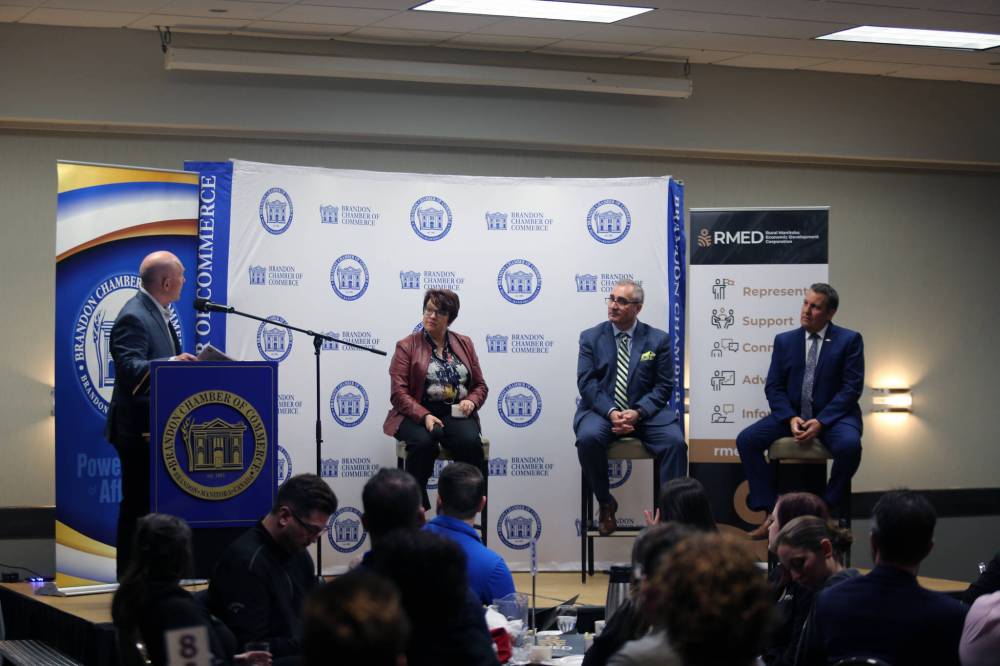
Panel host and Brandon chamber president Barry Cooper started off by asking the guests how public and private organizations can work together to promote sustainable social and economic growth in rural areas.
“People need to come to the table and be willing to roll up their sleeves and work,” Cathcart said. “We need to take a look at what each other is doing and respect the fact that we’re coming together with different ideas and skills and knowledge and at the end of the day, we can create fabulous communities by building on all those individual strengths.”
From a government perspective, Cullen said Premier Heather Stefanson is creating an economic development committee at the cabinet level that she will chair and he will vice-chair, with the aim of making those connections at the speed at which business moves.
The province is also creating an economic development secretariat around that committee to connect people in government with contacts in the private sector to develop contracts.
When provincial budget announcements are made next week, Cullen said a premier’s economic advisory committee will be formed with 12 to 15 people from the private sector. Together, these elements will bring together people in the public and private spheres to discuss taxation, investment and economic development to inform policy decisions.
When it comes to factors impeding economic development, Cooper brought up rural internet connectivity, which he said had become readily apparent since the pandemic started.
“My own business hosted farm families who pulled into our parking lot in the evening to download their schoolwork because their internet was so bad,” he said.
Cullen acknowledged there’s a lot of work to do on that front, but pointed to an agreement his government signed with internet service provider Xplornet in November 2021 to extend broadband service to approximately 30 First Nations communities and 350 rural and northern communities.
“From the pandemic, the one big takeaway that we get from the chamber perspective is one of the challenges that businesses are dealing with is technology,” Davidson said. “The pandemic has probably put us 10 years ahead of where we were. I think businesses nowadays recognize they can’t just have a brick-and-mortar store, they need to have an online presence. They need to be able to get to their clients.”
Conservations around infrastructure at the business level used to be about roads, highways and bridges, he said. Now, Davidson argues what businesses need for infrastructure is more technology. Because of that, the Manitoba Chambers of Commerce has a grant program to help businesses with technology.
Cooper then asked the panellists a question that has been on the minds of many businesses: how does Manitoba address its needs for skilled labour?
According to Davidson, it’s an issue that comes up no matter which business he talks to.
“The challenge is right now that if you’re an employee looking for work, it’s like buying a house,” he said. “It’s like a bidders’ war to get people to come to your organization. We’re seeing organizations that are putting in place incentives and bonuses and things to get people in the door.”
To address that problem, Davidson said his organization is promoting training, the ability to work from home and improving immigration.
Though businesses were challenged last year, Cullen said Manitoba’s gross domestic product actually increased by 4.1 per cent and Manitoba has the second-lowest unemployment rate in Canada.
The next big chamber event is its sold-out awards gala on April 14.
After being postponed due to COVID-19 in January, the state of the province address by Stefanson will take place on April 28.
» cslark@brandonsun.com
» Twitter: @ColinSlark