
Manitobans asked to squeal on invasive pigs
Advertisement
Read this article for free:
or
Already have an account? Log in here »
We need your support!
Local journalism needs your support!
As we navigate through unprecedented times, our journalists are working harder than ever to bring you the latest local updates to keep you safe and informed.
Now, more than ever, we need your support.
Starting at $15.99 plus taxes every four weeks you can access your Brandon Sun online and full access to all content as it appears on our website.
Subscribe Nowor call circulation directly at (204) 727-0527.
Your pledge helps to ensure we provide the news that matters most to your community!
To continue reading, please subscribe:
Add Brandon Sun access to your Free Press subscription for only an additional
$1 for the first 4 weeks*
- Enjoy unlimited reading on brandonsun.com
- Read the Brandon Sun E-Edition, our digital replica newspaper
*Your next Free Press subscription payment will increase by $1.00 and you will be charged $20.95 plus GST for four weeks. After four weeks, your payment will increase to $24.95 plus GST every four weeks.
Read unlimited articles for free today:
or
Already have an account? Log in here »
Hey there, time traveller!
This article was published 09/05/2022 (1590 days ago), so information in it may no longer be current.
The hunt for invasive swine continues to unfold with the province’s new Squeal on Pigs campaign created in partnership with Manitoba Pork.
It’s an issue that hasn’t been taken lightly by Manitoba’s agricultural sector.
“The issue with these animals are they eat anything and they are extremely destructive to the environment and ecosystem,” said Wayne Lees, co-ordinator of the Manitoba Invasive Swine Eradication Project.
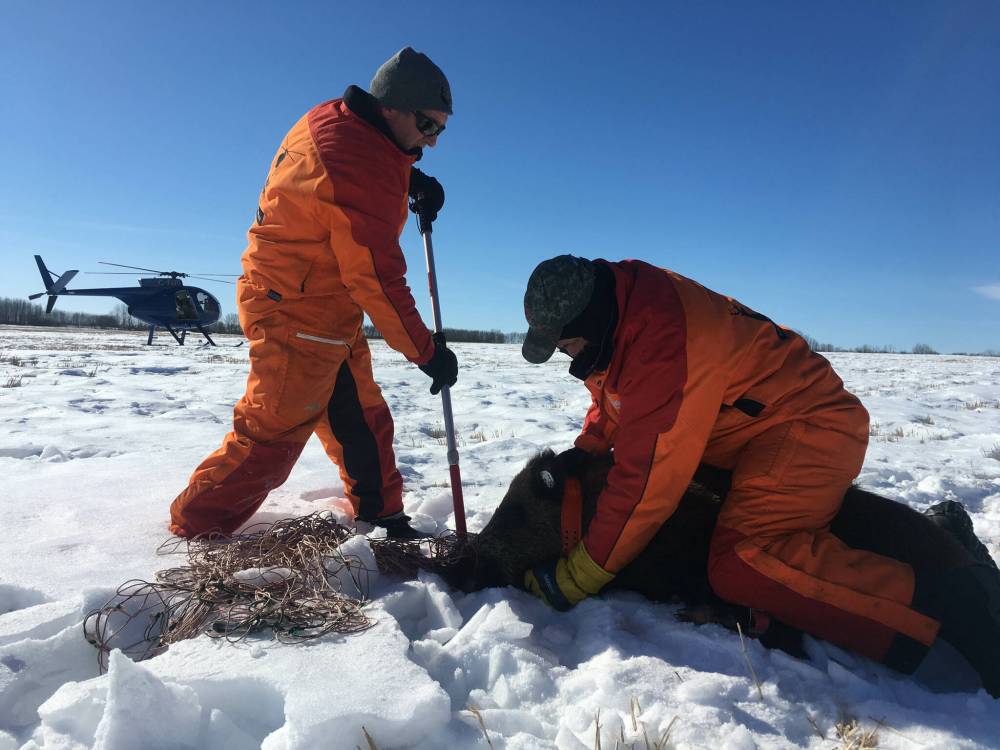
Lees described the project as a continuation of Phase 1 of what was announced in January. The first phase of the project, which is anticipated to wrap up in March 2023, is funded through the Canadian Agricultural Partnership.
He said there is currently a small group of people working on the preliminary phase of the eradication plan, to understand where the issues are and what are the techniques that are going to work to trap the invasive swine.
“[This work is done] so that the next program can be expanded to the whole population,” Lees said.
Keystone Agricultural Producers president Bill Campbell said the threat invasive swine pose is a public safety concern, and it’s time for action.
“The amount of risk they pose to ecosystems and wildlife and even the domestic pig population is quite concerning. We believe agriculture needs to work together to eradicate this threat,” Campbell said.
As previously reported by the Sun, Campbell is especially worried about the potential for these wild pigs to carry diseases such as porcine epidemic diarrhea (PED) and African swine fever. While African swine fever has not arrived in Manitoba, Campbell said control measures to stop the spread would be minimal.
“I think we need to realize the ability of these wild pigs to increase their population and give birth and adapt to the environment.”
Each sow can have up to two litters a year, and up to four to 12 piglets in the litter, according to Lees. With a lack of pig predators on the Prairies, the population is rapidly growing.
Campbell is urging people to go to the Squeal on Pigs website and report any sightings, noting the location and time. Lees said traditional means of hunting have not worked well to control the situation despite the enthusiasm for targeting the animals.
“Hunting tends to disperse them and you can never remove enough from a recreational hunting program,” Lees said.
“In Texas, hunting has been allowed for many years, and their population is exploding rather than decreasing. You need to trap the whole group.”
Quintin Pearce, general manager of P. Quintaine & Son Livestock Dealers based in Brandon, said the manoeuvrability of the animals is a key concern as they can target corrals, damage crops and display aggression toward other animals and people.
“They are definitely the vector for spreading pig diseases around because they roam around, undetected,” Pearce said.
Recently, Manitoba Pork featured Ryan Brook, an associate professor from the College of Agriculture and Bioresources at the University of Saskatchewan, as a guest speaker. His research has been instrumental over the past decade in the study and removal of these animals.
Brook said a push for wild boars in Canadian agriculture started in the 1980s to diversify the industry. Elks, emus and wild boar farms started popping up across the Prairies, and it wasn’t until 2001 in what he describes as the peak for boar use, after the animal was brought over from Europe.
He said problems began by the late 1990s following the flood of 1997 in Manitoba that released many wild pigs from flooding incidents. Noting their ability to swim, Brook said people used to cut fences and release them, as many as up to 300 at a time.
In recent years, Brook has zeroed in on Spruce Woods Provincial Park as a hot spot for invasive swine in Manitoba. Using between one to three airplanes and a helicopter, his research team makes use of an infrared camera to track sounders, which are groups of wild pigs.
“There is no one magic solution to dealing with wild pigs; you need to have multiple tools in your toolbox,” Brook said.
The procedure his team uses to catch the animals involves a judas pick, which implements a GPS-style collar on one of the pigs that will track the other wild swine and lead them to a group.
After releasing the pig embedded with the GPS-style collar, the team makes use of a system of trail camera networks that they have continued to implement for more than 12 years, collecting occurrences and sighting across Manitoba, Saskatchewan and the rest of the country.
“We are currently looking at the impacts of wild pigs on the prairie skink, which is a small lizard that you will only find in the Spruce Woods area, and looking at spatial overlap,” Brook said.
“We are interested with how they interact with livestock as well.”
While working up close and personal to the animals, Brook said his research on their fondness of Spruce Woods has led them to understand forest cover is vital for them to survive as hunters try to shoot the animals.
“Where they have survived best is where they can find large chunks of forest,” he said.
“Pigs will come out of the park, feeding on wheat, canola and especially corn and potatoes and do a tremendous amount of damage. Then they will go back into the park and hide.”
The animals will even sleep in the ditch during the day, and researchers are continuing to learn more from the GPS satellite collars. The use of an Iowa hog snare while restraining the animal’s head is combined with a net shot out of the helicopter his research team will fly from above.
It is not a job for everyone.
“These things have razor-sharp tusks and they are not afraid to use them,” he said.
“The biggest one we’ve handled was 638 pounds. They can be very large and strong. When you release it, that’s the moment of truth when your heart is beating really fast.”
Brook and his research team continue to advise Manitoba Pork and the provincial government on sightings while working to bring down the population of these dangerous animals, one pig at a time.
» jbernacki@brandonsun.com
» Twitter: @JosephBernacki