
Proof of immunization remains elusive
Advertisement
Read this article for free:
or
Already have an account? Log in here »
We need your support!
Local journalism needs your support!
As we navigate through unprecedented times, our journalists are working harder than ever to bring you the latest local updates to keep you safe and informed.
Now, more than ever, we need your support.
Starting at $15.99 plus taxes every four weeks you can access your Brandon Sun online and full access to all content as it appears on our website.
Subscribe Nowor call circulation directly at (204) 727-0527.
Your pledge helps to ensure we provide the news that matters most to your community!
To continue reading, please subscribe:
Add Brandon Sun access to your Free Press subscription for only an additional
$1 for the first 4 weeks*
- Enjoy unlimited reading on brandonsun.com
- Read the Brandon Sun E-Edition, our digital replica newspaper
*Your next Free Press subscription payment will increase by $1.00 and you will be charged $20.95 plus GST for four weeks. After four weeks, your payment will increase to $24.95 plus GST every four weeks.
Read unlimited articles for free today:
or
Already have an account? Log in here »
Hey there, time traveller!
This article was published 17/07/2021 (1907 days ago), so information in it may no longer be current.
Don Mitchell almost got his QR code tattooed to his arm.
Mitchell is a truck driver. The tattoo was going on his left arm for Canada Border ServicesAgency agents to scan on his way through the U.S. border crossing south of Boissevain.
Thank goodness he double-checked.
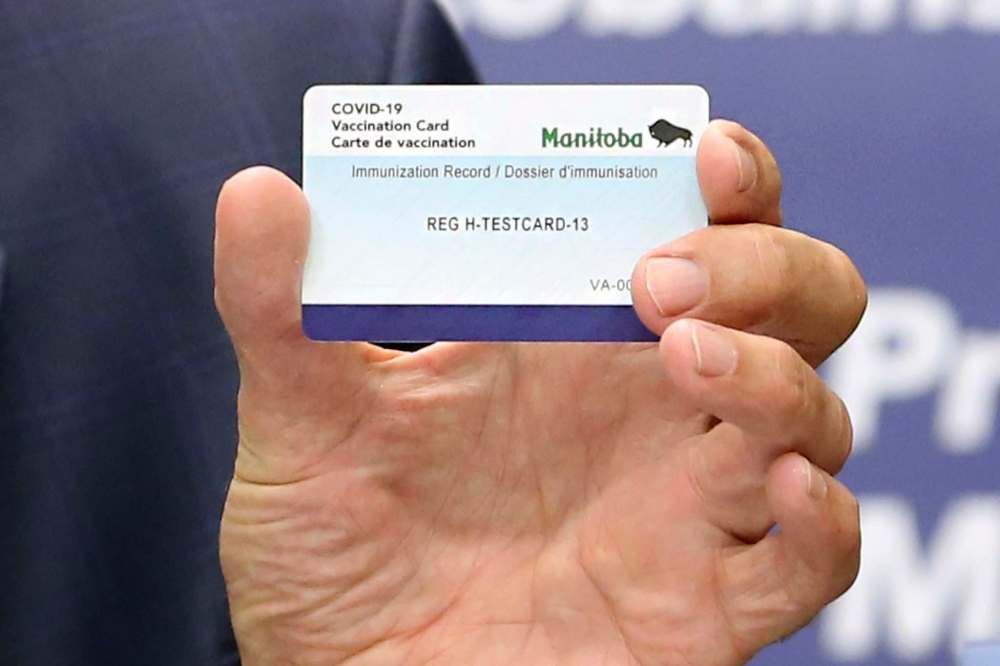
“The vaccine card is useless at the border,” he told the Sun.
The Canada Border Services Agency doesn’t have the scanners necessary to read the cards or the QR codes, he was told by border crossing agents.
“When I said I was getting a tattoo of my QR code, they said don’t bother. They’re no good.”
“The only thing they’ll accept is your immunization record.”
Mitchell is an essential worker and crosses the border twice a week so he has had access to border crossing all along.
But, he worries about the people who may think the provincial immunization card or QR code, unique to Manitoba, will allow them unfettered access back into the province once the border between the two countries opens.
Without immunization records, those people will have to quarantine for 14 days upon their return to Manitoba, he was told.
Manitoba has 12 border crossings.
A spokesperson for the province confirmed that anyone with a Manitoba immunization card app is able to scan the card. When scanned, the person’s name is displayed to the verifier so their identity can be confirmed. No personal health information or data can be displayed.
While the provincial spokesperson did not comment on the Canada Border Services Agency’s inability to scan provincial vax cards or the QR codes, the chances of a federal agency accepting a provincial vaccine identifier, are slim to none.
However, Manitobans may view their COVID-19 immunization record at sharedhealthmb.ca/covid19/test-results or contact their local public health office to receive a copy, the spokesperson said.
The Sun reached out to the Canada Border Services Agency for verification that they do not have the capability to accept provincial immunization cards or QR codes.
A spokesperson said the Public Health Agency of Canada is responsible for the Quarantine Act, as well as the Orders in Council that outlines travellers’ obligations when entering Canada, including what proof of vaccination may be accepted at the border.
“The development of vaccine passports is outside the CBSA’s mandate,” the source said, at which point they directed any further inquiries to Immigration, Refugees and Citizenship Canada.
However, the Canada Border Services Agency representative did clarify that those fully vaccinated travellers arriving by land or air who comply with specific criteria will not be required to quarantine or complete an eight-day test. However, they will continue to be required to complete mandator pre- and on-arrival testing.
Travellers who do not meet all criteria to be considered fully vaccinated are still be subject to a mandatory three-day stay at a government-authorized accommodation if they arrive by air. All testing requirements stand alongside a 14-day quarantine.
A spokesperson from Health Canada reinforced that provinces and territories own and maintain their own health registries.
But, having proof of vaccination credentials would be one tool to support the re-opening of societies and economies.
“Such credentials could help facilitate cross-border travel while minimizing the risk of importation and spread of COVID-19,” the spokesperson said.
Until that happens, Health Canada’s recommendation to provide proof of vaccination at the border is:
• Details of your first dose (date, country and vaccine you received)
• Details of your second dose if one was required (i.e., for Pfizer, Moderna, and AstraZeneca vaccines)
• A photo or .pdf file of the record of each dose of your vaccination, such as receipts, cards, or confirmations
If you received two doses and they are both recorded on a single card or .pdf, upload that same image or file for dose 1 and again for dose 2.
File formats accepted include .pdf, .png, .jpeg or .jpg, and each image upload has a two-megabyte size limit.
“Bring your original proof of vaccination with you while you travel,” the spokesperson added.
» kkielley@brandonsun.com