
Province posts small surplus for 2019-20
Advertisement
Read this article for free:
or
Already have an account? Log in here »
We need your support!
Local journalism needs your support!
As we navigate through unprecedented times, our journalists are working harder than ever to bring you the latest local updates to keep you safe and informed.
Now, more than ever, we need your support.
Starting at $15.99 plus taxes every four weeks you can access your Brandon Sun online and full access to all content as it appears on our website.
Subscribe Nowor call circulation directly at (204) 727-0527.
Your pledge helps to ensure we provide the news that matters most to your community!
To continue reading, please subscribe:
Add Brandon Sun access to your Free Press subscription for only an additional
$1 for the first 4 weeks*
*Your next subscription payment will increase by $1.00 and you will be charged $20.00 plus GST for four weeks. After four weeks, your payment will increase to $24.00 plus GST every four weeks.
Read unlimited articles for free today:
or
Already have an account? Log in here »
Hey there, time traveller!
This article was published 30/09/2020 (2011 days ago), so information in it may no longer be current.
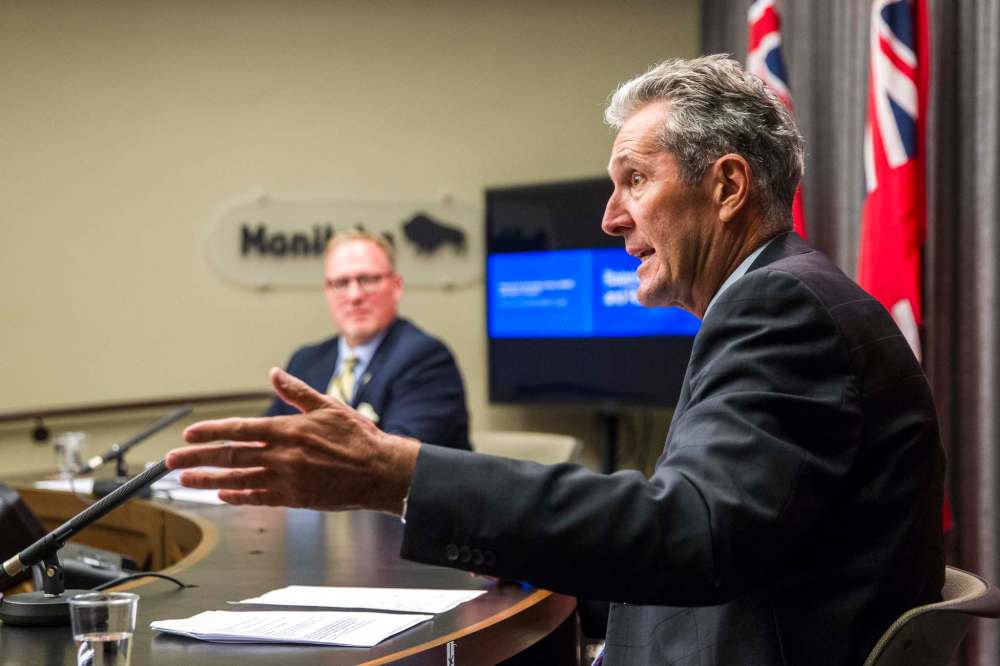
COVID-19 has eliminated the chances of it happening in the Province of Manitoba’s 2020-21 fiscal year, but Premier Brian Pallister announced on Tuesday his government ended up achieving a small surplus in the 2019-20 fiscal year.
Tuesday saw the release of several financial documents by the province, including public accounts showing a $5-million surplus in 2019-20 and a first-quarter 2020-21 fiscal update.
“We knew that we needed to turn the canoe away from the rapids and the rocks and to a safer shore,” Pallister said about the financial situation his government inherited from its predecessor when it took power in 2016 during a noon-hour media conference with Finance Minister Scott Fielding.
That’s better than originally expected for that fiscal year, with the 2019 budget estimating Manitoba would end up with a $360-million deficit.
Speaking on how a balanced budget was achieved, Pallister said his government’s philosophy has been to shop smart, know the difference between wants and needs, cut red tape, cut excess funding from the top levels of organizations and invest in front-line workers.
Because the COVID-19 pandemic only reached Manitoba in March 2020, the last month in its 2019-20 fiscal year, any financial impact caused by the virus is only minimally represented.
“COVID has handed us new challenges,” Pallister said. “Even greater ones, perhaps, than before.”
The 2020-21 fiscal year won’t be as lucky, with the premier and Fielding saying current projections estimate a $2.9-billion deficit. Before the pandemic, the government expected to only have a deficit of $220 million for that same fiscal year.
It is currently estimated the province will lose $957 million in tax revenue, $353 million in other revenues, $340 million in revenue from government business enterprises, and spend $105 million extra in health costs, $30 million extra on the risk recognition program and $933 million extra on the Manitoba protection plan and #RestartMB campaign.
Asked if the achievement of one of his signature goals would lead to his retirement, Pallister declined to comment on whether he would seek an early exit from politics or not run in the next provincial election.
It should be noted under the Fiscal Responsibility and Taxpayer Protection Act, the province cannot officially include Manitoba Hydro’s $99-million net profit for 2019-20, and the $229 million transferred to the Rainy Day Fund has to be noted as an expenditure.
That means instead of a $5-million surplus, there is a $323-million deficit when adjusted to comply with the act, below the deficit limit of $727 million the government was required to abide by.
Manitoba’s Auditor General, Tyson Shtykalo, had a statement included in the report stating from his perspective, the reported surplus should be $48 million higher because the province did not include the finances of the Workers Compensation Board. Because the WCB wasn’t included in last year’s annual financial report, he also said last year’s deficit should have been $53 million higher.
He also said the province should have included the assets of the Manitoba Agricultural Services Corporation’s production insurance trust and hail insurance trust in its 2019 and 2020 reports. If included, they would have decreased 2018-19’s surplus by $225 million and decreased 2019-20’s surplus by $10 million.
Combined, that would have led to a surplus of $23 million in 2018-19 and a surplus of $43 million in 2019-20.
The Sun asked Pallister and Fielding what the current balance of the province’s Rainy Day Fund is during the media conference, but a direct answer was not provided by either. Back in March, Pallister said the $800-million fund was likely going to be depleted within three months.
According to a page in one of the documents sent out by the province, approximately $1.8 billion had been budgeted for strategic infrastructure investments in 2019-20 but only approximately $1.4 billion was spent.
Asked about what infrastructure projects had been deferred to account for that $400-million gap, Pallister didn’t name any specific projects, but said his recent trip to Ottawa included a constructive talk with federal ministers about future infrastructure investments.
Speaking with the Sun Tuesday afternoon, Manitoba NDP Leader Wab Kinew said while the government might have a surplus, there’s plenty of evidence of the government underfunding sectors in the province.
“There’s a deficit in health care, there’s a deficit in infrastructure, there’s a deficit in education in terms of the services people are receiving,” he said. “The real-world impact of what this government’s been doing is that you can no longer go to an emergency room in Roblin. You can no longer go to an emergency room in Altona or many emergency rooms in Winnipeg. People have a lot less services and a lot less support.”
In response to Pallister and Fielding talking about having made record investments in health care, education and social services, Manitoba Liberal Leader Dougald Lamont told the Sun via phone these are results of the federal government increasing transfer payments rather than being accomplishments of the current provincial government.
He also pointed to the Auditor General’s notes on the accounts as the current government “cooking the books.”
“The way they balanced their budget if you look at how it happened, they got an absolutely colossal increase from the federal government in transfers: $354 million,” Lamont said. “On the one hand, I think the premier is trying to do a victory lap, but I think there was a lot of unnecessary pain there when the budget could have been balanced all along almost entirely thanks to increases in federal transfers and revenue.”
» cslark@brandonsun.com
» Twitter: @ColinSlark