
Study finds risky behaviour among BU students
Advertisement
Read this article for free:
or
Already have an account? Log in here »
We need your support!
Local journalism needs your support!
As we navigate through unprecedented times, our journalists are working harder than ever to bring you the latest local updates to keep you safe and informed.
Now, more than ever, we need your support.
Starting at $15.99 plus taxes every four weeks you can access your Brandon Sun online and full access to all content as it appears on our website.
Subscribe Nowor call circulation directly at (204) 727-0527.
Your pledge helps to ensure we provide the news that matters most to your community!
To continue reading, please subscribe:
Add Brandon Sun access to your Free Press subscription for only an additional
$1 for the first 4 weeks*
- Enjoy unlimited reading on brandonsun.com
- Read the Brandon Sun E-Edition, our digital replica newspaper
*Your next Free Press subscription payment will increase by $1.00 and you will be charged $20.95 plus GST for four weeks. After four weeks, your payment will increase to $24.95 plus GST every four weeks.
Read unlimited articles for free today:
or
Already have an account? Log in here »
Hey there, time traveller!
This article was published 10/10/2019 (2543 days ago), so information in it may no longer be current.
Students at Brandon University are likely to engage in unsafe sexual behaviour, a new study shows.
Three assistant professors in BU’s faculty of health studies, Nadine Smith, Candice Waddell and Jan Marie Graham, recently participated in a study with four other universities about risky behaviour among students.
In a survey of 330 BU students done for the study, 54 per cent of sexually active respondents said that they rarely or never use a condom.
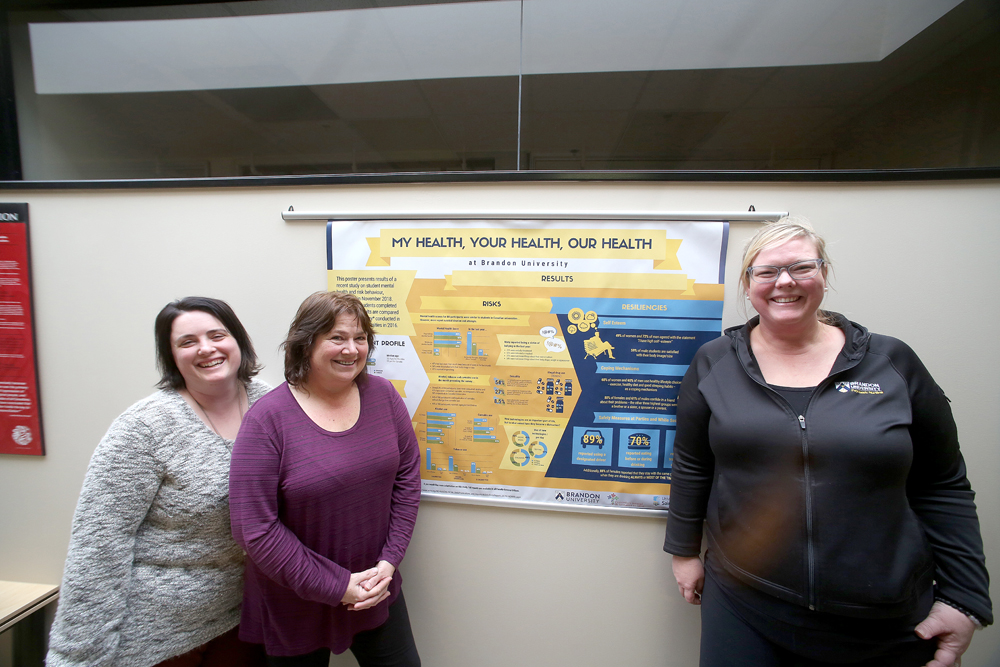
Smith, Waddell and Graham said they were surprised by that figure.
“I think even the students were surprised,” said Smith.
“I think as nurses, we’re obviously concerned about that,” said Graham. “Not just from pregnancy, but from sexually transmitted disease and stuff like that.”
She added that she didn’t believe that the accessibility of condoms is a factor in students deciding to use the devices.
Additionally, 43 per cent of students said that they use the withdrawal method for contraception.
The withdrawal method is not considered as effective as other methods of birth control and does not prevent the transmission of sexually transmitted infections because there is no barrier between bodily fluids.
Students at BU were surveyed and talked to in focus groups for the study between November 2018 and April 2019.
In terms of harassment and assault, 27 per cent of students said they’d been the subject of inappropriate sexual comments or unwanted physical contact in their lifetime.
Nine per cent of students said they had been physically forced into having sex and 13 per cent said they had been intimidated into having sex in their lifetime.
Drug use was another topic covered by the survey. Fourteen per cent of BU students said they had tried cocaine at least once and 9.5 per cent said they had tried amphetamines at least once.
In both cases, the rate of use at BU was approximately double the national average. As well, 12 per cent of students said they’d tried ecstasy at least once compared to a 10 per cent national average.
The national averages used as comparisons are taken from a 2016 national survey done of 41 Canadian universities.
It should be noted that these students said that they had tried these substances at least once in their lifetime, not necessarily during their time at BU.
Bullying was another concern addressed in the study. Forty-three per cent of students said they were ridiculed or mocked, 29 per cent said they were verbally threatened, 20 per cent were insulted based on their race or culture and 34 per cent were bullied because of their body shape, weight or appearance.
On a positive note, the study said that BU students are more likely than average to use a designated driver, with 89 per cent using one when going out drinking or partying. Seventy per cent of students said they ate before or after drinking.
Additionally, BU students rated their mental health as being better than their peers at other schools.
However, only five per cent of students said they’d accessed mental health services on campus and fewer than 10 per cent of students have sought the services of a mental health professional in the community.
The percentage of surveyed students that said they’d had suicidal thoughts or had attempted suicide was 15 per cent, more than double the national average of seven per cent.
Waddell said that figure might represent that more BU students than average are willing to be open about their mental health issues.
Of the 330 students that participated in the study, 75 per cent were female.
White students made up 63 per cent of those surveyed, while Asian students made up 10 per cent, black students made up eight per cent, 12 per cent were Indigenous and seven per cent of students identified as another ethnicity.
“(The sample) was very representative of the student population,” Waddell said.
Recently, the three professors said they met with all the deans at the university to go over findings from the study and present recommendations.
A spokesperson from the university said that the results are being taken seriously and are a focus for the school’s peer wellness educators.
Professor Danielle de Moissac at the Université de Saint-Boniface led the study, which was funded by the Consortium national de formation en santé, a francophone organization aiming to improve access to French-language health care in Canada.
Other institutions participating in the survey were the University of Ottawa, Bishop’s University, the Université du Québec en Abitibi-Témiscamingue and the Université de Saint-Boniface.
Next up for the BU professors is a followup study that they are working on a grant application for.
» cslark@brandonsun.com
» Twitter: @ColinSlark