
Vaccine eligibility expands to general population
Advertisement
Read this article for free:
or
Already have an account? Log in here »
We need your support!
Local journalism needs your support!
As we navigate through unprecedented times, our journalists are working harder than ever to bring you the latest local updates to keep you safe and informed.
Now, more than ever, we need your support.
Starting at $15.99 plus taxes every four weeks you can access your Brandon Sun online and full access to all content as it appears on our website.
Subscribe Nowor call circulation directly at (204) 727-0527.
Your pledge helps to ensure we provide the news that matters most to your community!
To continue reading, please subscribe:
Add Brandon Sun access to your Free Press subscription for only an additional
$1 for the first 4 weeks*
- Enjoy unlimited reading on brandonsun.com
- Read the Brandon Sun E-Edition, our digital replica newspaper
*Your next Free Press subscription payment will increase by $1.00 and you will be charged $20.95 plus GST for four weeks. After four weeks, your payment will increase to $24.95 plus GST every four weeks.
Read unlimited articles for free today:
or
Already have an account? Log in here »
Hey there, time traveller!
This article was published 25/02/2021 (2081 days ago), so information in it may no longer be current.
People 95 and older, as well as First Nations people 75 and older, are now eligible to receive the COVID-19 vaccine.
“I’m personally very excited to be announcing that we’re expanding into general population, and I’m looking forward to decrease the age of eligibility continually over time,” said Dr. Joss Reimer at Wednesday’s news conference.
Calls for the newly eligible can be made beginning this week, with vaccines beginning next week. The vaccine call centre, at 1-844-MAN-VACC (1-844-626-8222) now has 2,000 lines, with more than 370 trained agents. The online booking self-serve tool is in its pilot phase, but will not replace the call centre.
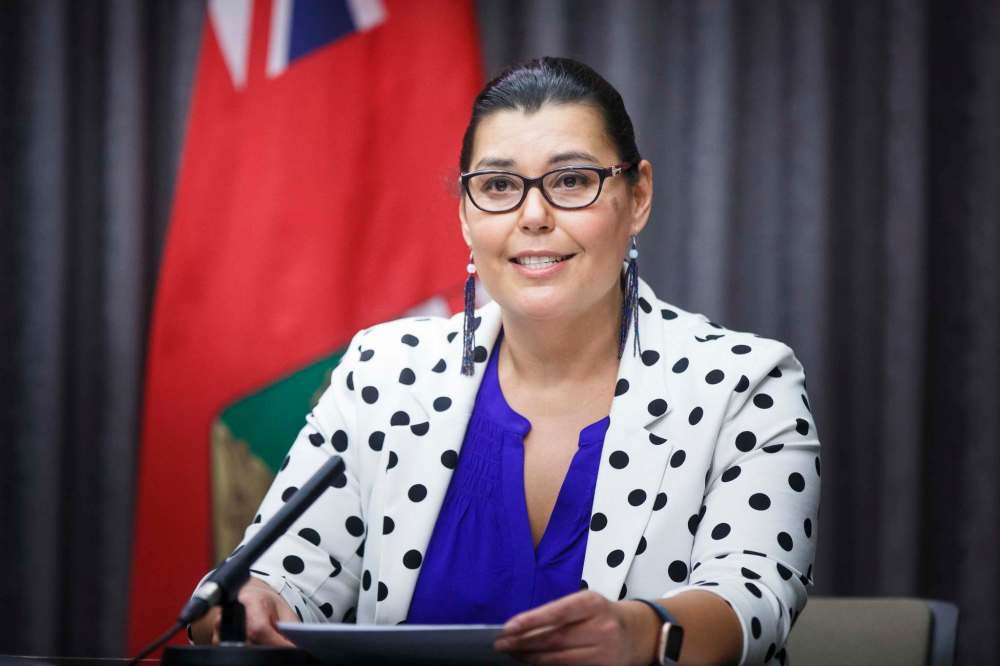
“We do know it’s possible the call centre will receive an overwhelming number of calls. We know Manitobans have been eager for this moment, and many of you are going to want to call right away,” said Reimer.
She asked that only eligible people, or the people calling for an elderly person, ensure they fit the criteria.
These days, the wait time is less than a minute on the booking line, with a call-back option. If the wait time does increase, people can opt to have their call returned rather than waiting on the phone.
Dr. Marcia Anderson, public health lead for the First Nation Pandemic Response Co-ordination Team, explained that in the coming weeks, people who call to make an appointment and self-identify as First Nations would be transferred to a member of a specialized team.
“These specialists will have additional training and cultural safety to ensure that they support callers and facilitate access to an appointment for those who are eligible,” Anderson said.
At first, self-identification will be the method by which First Nations can access the vaccine. But, in the future, because some people do falsely identify as First Nations — called “pretendians” — the system will be tightened up over time.
“This is a phenomenon that I have been aware of and had to work through in multiple different contexts, but I never imagined that one of the harmful ripple effects would be that non-registered or non-status First Nation people would face the risk of not being able to get a vaccine at a time when they rightly should be able to,” said Anderson.
In the future, First Nations people in Manitoba will be asked to verify their identity, she added.
“We want to make sure that this is done in a way that is safe for people and does not exclude our First Nations relatives, that because of the complicated and various processes of colonization, do not have Indian status cards,” she said.
If a First Nations person does not have a status card under the Indian Act, there will be an escalation process to deal with the more complex cases in a trauma-informed and culturally safe way.
Anderson reported that, as of last Friday, 7,023 doses of vaccine have been administered on-reserve — four per cent of the eligible population received first doses, while .08 per cent are fully vaccinated. Off-reserve, 2.96 per cent of the population have received one dose and .07 per cent are fully vaccinated.
Of Manitoba’s eligible population, 2.4 per cent are fully vaccinated.
As Anderson explained, First Nations have been disproportionately affected by COVID-19 — making up 54 per cent of new cases in the overall Manitoba population and 70 per cent of active cases, and the virus does affect them more harshly, as demonstrated by hospitalization rates.
The median age of death in Manitoba is 83, while in First Nations it is 66.
Meanwhile, full two-dose vaccination at personal care homes is set to wrap up this week.
“This is a tremendous accomplishment,” said Reimer, adding results are already showing.
“While we are seeing decreases in rates in the community overall, and we know that there are strong public health measures still taking place in personal care homes, we’re also seeing quite a sharp drop in the number of outbreaks happening in personal care homes.”
Additionally, the focused immunization teams began first doses at congregate living sites in Brandon and Winnipeg on Feb. 19, with regional health authorities scheduling high-priority congregate living sites starting this week. There are 1,400 congregate living sites in the province. A list of those sites can be found at bit.ly/2P9KaWX
The vaccination task force has looked ahead in terms of doses coming to Manitoba to the end of March — which Johanu Botha, co-lead for the Vaccine Implementation Task Force, said will be 15,000 Pfizer doses weekly, up slightly from the roughly 12,000 doses it is receiving currently.
“These are not large quantities,” said Botha, adding all Pfizer doses go to supersites due to the storage requirements. There are currently two supersites — in Winnipeg and Brandon — with two more scheduled to open. The plan is to open Selkirk’s site in early March and Morden/Winkler’s in mid-March.
Apart from the doses received from Moderna this week, next shipments of that vaccine are unknown.
“We have just over 8,000 doses on hand remaining,” said Botha, who added that those are tagged to complete vaccinations at personal care homes and support the congregate living campaign.
Moderna is the vaccine of choice for First Nations, due to its less stringent storage requirement. That’s concerning, said Anderson.
“We certainly want to respond to the data and have everybody — First Nations people living both on and off reserve — vaccinated as quickly as possible, especially as we start to think about heading into flood season, fire season, and what a large-scale evacuation at the same time as we’re dealing with the pandemic would mean,” she said.
But Anderson referenced Reimer’s news that Pfizer is looking into changing some of its shipping and storage restrictions. That may mean Pfizer can be used at First Nations in the future.
“And I would say my experience has been both our provincial and federal counterparts are very willing to have that dialogue,” she said.
Anderson said it’s hard to calculate First Nation uptake of the vaccine at this time.
“In general, in 61 of the 63, the anecdotal feedback that we got was that uptake was very high among those who were eligible. In one community, some further communication was needed, and support. Then uptake improved,” she said.
Anderson said the experience is much more in line with H1N1, which was higher than usual vaccine uptake.
“We’re very encouraged by this progress.”
It was also revealed at the news conference that the Manitoba Metis Federation continues to be in conversation with the province for a vaccine program targeting vulnerable Métis populations.
Reimer suggested Manitobans monitor the eligibility criteria website. The eligibility criteria will expand — sometimes quickly — by decreasing age, and can be found at bit.ly/3ssXBQb
Additionally, 213 pharmacies and doctors across the province have signed up to deliver vaccines when more, with less stringent storage needs, are approved.
The Wednesday technical briefing for media, which preceded the news conference, can be found at bit.ly/37LRuhP
» mletourneau@brandonsun.com
» Michele LeTourneau covers Indigenous matters for The Brandon Sun under the Local Journalism Initiative, a federally funded program that supports the creation of original civic journalism.
Wednesday’s covid-19 update
The COVID-19 update from the province on Wednesday included one death — a female in her 90s from the Winnipeg health region linked to the outbreak at Oakview Place Personal Care Home.
The province reported 45 new cases. However, six cases were removed due to data corrections. This brings the net-new number of cases to 39.
The new cases are as follows:
• three cases in the Interlake–Eastern health region;
• 10 cases in the Northern health region;
• one case in the Prairie Mountain Health region;
• eight cases in the Southern Health–Santé Sud health region; and
• 23 cases in the Winnipeg health region.
The five-day COVID-19 test positivity rate was 4.6 per cent in the province, and four per cent in Winnipeg.
Lab-confirmed cases in Manitoba since the beginning of the pandemic total 31,483.
The province reports 1,196 active cases, and individuals who have recovered total a reported 29,507.
The province also reported 81 people are in hospital with active COVID-19, as well as 126 people in hospital with COVID-19 who are no longer infectious but continue to require care, for a total of 207 hospitalizations.
Eleven people are in intensive care units with active COVID-19, as well as 18 people with COVID-19 who are no longer infectious but continue to require critical care, for a total of 29 ICU patients.
In the PMH region, there are a reported 20 active cases, with 1,984 recovered. There are two active cases hospitalized, and five people hospitalized who are no longer infectious. There is one patient in ICU. The region has seen 53 deaths.
Brandon’s active case count is nine, with 971 recovered and 22 deaths.
On Tuesday, 1,805 tests were completed, for a total of 517,602 since February 2020.
» Source: Province of Manitoba