
Quebec flooding: Bodies of firefighters found two days after being swept away
Advertisement
Read this article for free:
or
Already have an account? Log in here »
We need your support!
Local journalism needs your support!
As we navigate through unprecedented times, our journalists are working harder than ever to bring you the latest local updates to keep you safe and informed.
Now, more than ever, we need your support.
Starting at $15.99 plus taxes every four weeks you can access your Brandon Sun online and full access to all content as it appears on our website.
Subscribe Nowor call circulation directly at (204) 727-0527.
Your pledge helps to ensure we provide the news that matters most to your community!
To continue reading, please subscribe:
Add Brandon Sun access to your Free Press subscription for only an additional
$1 for the first 4 weeks*
- Enjoy unlimited reading on brandonsun.com
- Read the Brandon Sun E-Edition, our digital replica newspaper
*Your next Free Press subscription payment will increase by $1.00 and you will be charged $20.95 plus GST for four weeks. After four weeks, your payment will increase to $24.95 plus GST every four weeks.
Read unlimited articles for free today:
or
Already have an account? Log in here »
Hey there, time traveller!
This article was published 03/05/2023 (1226 days ago), so information in it may no longer be current.
BAIE-SAINT-PAUL, Que. – Searchers recovered two bodies Wednesday believed to be those of volunteer firefighters swept away by a swollen river this week, as residents of Quebec’s Charlevoix region began cleaning up from the devastating flooding.
Provincial police spokeswoman Sgt. Béatrice Dorsainville said the bodies were found by a police helicopter in St-Urbain, Que., around 110 kilometres northeast of Quebec City. They were in the Rivière du Gouffre, about 500 metres from each other, she told reporters. While police said the bodies appear to be those of the missing firefighters, formal identification will have to come from the coroner.
Media reports have identified the firefighters who went missing Monday as Christopher Lavoie, 23, and Régis Lavoie, 55, who were reportedly not related.
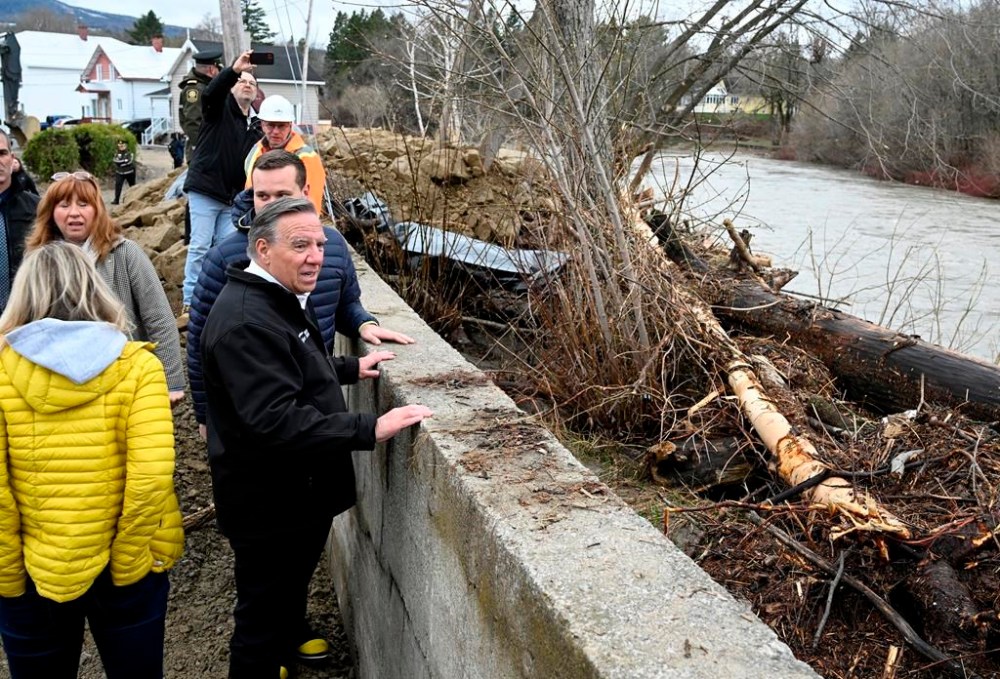
Quebec Premier François Legault spoke about the men Wednesday during a visit to heavily flooded Baie-St-Paul, which is just downriver from St-Urbain. He noted that one of them was in his 50s and was using his own amphibious ATV to try to reach a couple whose home was surrounded by water. The other man, Legault said, was a “boy of 23 years.”
“Twenty-three years,” Legault repeated after a short pause. “It’s an infinite sadness.”
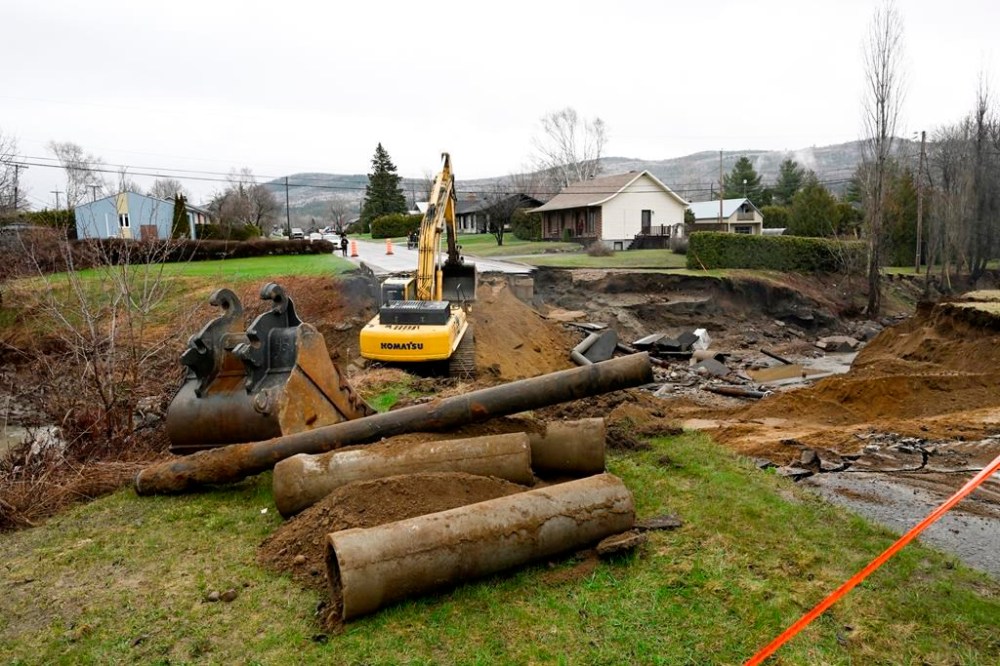
More than 90 millimetres of rain has fallen on St-Urbain since Saturday, Environment Canada reported. More than 60 mm has fallen on Baie-St-Paul, where officials declared a state of emergency earlier this week and where about 600 people were forced from their homes.
Flooding has also been reported in the Lanaudière and Laurentians regions and in western Quebec. The Public Security Department has said a half dozen communities across the province declared states of emergency due to the heavy rains.
Legault asked people not to rush to judgment about the intervention that led to the deaths. Firefighters, he said, “do an essential but risky job. Obviously, we try to minimize these risks as much as possible, but we can say thank you for their courage.”
Psychological support and financial aid will be offered to residents of the area, he said. “There are also people here who I spoke with who have lost what they built all their lives,” Legault said, adding that many have lost family homes that had been passed down through generations.
Legault toured the flood-hit town and spoke to residents who told him they were given five minutes to get out of their homes as the river rose Monday. Some asked what aid would be offered, explaining their insurance didn’t cover flood damage.
Baie St-Paul Mayor Michaël Pilote told reporters it’s too early to estimate the cost of the damage, adding that about 350 residences — home to approximately 1,000 people — have been damaged or destroyed.
In the long term, Legault said, the government will look at how to make the region more resilient to severe flooding, which he said used to occur once every hundred years but is now becoming more frequent because of climate change.
Some areas that are particularly prone to flooding, however, will not be rebuilt, he warned. “Maybe we’ll have to ask some people to move; in the meantime, we’ll help the people and we’ll work with the mayors.”
Meanwhile, thousands of people in the Lanaudière region were cut off from the rest of the province after flooding forced the Transport Department to close Highway 131, the main route south.
Sipi Flamand, chief of the Atikamekw Council of Manawan, said the highway is an important link for his community of 3,000 people, located about 250 kilometres north of Montreal. “It’s the safest way for the community to reach essential services, like hospitals,” Flamand said in an interview Wednesday.
Emergency vehicles were still being allowed through, he said, adding that while there were concerns about supplies of food and gas, the band council took steps to get essential supplies delivered through secondary forest roads. However, Flamand said he was worried that other nearby rivers could flood, blocking those routes.
The closure of Highway 131 has cut off access to the south for a total of about 8,000 people, said Réjean Gouin, the mayor of Saint-Michel-des-Saints, Que. He said in an interview the closure means people won’t be able to get to medical appointments, including chemotherapy.
While the Transport Department has said it plans to repair the road, Gouin said it could take weeks for the water levels to decline enough to allow repairs and that he thinks the road could be partially opened now.
“It’s our only route,” he said.
Meanwhile, in Gatineau, Que., across the river from Ottawa, flooding has forced more than 300 people from their homes, Mayor France Bélisle told reporters. She asked those who live along the Ottawa River to leave their homes as a precaution.
This report by The Canadian Press was first published May 3, 2023.
— By Jacob Serebrin in Montreal with files from Thomas Laberge in Baie-St-Paul