
Crown execs should live in province, premier says
Advertisement
Read this article for free:
or
Already have an account? Log in here »
We need your support!
Local journalism needs your support!
As we navigate through unprecedented times, our journalists are working harder than ever to bring you the latest local updates to keep you safe and informed.
Now, more than ever, we need your support.
Starting at $15.99 plus taxes every four weeks you can access your Brandon Sun online and full access to all content as it appears on our website.
Subscribe Nowor call circulation directly at (204) 727-0527.
Your pledge helps to ensure we provide the news that matters most to your community!
To continue reading, please subscribe:
Add Brandon Sun access to your Free Press subscription for only an additional
$1 for the first 4 weeks*
- Enjoy unlimited reading on brandonsun.com
- Read the Brandon Sun E-Edition, our digital replica newspaper
*Your next Free Press subscription payment will increase by $1.00 and you will be charged $20.95 plus GST for four weeks. After four weeks, your payment will increase to $24.95 plus GST every four weeks.
Read unlimited articles for free today:
or
Already have an account? Log in here »
Hey there, time traveller!
This article was published 10/06/2023 (1225 days ago), so information in it may no longer be current.
WINNIPEG — All the top brass directing Manitoba’s Crown corporations, health authorities and hospitals would reside in the province full-time — if Manitoba Premier Heather Stefanson had it her way.
On Thursday, the premier said she’s not a fan of arrangements allowing high-ranking executives employed by publicly owned corporations and health organizations to commute to work from outside Manitoba.
They should be living in the province, she said.
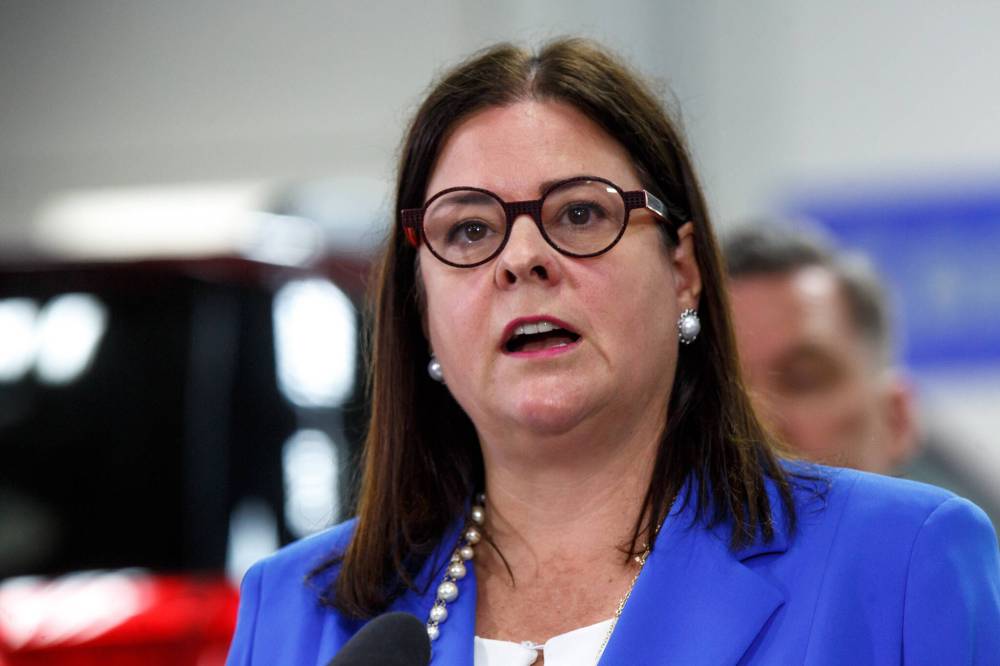
Heather Stefanson
“I never really liked that, frankly,” Stefanson told reporters.
“We want people living in Manitoba. I want more people living in Manitoba. I want to grow our economy here.
“In order to do that, we need to attract people to Manitoba.”
On Tuesday, Manitoba Public Insurance board chairman Ward Keith revealed the Crown corporation had been covering the tab for its former chief information and technology officer to commute from Ontario over an eight-month period.
Siddhartha Parti resigned as a vice-president with MPI on June 2 rather than move to Manitoba, as requested by the board, as part of his employment with the publicly owned auto insurer.
MPI spent up to $19,000 to facilitate Parti’s travel to Manitoba during his time with the corporation, based on an agreement approved by former chief executive officer Eric Herbelin.
Keith described the arrangement as unacceptable and said no other officers of the corporation are living outside Manitoba.
Stefanson said it was a fair request to ask a vice-president to relocate to the province. However, she declined to provide her opinion on MPI’s decision to cover the travel expenses.
“I’ll leave that to the board to make those decisions. They’re independent from us and we respect the work that they’re doing.”
Both Manitoba Hydro and Manitoba Liquor and Lotteries Corp. confirmed all current members of their executive teams reside full-time in the province.
Hydro spokesman Bruce Owen said its executive leaders are expected to live in Manitoba.
A spokesperson for MLL said it has a remote work policy that applies to all employees, including executive officers, which allows them to work from a consistent location other than their primary location (such as a corporate office).
One-time, temporary exceptions are considered on a case-by-case basis, the spokesperson said.
In 2018, MLL was forced to defend its decision to employ former vice-president of marketing and communications Deanne Carson, who split her time between Winnipeg and Alberta, and paid for her travel expenses out of pocket.
Former Hydro senior executive Siobhan Vinish also commuted to her home in Calgary on weekends for three and a half years before leaving the corporation in 2018.
Cross-country commutes made by Manitoba health executives have also been the subject of public scrutiny.
Former St. Boniface Hospital CEO Martine Bouchard spent most of her weekends in Montreal, with travel expenses covered by the institution’s sponsoring organization, Catholic Health Corp. of Manitoba. No public funds were used.
She was employed by the hospital from May 2018 to October 2021. She was paid $615,170 in her last year with St. Boniface.
According to Shared Health — Manitoba’s provincial health authority — all of its current executive members reside full-time in the province.
However, recently departed chief human resources officer Armin Pyde split his time between Alberta and Manitoba at his own personal expense. Additional comment on human resource matters could not be provided, a Shared Health spokesperson said.
Pyde left the health authority about two weeks ago.
According to Shared Health, the authority has offered a work-from-home program for eligible employees within the province since the onset of the COVID-19 pandemic.
However, there are situations where reasonable accommodation is required and they are reviewed on a case-by-case basis, the spokesperson said.
“In these circumstances, travel costs are not reimbursed,” Shared Health said in a statement.
The authority also has a “senior leadership relocation policy” allowing for reimbursement of eligible relocation expenses, including packing, moving and unpacking. However, travel, accommodation and per diems beyond those covered through relocation agreements are not eligible for repayment, according to Shared Health.
Executive talent recruiter Donna Bilodeau said employers are more open to remote work arrangements for senior executives, owing to a lack of qualified candidates.
“It’s forcing employers to be more open to accommodating the needs of an ideal candidate in order to get them,” she said, noting effective long-distance work arrangements during the pandemic have also changed negotiations.
“Those are two factors that are making employers think a little bit outside the box,” said Bilodeau, a vice-president with Winnipeg-based organizational consulting firm Legacy Bowes.
“There’s a shortage of candidates. There aren’t necessarily half a dozen in line behind that top candidate,” Bilodeau said. “That could be a factor in decisions to accommodate.”
» Winnipeg Free Press