
Manitoba government says searching landfill for remains of Indigenous women too risky
Advertisement
Read this article for free:
or
Already have an account? Log in here »
We need your support!
Local journalism needs your support!
As we navigate through unprecedented times, our journalists are working harder than ever to bring you the latest local updates to keep you safe and informed.
Now, more than ever, we need your support.
Starting at $15.99 plus taxes every four weeks you can access your Brandon Sun online and full access to all content as it appears on our website.
Subscribe Nowor call circulation directly at (204) 727-0527.
Your pledge helps to ensure we provide the news that matters most to your community!
To continue reading, please subscribe:
Add Brandon Sun access to your Free Press subscription for only an additional
$1 for the first 4 weeks*
- Enjoy unlimited reading on brandonsun.com
- Read the Brandon Sun E-Edition, our digital replica newspaper
*Your next Free Press subscription payment will increase by $1.00 and you will be charged $20.95 plus GST for four weeks. After four weeks, your payment will increase to $24.95 plus GST every four weeks.
Read unlimited articles for free today:
or
Already have an account? Log in here »
Hey there, time traveller!
This article was published 05/07/2023 (1200 days ago), so information in it may no longer be current.
WINNIPEG – The Manitoba government appeared to all but shut the door Wednesday on a proposed search for the remains of two slain Indigenous women believed to be in a landfill north of Winnipeg.
Premier Heather Stefanson, after meeting with some relatives of the slain women, cited a recent feasibility study on the proposed search and said it would pose a health risk to workers with no guarantee the remains would be found.
“We understand the desire to leave no stone unturned. However, the search process described in the report is complex, and comes with long-term human health and safety concerns that simply cannot be ignored,” Stefanson said in a written statement.
“Based on the report, we cannot knowingly risk Manitoba workers’ health and safety for a search without a guarantee. As stated in the report, the emotional costs associated with conducting a search and not recovering remains must be considered, as should the emotional costs associated with potential delays and the duration of a search.”
The premier’s office later clarified that the province would not stop a search if the federal government supports one and can provide sufficient safeguards around the risks.
A daughter of one of the slain women expressed anger and disappointment after the meeting.
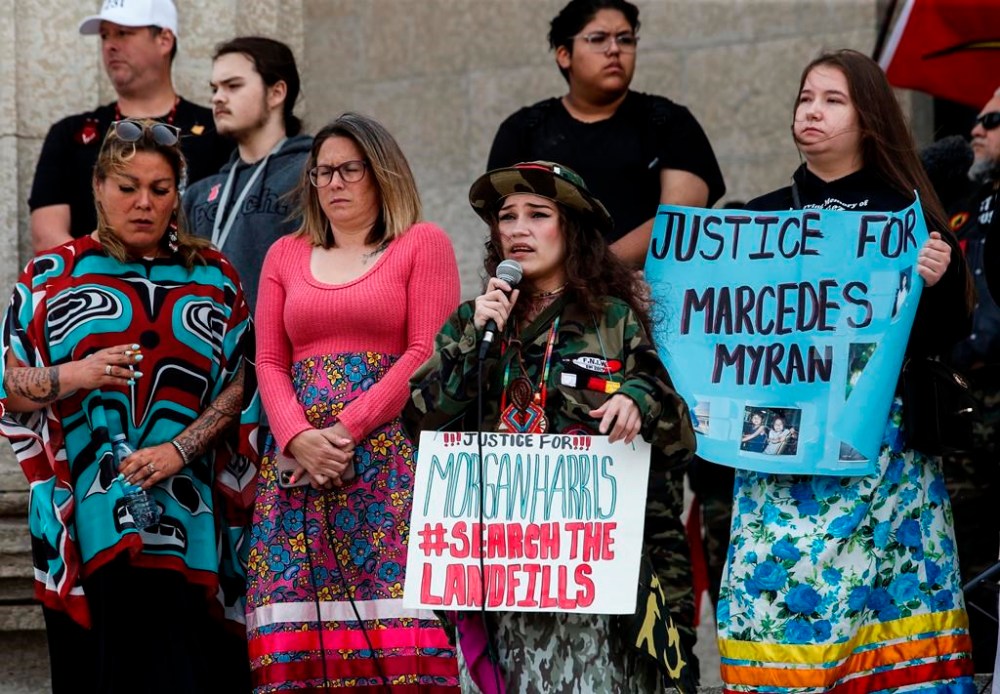
“I told (Stefanson) she was retraumatizing my family quite frankly, and I found it disrespectful,” Cambria Harris wrote in a social media post.
“Once again a game of political yo-yo, pointing fingers back at the federal government and (Crown-Indigenous Relations) Minister Marc Miller, who has met with my family on numerous occasions.”
Morgan Harris and Marcedes Myran are believed to have been killed last year. Police believe the women’s remains were left in a garbage bin three days apart in early May 2022, and the contents of the dumpster were sent to the Prairie Green Landfill.
Jeremy Skibicki has been charged with first-degree murder in their deaths, as well as the deaths of Rebecca Contois, whose remains were found in another landfill, and an unidentified woman whom Indigenous leaders have named Buffalo Woman. Her remains have not been found.
The federal government funded a study that concluded a canvass of the Prairie Green Landfill is feasible.
It warned there are risks due to exposure to toxic chemicals and asbestos. The search could take up to three years and cost $184 million with no guarantee of success. But the report said forgoing a search could be more harmful for the women’s families.
Last month, another relative said the federal government sat down with the families and expressed support for searching the landfill but hung the onus on the province. Miller’s office has said it is still reviewing the study.
This report by The Canadian Press was first published July 5, 2023.