
Former foreign minister Marc Garneau says Canada, South Korea should form closer ties
Advertisement
Read this article for free:
or
Already have an account? Log in here »
We need your support!
Local journalism needs your support!
As we navigate through unprecedented times, our journalists are working harder than ever to bring you the latest local updates to keep you safe and informed.
Now, more than ever, we need your support.
Starting at $15.99 plus taxes every four weeks you can access your Brandon Sun online and full access to all content as it appears on our website.
Subscribe Nowor call circulation directly at (204) 727-0527.
Your pledge helps to ensure we provide the news that matters most to your community!
To continue reading, please subscribe:
Add Brandon Sun access to your Free Press subscription for only an additional
$1 for the first 4 weeks*
*Your next subscription payment will increase by $1.00 and you will be charged $20.00 plus GST for four weeks. After four weeks, your payment will increase to $24.00 plus GST every four weeks.
Read unlimited articles for free today:
or
Already have an account? Log in here »
Hey there, time traveller!
This article was published 25/09/2023 (835 days ago), so information in it may no longer be current.
OTTAWA – Former foreign affairs minister Marc Garneau says Canada should push for a role in a new security pact, arguing South Korea and Ottawa could help each other gain strategic influence in the Indo-Pacific.
“At a time when the geopolitical dialogue tends to be dominated by the superpowers, successful middle powers like Korea and Canada have things to say that are worth listening to,” Garneau said in an interview.
“There’s the potential for us to work together and to, in a co-ordinated manner, have a greater voice on the world stage.”
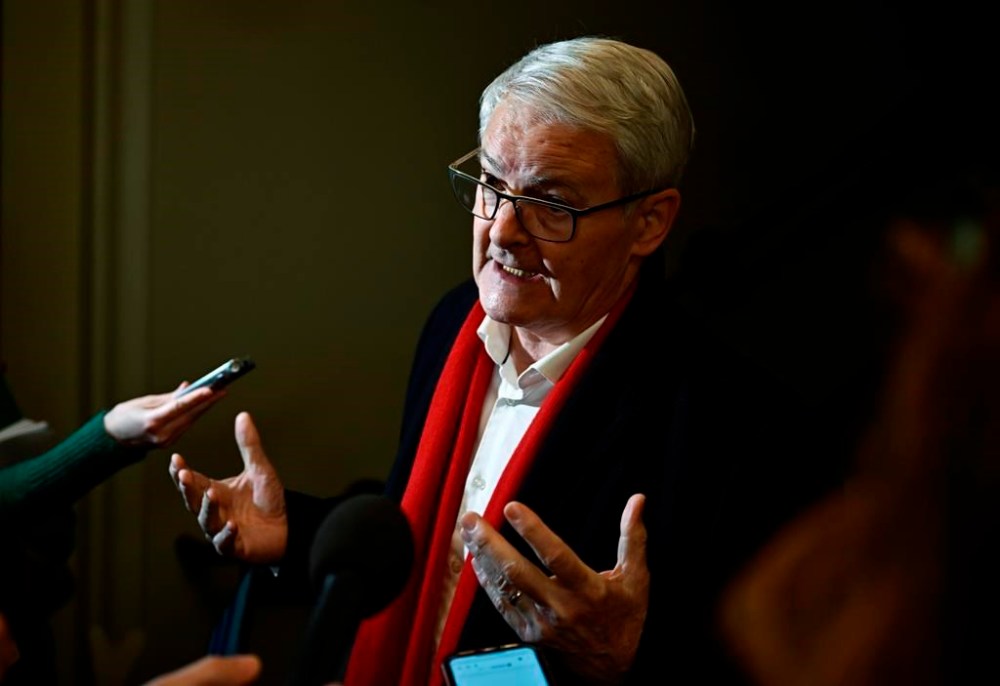
Garneau is to be appointed next month as the Canadian co-chair of the Canada-Korea Forum, a group dedicated to boosting trade and scientific exchanges between the two countries.
His appointment comes at a time when Ottawa and Seoul say they’ve never been as close, with both launching Indo-Pacific strategies that call for deeper engagement with countries along the Pacific Rim in order to create less reliance on China.
Both plans include the goal to form better partnerships with democracies committed to a low-carbon world and upholding rules meant to keep rogue states like North Korea from encroaching on sovereign borders.
In recent weeks, automotive giant Stellantis has begun hiring people for a future electric-vehicle battery plant in Windsor, Ont., a joint venture with Korea’s LG Energy Solution. And Korean and Canadian companies have joined forces to announce plans for two separate factories near Trois-Rivières, Que., for components that go into such batteries.
Meanwhile, South Korea has been vocal about wanting to import more food commodities and liquefied natural gas from Canada, especially as it frets about China and Russia holding back access to energy and food products.
It’s all part of a burgeoning trade relationship that has deepened since the two countries signed a trade deal nearly a decade ago.
While Canada’s exports to South Korea had typically focused on critical minerals and wood pulp, aviation simulators, real-estate investments and financial services have more recently been added to the list.
“We’re looking in fine detail at areas where we can profit from each other in terms of trade, so that they can have more reliable supply chains, and that we can have more opportunities for trade,” the former Liberal minister said.
“We want to rev it up to a higher gear,” said Garneau, who was the first Canadian citizen to go into space.
Garneau argued Ottawa should push to be part of a security arrangement Washington crafted last month with Japan and South Korea.
The two share a difficult history and a complicated relationship, given Japan’s former colonization of Korea. Yet they find themselves increasingly co-operating in the face of disruptive governments in nearby China and Russia.
That’s why the United States crafted a three-pronged strategic partnership with Tokyo and Seoul. Garneau argues Ottawa should join them.
“I think that, from a Korean perspective, they’d like Canada to be involved with that as well, and I think it’s in our interest as North Pacific countries,” he said. “The four of us have so much in common that it would be nice to explore that.”
Garneau has been to Korea just three times, but he said he sees the country as a global juggernaut for producing Samsung, LG and a vibrant K-pop music scene.
“It’s remarkable in the sense that it essentially rose from the ashes in 1953 after the Korean War, and from virtually nothing except their own determination and brain power, with the government and business working together, (they became) the 10th-largest economy in the world.”
Garneau helped write Canada’s Indo-Pacific strategy, and said he feels encouraged to see that it is leading to more diplomatic activity in the region.
But recent tensions with India show the need to have a range of connections, he said, adding that Global Affairs Canada still needs to fill gaps in Asian expertise among its teams.
Shoring that up will require not just training diplomats in the languages and cultures of the region, but in how to conduct high-level visits, Garneau said, especially those pegged to historical milestones.
South Korean President Yoon Suk Yeol came to Ottawa last fall, months before Canada and South Korea marked six decades of diplomatic relations, which Prime Minister Justin Trudeau commemorated in a visit to Seoul in May.
Still, he said most Canadians aren’t aware of Canada’s existing role in the region, from a legacy of helping post-colonial countries develop their education systems to the more recent work of using Canadian satellite and radar technology to spot illegal overfishing.
“The proof will be in the pudding, how much (Ottawa) follows up and follows through on its engagement. But I think the penny has dropped,” Garneau said.
“It is now time for Canada to turn its gaze and its focus to the Asian continent, to the Indo-Pacific. Because literally, that’s the most dynamic region in the world. It is already the Indo-Pacific century.”
This report by The Canadian Press was first published Sept. 25, 2023.