
Advertisement
Read this article for free:
or
Already have an account? Log in here »
We need your support!
Local journalism needs your support!
As we navigate through unprecedented times, our journalists are working harder than ever to bring you the latest local updates to keep you safe and informed.
Now, more than ever, we need your support.
Starting at $15.99 plus taxes every four weeks you can access your Brandon Sun online and full access to all content as it appears on our website.
Subscribe Nowor call circulation directly at (204) 727-0527.
Your pledge helps to ensure we provide the news that matters most to your community!
To continue reading, please subscribe:
Add Brandon Sun access to your Free Press subscription for only an additional
$1 for the first 4 weeks*
- Enjoy unlimited reading on brandonsun.com
- Read the Brandon Sun E-Edition, our digital replica newspaper
*Your next Free Press subscription payment will increase by $1.00 and you will be charged $20.95 plus GST for four weeks. After four weeks, your payment will increase to $24.95 plus GST every four weeks.
Read unlimited articles for free today:
or
Already have an account? Log in here »
Hey there, time traveller!
This article was published 02/10/2023 (1114 days ago), so information in it may no longer be current.
WINNIPEG — Campaign signs could have had a positive effect on his election campaign, but Dennis Bayomi is more concerned about the negative impact they will have on the environment.
That’s why the Green Party of Manitoba candidate for Kirkfield Park decided to forgo lawn signage this election — and he’s encouraging future political candidates to do the same.
“Customized signs, to me, really don’t hit the environmental note that I would like to reach,” Bayomi said.
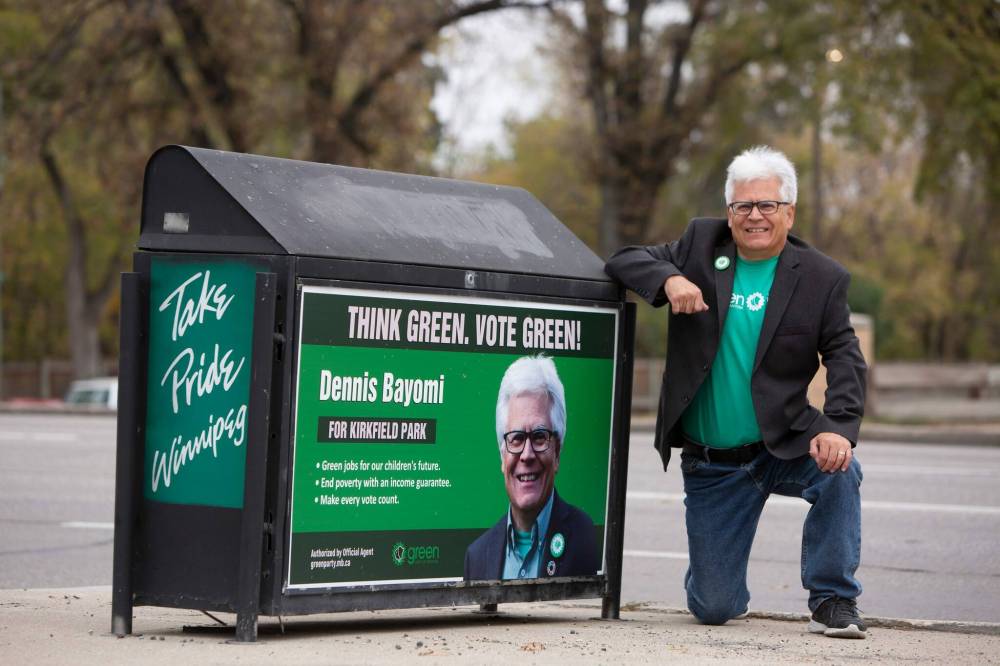
Dennis Bayomi, who is a Green Party of Manitoba candidate for Kirkfield Park, stands next to one of his campaign signs, which is attached to a recycling bin next to the Deer Lodge Centre in Winnipeg, Man. on Sunday. Bayomi decided not to use lawn signs for his election campaign to be more environmentally friendly. (Brook Jones/Winnipeg Free Press)
For eons, colourful political placards and signs bearing smiling party avatars have littered lawns across the province to signal the start of an election campaign, be it municipal, provincial or federal.
But there are growing calls among environmentalists to reduce, reuse and recycle Coroplast signs so they do not end up in landfills like other single-use plastics — some of which, like straws and checkout bags, are now outlawed in Canada.
Bayomi has turned down about a dozen supporters who have requested a lawn sign, citing his position on their wastefulness and concerns that politicizing yards causes “community splintering.”
The production of signs is a problem, as well as the stockpiles following an election and the forgotten ones that end up as junk on the side of the road, he said. Bayomi also noted the significant emissions attached to delivery and pickup since most candidate teams rely on gas-powered vehicles.
“We are advocating, as part of our electoral reform cornerstone, to include banning lawn signs, but right now, we don’t have a policy; it’s really up to each candidate,” said the president of the Greens’ local chapter.
While Bayomi’s campaign is not net-zero, the longtime vegan said he has been trying his best to reduce emissions as much as possible to live up to his party’s key values, one of which is “ecological sustainability.”
He has been primarily advertising his latest bid via community radio bulletins and recycling bin posters.
“This is reflective of the larger societal challenges that we have related to advertising, related to capitalism in general, related to challenges with Meta and social media and news not being able to be spread in that way as easily as it used to,” said Bethany Daman, spokeswoman for Manitoba’s Climate Action Team.
“If (candidates) had to report on emissions in the same way as they had to report on their spending, I think that would be really interesting because it would force people to think more about doing things efficiently.”
Daman said the team behind Consider Climate, Manitoba — a third-party campaign that was launched to educate policy makers about the importance of climate action during the 2023 election — debated the appropriateness of using Coroplast signs.
Ultimately, the group printed signs promoting their cause on a highlighter-yellow backdrop with plans to reuse them indefinitely because the long-term impact will outweigh the negative cost of production and distribution, she said.
The spokeswoman added she commends anyone who is finding alternative ways to get their messages out to the public using as few fossil fuels as possible.
Halifax’s mayoral candidates agreed to ditch lawn signs to reduce emissions in a 2016 race that is believed to be the first of its kind in Canada.
More recently, during the last federal election, a Green candidate in Guelph made lawn signs out of canvas shopping bags that could be repurposed as totes after the election.
Daman said she has been encouraged by the conversations she has had with local political candidates who have found second lives for their campaign signs, including by donating them to schools, daycares and art programs to be used for crafting.
Political signs can be covered up to serve as lawn signs or used as building materials for birdhouses, forts and storage bins, she said.
For Alex Singbeil, a waste and renewables consultant, corrugated plastic — which is made out of petrochemicals and will remain in landfills in 1,000 years — is far less concerning than other garbage that leaches and can contaminate ground and surface water.
“We need to stop being distracted about the signs. That would be my take,” said Singbeil, an engineer based in Winnipeg who has long been advocating for the city to implement a composting program.
“Something that minor, in the scheme of things, is so meaningless compared to the amount of organics that have been generated in Winnipeg during this (10-minute interview).”
Singbeil said parties could commit to only using standard signs without candidate headshots to limit waste. At the same time, he noted human-caused climate change is not being solved in any meaningful way by outlawing plastic straws and other single-use items.
» Winnipeg Free Press