
B.C. establishes largest provincial park in a decade to protect threatened caribou
Advertisement
Read this article for free:
or
Already have an account? Log in here »
We need your support!
Local journalism needs your support!
As we navigate through unprecedented times, our journalists are working harder than ever to bring you the latest local updates to keep you safe and informed.
Now, more than ever, we need your support.
Starting at $15.99 plus taxes every four weeks you can access your Brandon Sun online and full access to all content as it appears on our website.
Subscribe Nowor call circulation directly at (204) 727-0527.
Your pledge helps to ensure we provide the news that matters most to your community!
To continue reading, please subscribe:
Add Brandon Sun access to your Free Press subscription for only an additional
$1 for the first 4 weeks*
*Your next subscription payment will increase by $1.00 and you will be charged $20.00 plus GST for four weeks. After four weeks, your payment will increase to $24.00 plus GST every four weeks.
Read unlimited articles for free today:
or
Already have an account? Log in here »
Hey there, time traveller!
This article was published 14/06/2024 (663 days ago), so information in it may no longer be current.
VICTORIA – A scientist working on the recovery of the caribou population in northeastern British Columbia said Friday was “a landmark day” for the species, after the province announced a massive park expansion aimed at wildlife preservation.
The B.C. Ministry of Environment said Friday that the Klinse-za Park, located west of Chetwynd about 1,100 kilometres north of Vancouver, will grow to almost 2,000 square kilometres in size.
The expansion to the park, originally created in 2001 at about 27 square kilometres, will make it the largest provincial park established in the province in a decade.
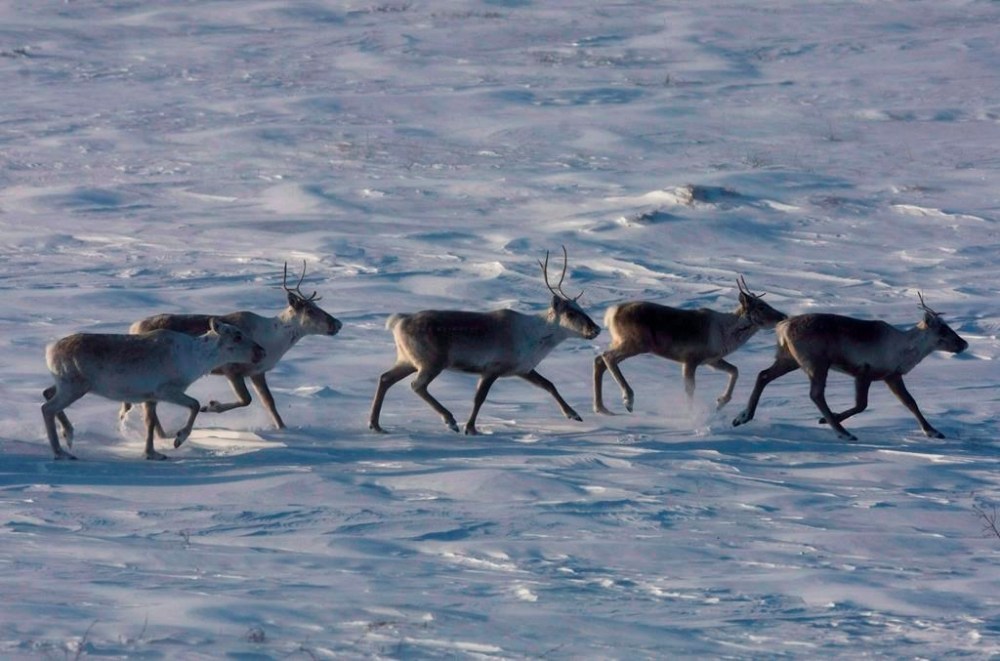
“That’s what caribou need: A large, intact landscape that has a predator-prey community that’s working as it’s supposed to,” said Clayton Lamb with Biodiversity Pathways, a non-profit wildlife research group.
“And what is not working for caribou is these disturbed or degraded landscapes where the predator-prey community gets out of alignment.”
The addition to the park is the result of a partnership in 2020 between the province and the Saulteau and West Moberly First Nations, where they agreed to help stabilize and protect the threatened southern mountain caribou.
The Saulteau and West Moberly nations have been working together on caribou revitalization since the 2013 launch of the Nikanese Wah tzee Stewardship Society, when there were only 38 animals left in the region.
The province says the number of caribou in B.C. fell by more than 55 per cent in the last century, mostly due to human-caused habitat disturbance, and there are fewer than 4,000 of the southern mountain species left.
Saulteau First Nations Chief Rudy Paquette said in a statement that the park expansion is the latest proof of the labour of Indigenous communities on caribou restoration.
“This is another step in the process by which we are proving that we can recover endangered species and protect the sacred lands of First Nations people, while also providing for healthy ecosystems and diverse economies,” Paquette said.
David Suzuki Foundation boreal project manager Rachel Plotkin said the park expansion comes as welcome news for conservationists, since northeastern B.C. has seen heavy industrial activity.
Plotkin said those activities often create seismic lines, well sites and logging roads that give predators easier access to caribou territory, dramatically reducing the population.
“All of the linear disturbances increase the sightlines for predators,” she said. “And then predators are more successful in killing caribou.
“If you are out in the winter sometimes and you find a path that’s been created for humans, it’s often also used by wildlife. So, wolves use the paths we created, and it increases their success rate in predation.”
Lamb, who is also the project scientist for the Nikanese Wah tzee Stewardship Society, said efforts by the two First Nations in the last decade included putting pregnant caribou into pens to protect them from predators.
He called the effort “probably Canada’s greatest conservation challenge” and said the restoration of habitat will be crucial if the effort is to create self-sustaining caribou populations in the wild.
Announcements such as the Klinse-za Park expansion have began to turn the tide, he added.
“I think the narrative on caribou optimism changes by the decade,” Lamb said. “If you asked me that question a decade ago or more, it might have been fairly pessimistic.
“But in this case, given the partners, the level of protection and team success to date, we have an unprecedented opportunity to create a restored landscape for caribou that’s never been done before.”
As part of the park expansion announcement, the federal government provided $46 million toward compensating industries and tenure holders affected by the change, in addition to another $10 million to boost an economic diversification trust locally.
The expanded park will also protect other at-risk species, such as fishers, bull trout, grizzly and wolverines, as well as sacred cultural sites for Treaty 8 First Nations in the area.
“The teachings were to leave no trace nor impact as you pass through the lands,” Chief Roland Willson of West Moberly First Nations said in a statement. “Times have changed and others have come seeking natural resources for economic development: forestry, oil and gas, large-scale hydroelectric, mining, and so on. They leave a much different footprint.”
The province said the park expansion will also contribute to B.C.’s committed goal of putting 30 per cent of the province’s land under protection by 2030.
This report by The Canadian Press was first published June 14, 2024.