
The hunt for invasive wild pigs
Advertisement
Read this article for free:
or
Already have an account? Log in here »
We need your support!
Local journalism needs your support!
As we navigate through unprecedented times, our journalists are working harder than ever to bring you the latest local updates to keep you safe and informed.
Now, more than ever, we need your support.
Starting at $15.99 plus taxes every four weeks you can access your Brandon Sun online and full access to all content as it appears on our website.
Subscribe Nowor call circulation directly at (204) 727-0527.
Your pledge helps to ensure we provide the news that matters most to your community!
To continue reading, please subscribe:
Add Brandon Sun access to your Free Press subscription for only an additional
$1 for the first 4 weeks*
- Enjoy unlimited reading on brandonsun.com
- Read the Brandon Sun E-Edition, our digital replica newspaper
*Your next Free Press subscription payment will increase by $1.00 and you will be charged $20.95 plus GST for four weeks. After four weeks, your payment will increase to $24.95 plus GST every four weeks.
Read unlimited articles for free today:
or
Already have an account? Log in here »
Hey there, time traveller!
This article was published 10/10/2024 (696 days ago), so information in it may no longer be current.
If a pig warned his friends that heat-seeking drones were coming for them, he’d probably seem a little crazy.
But it’s true. Thermal vision drones are a significant part of population control in Manitoba, and they guide trappers to invasive pigs that would otherwise be missed.
Field operations manager of a population control group Squeal on Pigs Manitoba, Devon Baete, tells the Sun that thermal vision has become crucial, especially heading into colder months.
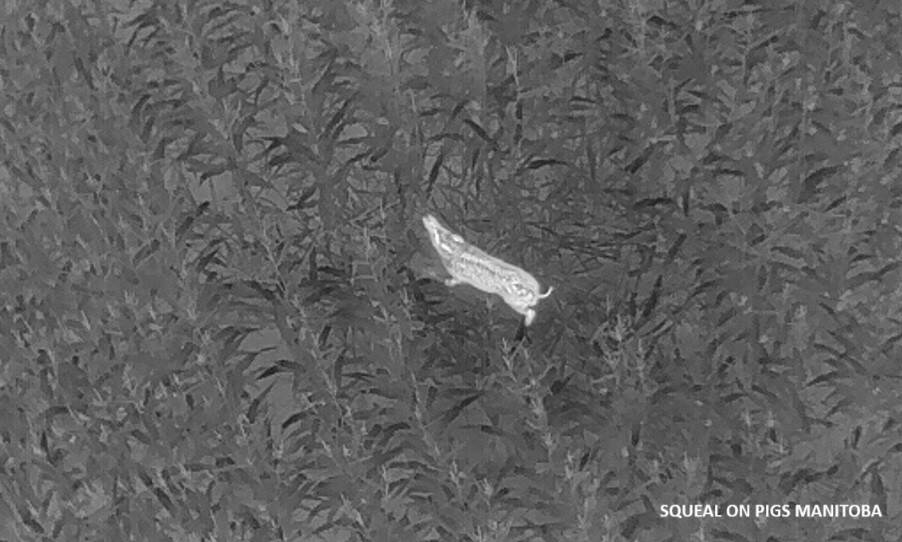
A pig is spotted on thermal vision technology as it stands in a corn field. Thermal vision drones are being used to find wild pigs, an invasive and destructive species according to researchers. (Photo submitted by Squeal on Pigs Manitoba)
“The drones are extremely helpful,” Baete told the Sun. “It’s been really key, and it will be really key this winter.”
Unfortunately for invasive wild pigs, the seasonal change to winter means they are easier to see. The colder surroundings make their warm bodies stand out on thermal technology, and they are protected less by leaves and bushes that have blown away in the wind, no longer obstructing the view of drones.
“It has been one of our most useful tools to locate wild pigs,” said Baete. “During warm summers and in areas with heavy leaf cover it is less effective, but in winter with frozen ground and no cover it works amazing. Even right now in heavy vegetation with a continuous temperature such as a tall thick corn field we can pick up those wild pigs.”
Baete tells the Sun that all four technicians at Squeal on Pigs have thermal drones and will be using them to find pigs this winter. He says the change of seasons will bring a change of strategy for trappers.
“This winter in particular we are going to be specifically targeting areas because we can use those thermal drones more effectively,” he said. “You can probably see a rabbit from a half-mile away with a thermal drone in the winter. It’s a glowing light.”
The technicians at Squeal on Pigs Manitoba plan to fly thermal drones, spot pigs and map patterns in the pigs movement. It lets them identify shelter and feeding areas, which they then set a trap in. It is the most effective time of the year, he said.
Baete supplied a photo of a wild pig seen in a corn field, through a thermal camera. The pig appears as a radiant white blotch on a dark background of corn stalks.
While trapping efforts are most effective in the coming winter months, Baete said pigs are also caught perhaps even more frequently in the summer. Efforts are just less effective in the heat because pigs are more elusive.
“The overwhelming majority of control efforts in North America typically happen in winter months,” said University of Saskatchewan professer Ryan Brook. “Finding pigs in summer is very, very hard.”
Like Baete, he said that pigs’ behaviour becomes easier to predict as winter approaches, and that makes trapping easier. The pigs have fewer resources for food, making them attracted to bait, and their movement is more predictable as it narrows down to necessities like getting to food.
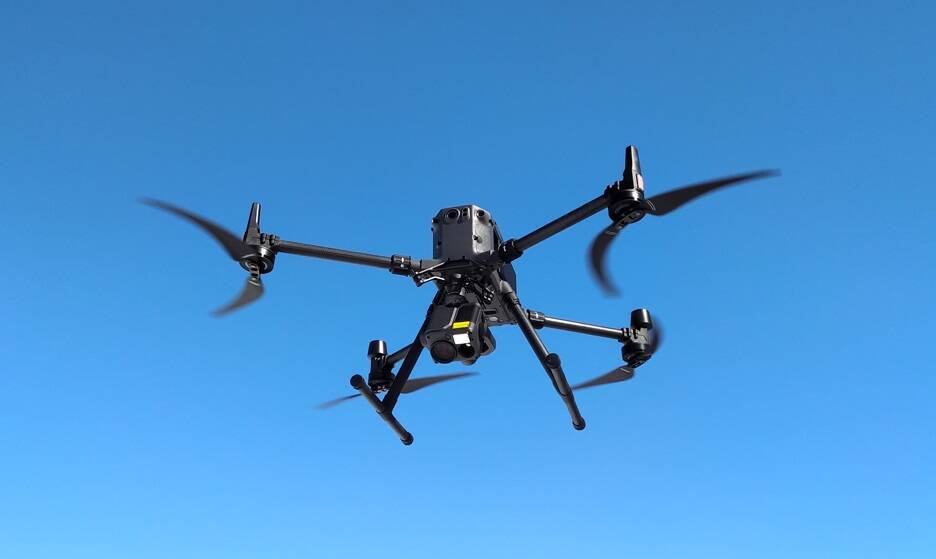
Squeal on Pigs field operations manager Devon Baete says thermal drones are a massive part of the tracking and trapping tools used in Manitoba. (Photo submitted by Devon Baete)
“Their interest in ag crops goes up dramatically as soon as the snow flies,” Brook told the Sun. “If you want to find pigs this fall or early winter, look for places where people have left standing corn out.”
Brook has researched wild pigs for 15 years. He says they are pushed around as vegetation thins out, snow covers the ground and crops are harvested. For some time they will become more desperate for food.
“Pigs will start to take more and more risks, coming into yards at night, trying to get into anything and everything they can,” he said. “As long as the snow isn’t too deep they will be really active, moving around a lot, constantly searching and smelling for food.”
Things to look out for with pigs is spilled livestock feed, or hay or corn in the area, he said. And the “hot spot” for sightings has long been the Spruce Woods area, he and Baete agreed, but he expects sightings soon in city areas like Brandon.
But thermal tracking isn’t the only boon in the winter time. Brooks added the blanket of snow on the ground preserves tracks of pigs — the impression that a belly was dragged across the surface, overtop imprints of their footsteps. It distinguishes pig tracks from other wild animals like elk.
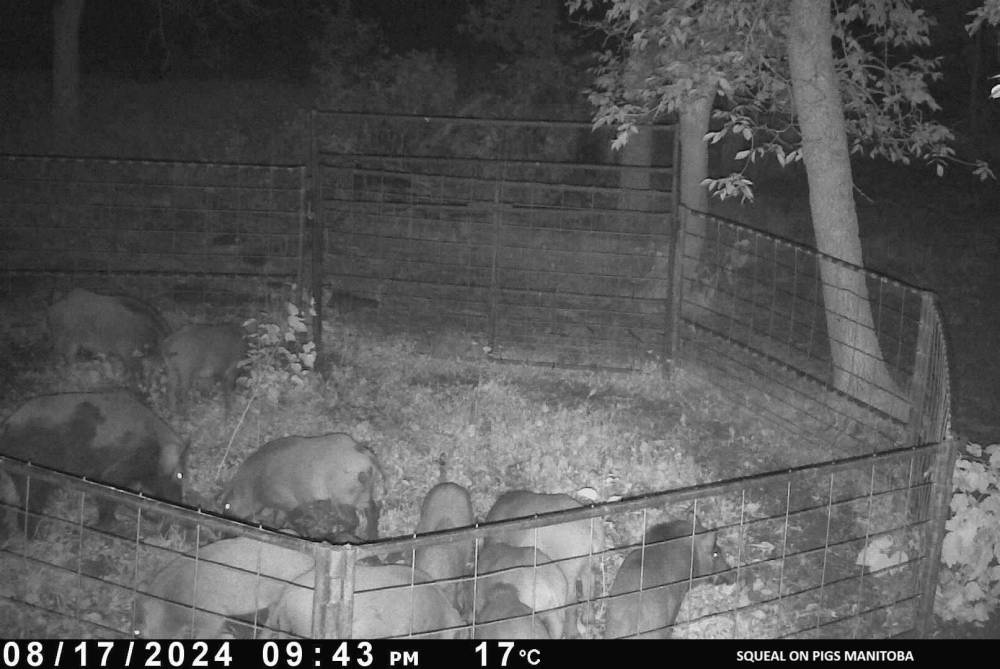
Wild pigs are seen in a corral trap, which field technicians at Squeal on Pigs Manitoba set up. Field operations manager Devon Baete tells the Sun corral traps are the most common form of population control used by the group. (Photo submitted by Squeal on Pigs Manitoba)
And the cold season also makes pigs more visibile in their burrows. With hundreds of pounds of pigs warm below the prairie’s biting cold days, a time comes when there’s a dead giveaway.
“The steam will be pouring out of there … you can really see it. It forms a fog,” said Brook.
The professor said in his experience, the most effective strategy for finding pigs, however, is not drones or steam. It’s another conspiracy-like move: abduction.
It’s called the “Judas” pig strategy. This is where humans remove all but one pig from a group, and leave the remaining pig with a GPS collar on, said Brook. The remaining pig then searches for nearby pigs and goes to join them, guiding humans in the process.
“Using pigs to find other pigs has been really effective,” said Brook. “Wild pigs find other wild pigs better than anything else.”
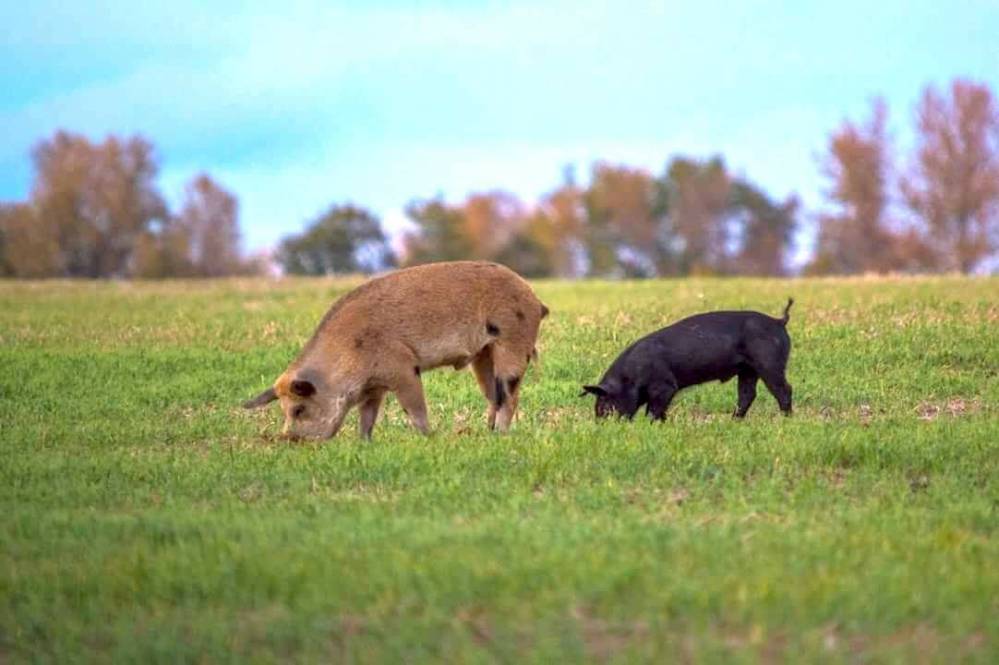
Wild pigs are seen eating in a field. (Photo submitted by Canadian Wild Pig Research Project)
The name, Brook said, comes from the biblical story of Judas, who led soldiers to Jesus for capture.
The population control efforts sound harsh on the pigs, but both researchers said the pigs cause a swath of problems in the prairies. They severely damage areas as they rip up the earth in search of food, they spoil water sources and wetlands as they mix around to cool off and defecate in the water, and they spread parasites to domestic pigs, livestock, humans and pets and other wildlife.
“We call them an ecological trainwreck,” Brook said, adding “they do a tremendous amount of crop damage.”
According to the professor, pigs survive well in Manitoba for a few reasons. They reproduce year-round, rather than a short season like elk. And the pigs survive winters well due to their fat and fur, and they are willing to gorge on mostly all things that are edible.
“Cement and metal. Outside of that they’ll pretty much eat anything,” said Brook.
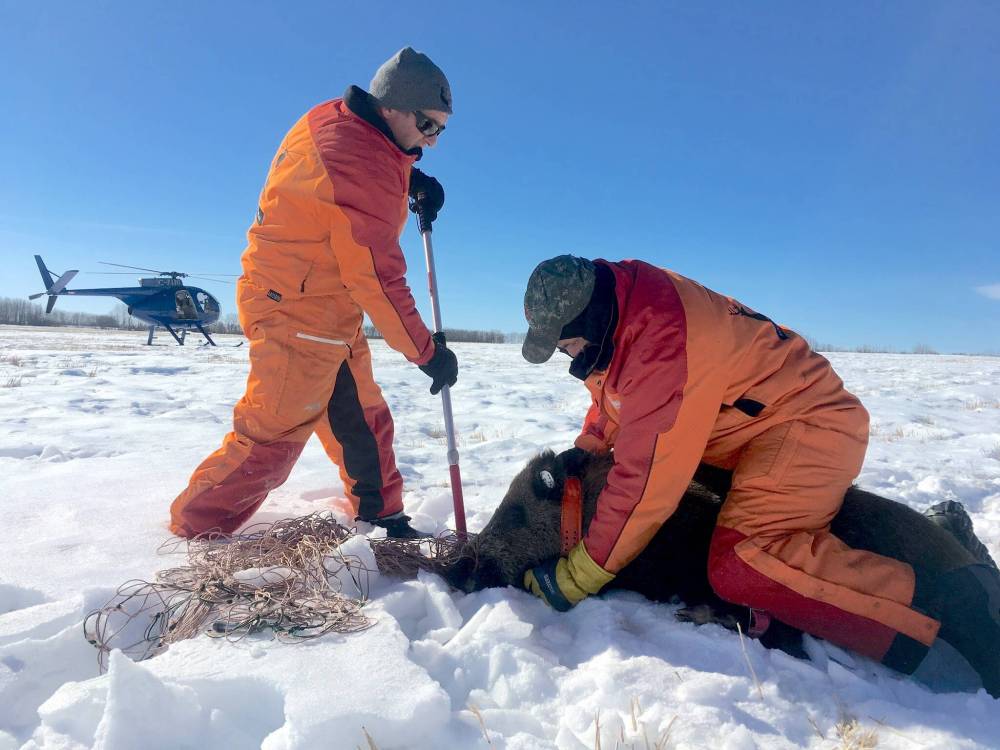
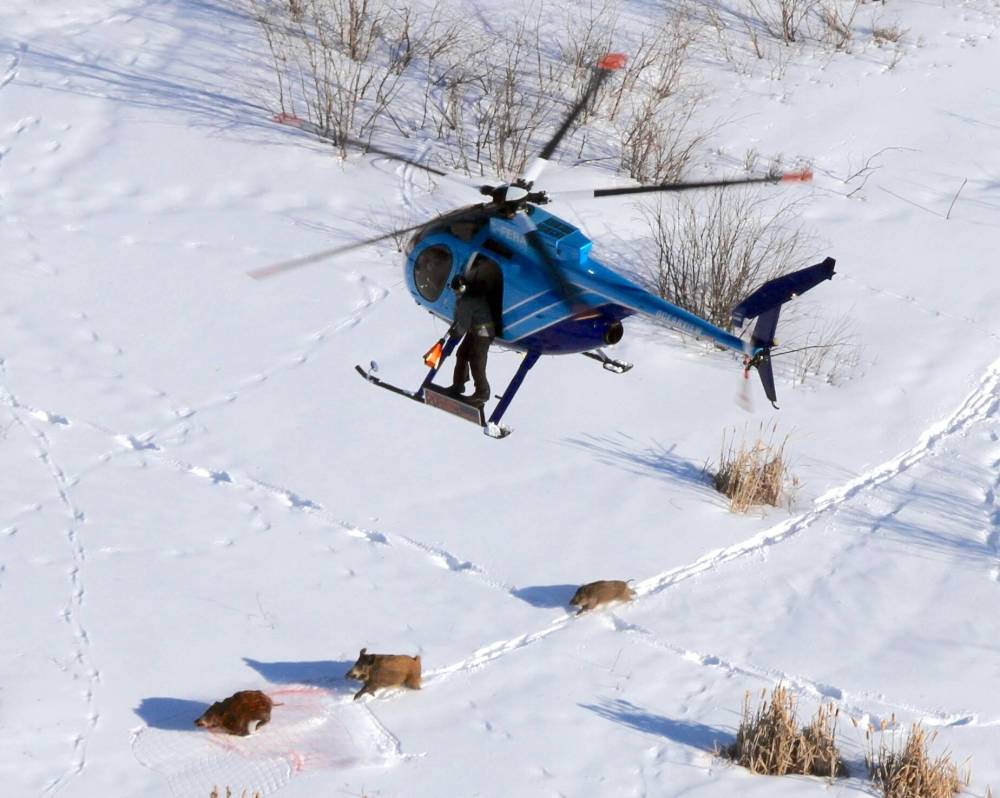
A pig is captured. Population control efforts include helicopter searches with thermal tracking technology, nets and gps collars. (Photo submitted by Canadian Wild Pig Research Project)
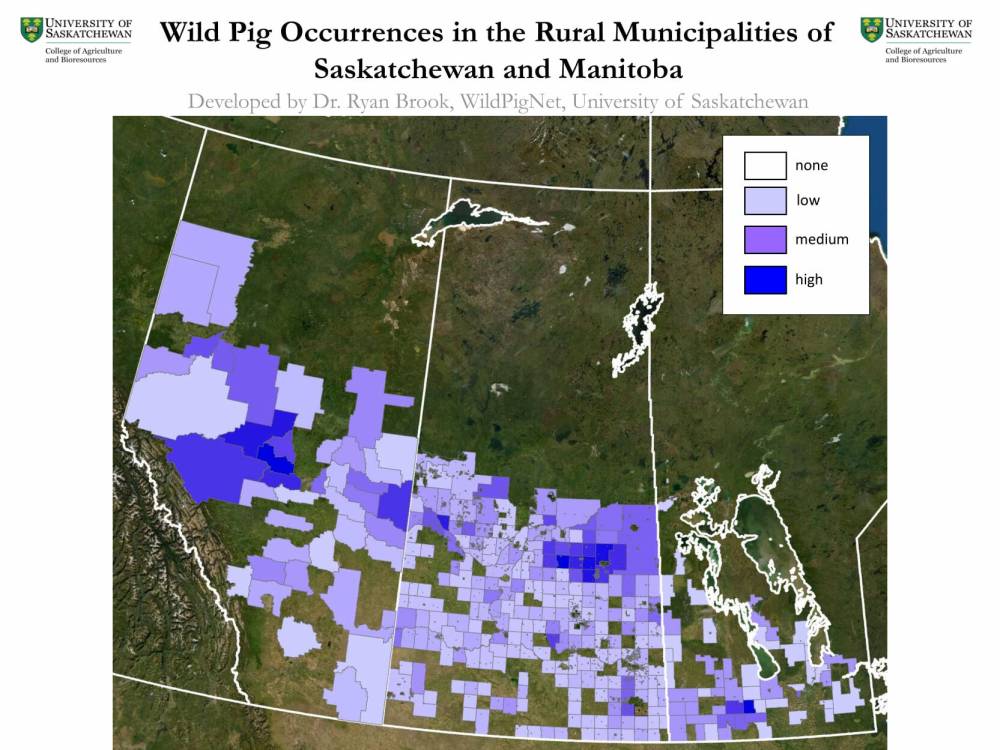
Maps showing sightings of wild pigs indicate that the issue is much worse in Saskatchewan than in Manitoba.
While Brook said helicopters have been effective for finding and tagging pigs, Baete said the approach on the ground has been mostly trapping in Manitoba. Corral-style fenced-in areas set off by a trigger are the primary way that Squeal on Pigs Manitoba is fighting the population levels in our province.
While Baete said the problem isn’t so severe in Manitoba, Brook saw it differently.
“Wild pigs have just exploded, and they are continuing to spread on the prairies,” Brook said. “We’re just managing a problem species that’s here for the long term now.”
» cmcdowell@brandonsun.com
» X: @ConnorsCupful