
Black group seeks voice in council
Advertisement
Read this article for free:
or
Already have an account? Log in here »
We need your support!
Local journalism needs your support!
As we navigate through unprecedented times, our journalists are working harder than ever to bring you the latest local updates to keep you safe and informed.
Now, more than ever, we need your support.
Starting at $15.99 plus taxes every four weeks you can access your Brandon Sun online and full access to all content as it appears on our website.
Subscribe Nowor call circulation directly at (204) 727-0527.
Your pledge helps to ensure we provide the news that matters most to your community!
To continue reading, please subscribe:
Add Brandon Sun access to your Free Press subscription for only an additional
$1 for the first 4 weeks*
*Your next subscription payment will increase by $1.00 and you will be charged $20.00 plus GST for four weeks. After four weeks, your payment will increase to $24.00 plus GST every four weeks.
Read unlimited articles for free today:
or
Already have an account? Log in here »
Hey there, time traveller!
This article was published 07/02/2025 (302 days ago), so information in it may no longer be current.
WINNIPEG — To Zita Somakoko, Manitoba has been missing a crucial voice in its United States trade strategy: Black entrepreneurs.
“It’s very important that in this atmosphere of fear and uncertainty, the voice of our Black businesses are … at the table,” said Somakoko, president of the Black-Manitobans Chamber of Commerce.
The three-year-old chamber counted 500 Black Manitoba businesses in its inception. The number has since ballooned to 1,500, Somakoko said, noting most aren’t paying members.
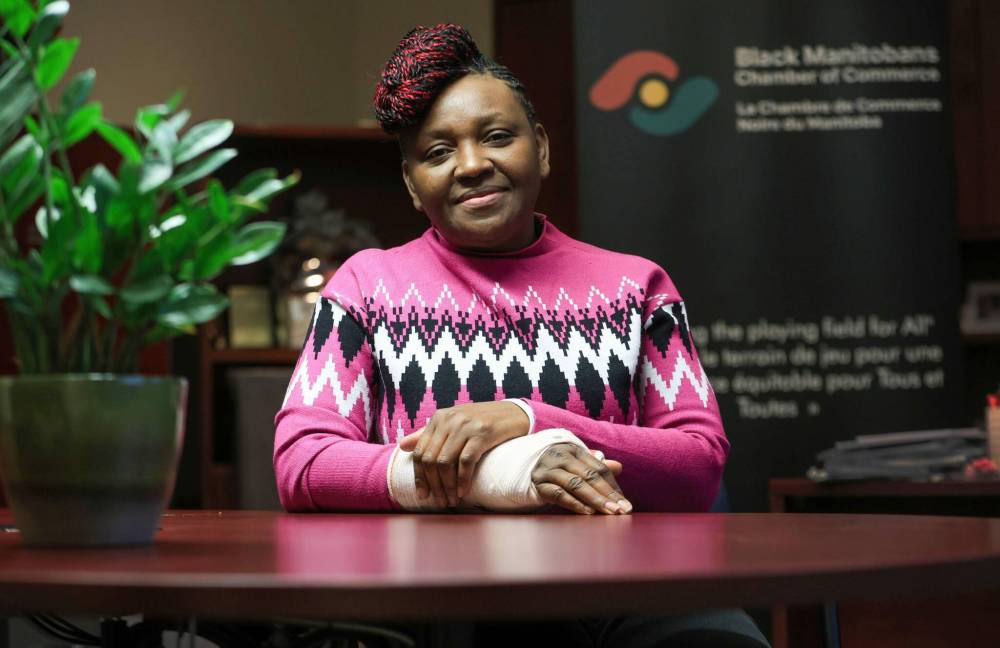
Black-Manitobans Chamber of Commerce Zita Somakoko believes her group should have a role in the province’s U.S. Trade Council. (Ruth Bonneville/Winnipeg Free Press files)
Somakoko learned of Manitoba’s U.S. Trade Council — launched late last month in response to threatened U.S. tariffs on a wide range of Canadian goods — and scanned the list of members.
Initially, 16 businesses, associations and chambers were tapped. The Manitoba Métis Federation, Assembly of Manitoba Chiefs and four more organizations have since joined.
“Our government made an announcement and called everybody at the table but us,” Somakoko said. “What is the strategy for our Black businesses and Black entrepreneurs?”
When asked, a spokesperson for Premier Wab Kinew called the Black-Manitobans Chamber of Commerce a “welcome addition” to advise the premier.
“The U.S. Trade Council is a living entity,” the spokesperson wrote in a statement. “Since its creation, we have been adding members.”
Most Black-owned companies import and export, to an extent, through the United States. They face unique challenges, including systemic racism affecting their ability to conduct business, Somakoko explained.
“Sometimes, the smaller businesses, we don’t have the opportunity to be at the table,” said Alain Karegeya, a chamber member. “Having the chamber at the table will have someone speaking on our behalf.”
Karegeya is awaiting U.S. Food and Drug Administration approvals to ship his company’s bottled hot sauces south of the border. It’s Komera Inc.’s next step in expansion — but the political climate has jeopardized the plan.
Earlier this week, U.S. President Donald Trump promised a pause of at least 30 days on sweeping 25 per cent tariffs to hit Canadian imports. It followed months of threats and a proposed retaliation from Canada affecting $155 billion worth of goods.
Komera Inc. can’t swallow 25 per cent tariff costs, Karegeya relayed. He’s unsure whether his distributor or American customers would accept the resulting inflated price.
“We don’t know how, exactly, to react,” Karegeya said.
He’s hoping to receive updates on trade from the Black-Manitobans Chamber of Commerce, should it work more closely with government.
Sejiro Giwa is bracing for price increases on his long-grain rice imports. African Varieties Store ships its rice from the U.S. to its Concordia Avenue shop in Winnipeg.
Giwa sources goods that aren’t being sold by corporations like Loblaws and Walmart: “It’s very hard for us to beat the price.”
Behemoth grocery chains have taken a bite out of the ethnic foods market. It has impacted local Black businesses, making the response to looming U.S. tariffs even more important, Somakoko asserted.
However, adding another member to Manitoba’s U.S. Trade Council is a tricky proposition, from Wenlong Yuan’s viewpoint.
“When you get a very large council … it’s going to be hard for the council to be effective,” said the University of Manitoba business professor.
On one hand, it’s important to hear minority groups’ voices and understand where their interests lie. More council members also means more access to U.S. relationships, Yuan outlined.
However, too many people could lead to inefficiencies and members not being heard, Yuan said.
A committee ready to “get its hands dirty” is likely most effective when it involves less than 10 people, said Yuan, the Stu Clark chair in entrepreneurship and innovation. Groups made with the sole purpose of advising can be larger, he added.
Manitoba’s U.S. Trade Council allows the provincial government to “keep (its) ear to the ground,” Kinew said during its unveiling.
The council met Monday, a day before the U.S. tariffs were expected to be enacted.
» Winnipeg Free Press