
Mounties, MPI team up to target speeders
Advertisement
Read this article for free:
or
Already have an account? Log in here »
We need your support!
Local journalism needs your support!
As we navigate through unprecedented times, our journalists are working harder than ever to bring you the latest local updates to keep you safe and informed.
Now, more than ever, we need your support.
Starting at $15.99 plus taxes every four weeks you can access your Brandon Sun online and full access to all content as it appears on our website.
Subscribe Nowor call circulation directly at (204) 727-0527.
Your pledge helps to ensure we provide the news that matters most to your community!
To continue reading, please subscribe:
Add Brandon Sun access to your Free Press subscription for only an additional
$1 for the first 4 weeks*
*Your next subscription payment will increase by $1.00 and you will be charged $20.00 plus GST for four weeks. After four weeks, your payment will increase to $24.00 plus GST every four weeks.
Read unlimited articles for free today:
or
Already have an account? Log in here »
Hey there, time traveller!
This article was published 24/04/2025 (336 days ago), so information in it may no longer be current.
WINNIPEG — As temperatures rise and more drivers hit the road, the RCMP and Manitoba Public Insurance are joining forces to crack down on those speeding across the province.
At a joint news conference Wednesday at the RCMP’s East St. Paul detachment, MPI revealed that speed was a contributing factor in crashes that killed 68 people and injured more than 2,200 others on Manitoba roads over the past three years.
“All it takes is one bad decision, and there could be a long line of consequences for everybody involved,” said Staff Sgt. Shelley Lepla, enforcement commander for traffic services in Manitoba. “Nobody gets behind the wheel thinking something bad will happen until it does.”
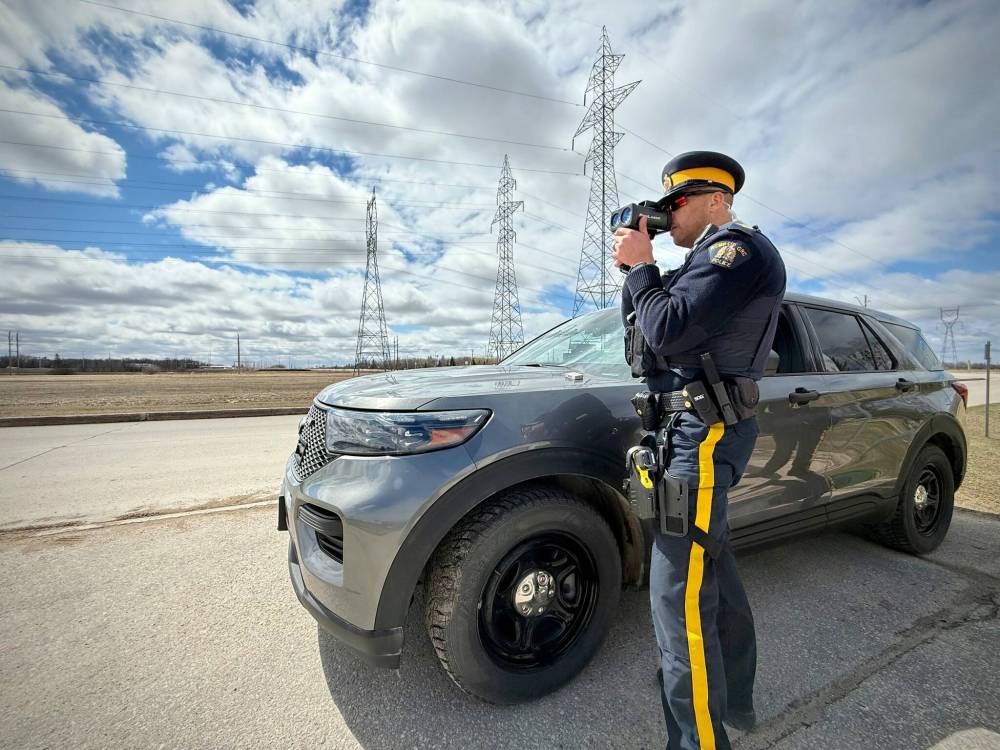
Sgt. R.M. Jansen, unit commander for RCMP Eastman Traffic Services in East St. Paul, demonstrates the police service’s laser radar technology during a joint announcement with Manitoba Public Insurance on Wednesday. (Scott Billeck/Winnipeg Free Press)
Over the past three years, there were 10,499 speed-related collisions in the province, according to MPI data. In that same period, law enforcement issued 1,326 serious speeding offence notices for drivers caught going more than 50 km/h over the limit. One of the worst offenders was clocked at 225 km/h in 2024.
“Too many of our officers, including myself, have had to knock on someone’s door and deliver the worst news they will ever receive,” Lepla said. “It’s very hard. It’s hard on the members. We’re all people. And it’s obviously hard on the family, too. It’s emotionally and physically draining. If people would just slow down, we wouldn’t have to attend to people’s houses with bad news.”
Speed not only increases the chance of a crash but also the severity of injuries, especially for pedestrians. At 30 km/h, the risk of a pedestrian fatality is around five per cent. At 65 km/h, that risk jumps to 80 per cent, MPI data show.
“Speeding is one of the most dangerous high-risk driving behaviours we see in Manitoba,” said MPI vice-president Maria Campos. “The thousands of crashes and the high number of fatalities is very concerning, and we want to make sure that law enforcement have the tools they need to help curb this behaviour.”
Those tools include laser radar detectors and automated licence-plate readers, the latter of which MPI began funding in 2022.
“These tactics help in cracking down on dangerous behaviour, but the best outcome is drivers keeping their speed within the legal limit,” Campos said.
On Wednesday, RCMP officers demonstrated the licence-plate readers, which can instantly flag if a vehicle is unregistered or stolen, if the driver is suspended, or if there’s an outstanding warrant for the owner, among others.
Sgt. R.M. Jansen, unit commander for RCMP Eastman Traffic Services, said the system will scan around 3,500 licence-plate images on a busy traffic patrol day.
“It’s a tool for us to get high-risk people off of the road,” said Jansen, whose father was killed by a drunk driver in 1981. “We don’t want other families having to go through that. I grew up without my dad. That doesn’t need to happen because of a poor choice.”
Jansen recalled one recent example of the system working as intended.
“The system alerted me that their registration was expired for over two years,” he said.
Previously, officers had to manually run plates — a slower and less efficient process.
Meanwhile, Campos noted the close collaboration between MPI and the RCMP is critical for the Crown insurer to educate Manitobans.
“And quite honestly, to bring the realities those decisions could result in for themselves, their families, their friends and their communities,” she said.
» Winnipeg Free Press