
17,000 ordered to flee from north
Advertisement
Read this article for free:
or
Already have an account? Log in here »
We need your support!
Local journalism needs your support!
As we navigate through unprecedented times, our journalists are working harder than ever to bring you the latest local updates to keep you safe and informed.
Now, more than ever, we need your support.
Starting at $15.99 plus taxes every four weeks you can access your Brandon Sun online and full access to all content as it appears on our website.
Subscribe Nowor call circulation directly at (204) 727-0527.
Your pledge helps to ensure we provide the news that matters most to your community!
To continue reading, please subscribe:
Add Brandon Sun access to your Free Press subscription for only an additional
$1 for the first 4 weeks*
*Your next subscription payment will increase by $1.00 and you will be charged $20.00 plus GST for four weeks. After four weeks, your payment will increase to $24.00 plus GST every four weeks.
Read unlimited articles for free today:
or
Already have an account? Log in here »
Hey there, time traveller!
This article was published 29/05/2025 (301 days ago), so information in it may no longer be current.
WINNIPEG — More than 17,000 residents of northern communities scrambled to escape advancing wildfires Wednesday as the Manitoba government declared a state of emergency and the firefight was hampered because resources were stretched thin.
“With the wildfires in northern Manitoba intensifying, our government has triggered a provincewide state of emergency to help us through this crisis,” said Premier Wab Kinew at a 5:30 p.m. news conference, his second of the day to address the situation.
“The safety of Manitobans is, and will always be, our No. 1 priority.”
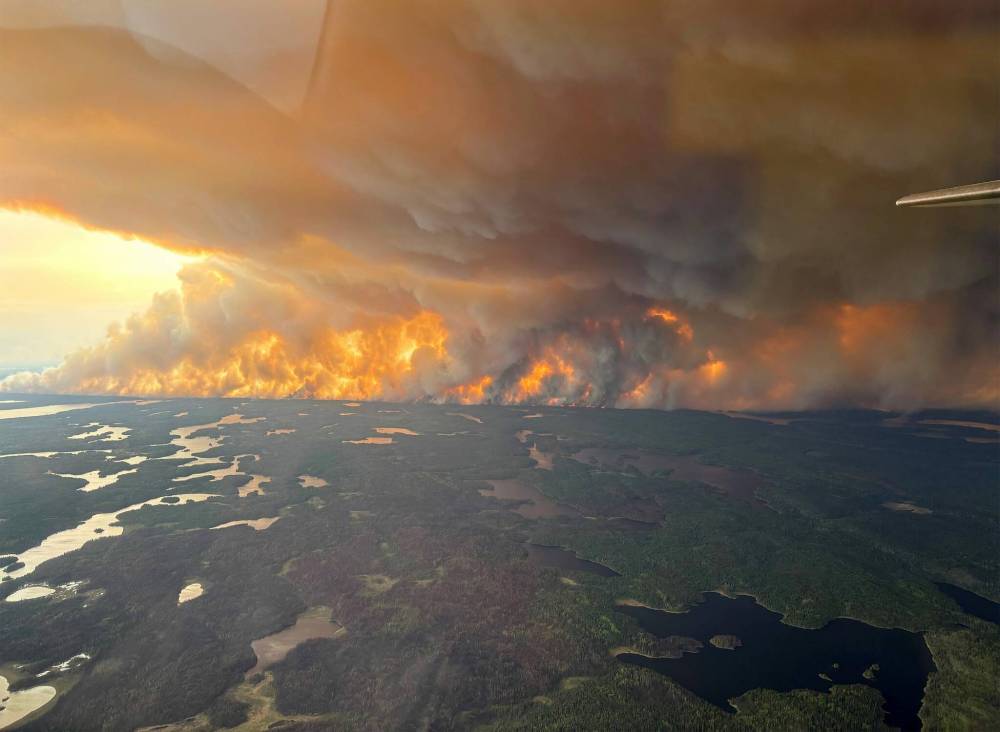
An aerial photo of a wildfire threatening Flin Flon taken on Tuesday. (Government of Manitoba)
The City of Flin Flon and the First Nations of Pimicikimak and Mathias Colomb issued mandatory evacuation orders. All residents and visitors were told to get out before midnight.
“This is the largest evacuation Manitoba will have seen in most people’s living memory,” the premier said.
Kinew said he had advised Prime Minister Mark Carney about the gravity of the crisis, and he agreed to send in the military.
The decision to make the declaration under the Emergency Measures Act was based on the recommendation of wildfire and emergency management officials. The state of emergency, which ensures federal, provincial and local resources can be delivered in a co-ordinated response, is in effect for 30 days and may be extended.
Canadian Armed Forces staff will help with the evacuation of northerners, most of whom are expected to come to Winnipeg.
Officials in Flin Flon and Pimicikamak (Cross Lake) announced on social media late Wednesday afternoon that the wildfires present an imminent threat.
“Full evacuation in progress,” Cross Lake Chief David Monias announced on Facebook, telling residents to drive to Norway House.
“All firefighters are now being pulled from fire No. 005 as it is too big and dangerous.”
In the northwest, residents with their own transportation were advised to head south on Highway 10 from Flin Flon to The Pas.
The City of Flin Flon was making arrangements to help residents without transportation.
The fire, which is two kilometres away from Flin Flon, had consumed 20,000 hectares, while the blaze that’s five kilometres away from Cross Lake had grown to 1,500 hectares, Wednesday’s late fire bulletin reported.
Everyone was evacuated from Lynn Lake Monday, except essential workers who are working to protect the town.
In a statement, Tory Leader Obby Khan offered his party’s support.
“My thoughts and prayers are with the 17,000 evacuees … and the emergency personnel working tirelessly to bring these wildfires under control. I encourage all Manitobans to make safety their top priority during this province-wide state of emergency. Be safe, listen to emergency services workers, EMO officials, and the RCMP. Be kind to your neighbours and strangers alike.”
At the briefing in the morning, Kinew called the overall firefight “a very, very serious situation.”
Manitoba has had the highest fire activity in Canada in 2025, said Kristin Hayward, assistant deputy minister of the wildfire service.
Nearly 200,000 hectares of land has burned this year — nearly triple the five-year average for an entire year.
Hayward said more than 198,00 hectares have burned in just one month, compared with the five-year average of 70,000 for an entire year.
She attributed the blazes to prolonged periods of warm, dry weather across the province.
The province said there are 22 active fires burning Wednesday and 102 total this year. The 20-year average for May 28 is 78.
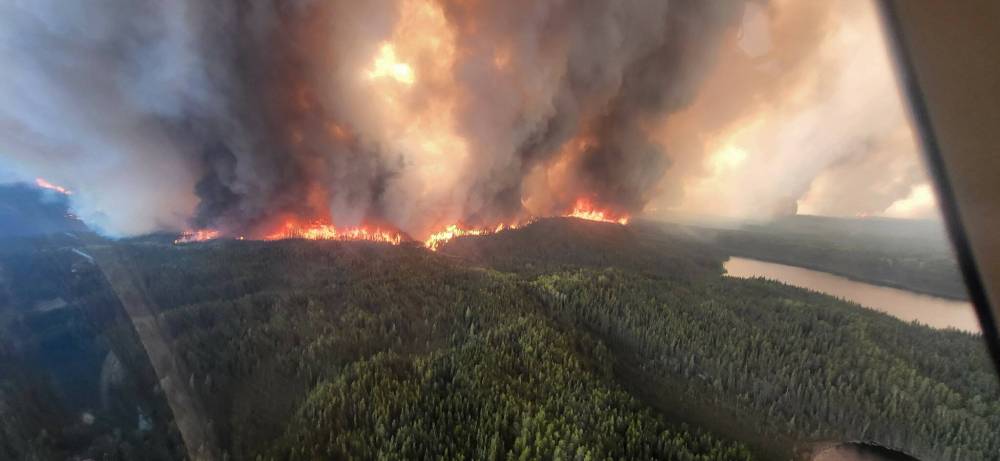
An aerial photo of a wildfire threatening Flin Flon taken on Tuesday. (Government of Manitoba)
“So, we’re well above-average,” Hayward said.
This year’s season presents a unique challenge because large fires are burning in different parts of the province at once, said Kinew.
“You would have one region having a challenge at a given time … This year, it’s all the regions at the same time,” Kinew told reporters.
Manitoba is eliciting help from other parts of the country. In addition to the more than 100 firefighters from Alberta, British Columbia and Parks Canada, the province is expecting 22 firefighters from New Brunswick, two from Prince Edward Island and 28 more from B.C.
An air-tanker group supplied from Alberta and 500 sprinklers from B.C. are also assisting in the fight.
A Parks Canada firefighter was injured Sunday, having sustained severe injuries from a falling tree.
Hayward admitted resources are few and far between but with the outside help, crews are able to staff up priority areas.
“There’s a lot of different factors that go into the initial decision of where to put resources, and then on an ongoing basis. All day, we’re constantly re-evaluating and repositioning resources as needed,” she said.
The province has deployed conservation officers specifically to provide mental health supports to front-line workers, the premier said.
Tristen Durocher is one of about 50 people left in Lynn Lake to prepare the town should the nearby wildfire encroach on it.
Durocher, who has been a volunteer firefighter with the town for four months, has been setting up sprinkler systems and pushing loose brush toward the forest in case the 10,000-hectare fire encroaches on the community of 579.
Everyone was evacuated from the community Monday except essential workers who have been on the front lines working to protect the town, 1,000 kilometers north of Winnipeg.
If the blaze, which was about 7,000 hectares at last count, reaches the community, the hospital and an apartment block would be the first buildings to burn.
Durocher says helicopters with water buckets have been working at the blaze all week, but more resources would help.
“When you have (so many) active wildfires in a province, you do need to prioritize the population-dense regions and critical infrastructure, and I trust that they’re making the right decisions on that front,” he said.
Kinew stressed the need for residents to obey fire bans and keep the airspace near wildfires clear of drones to allow for water bombers and helicopters to do their work.
Firefighting efforts near Flin Flon were delayed because of a drone in the air near the fire. The blaze started in Saskatchewan on Monday and crossed into Manitoba Tuesday.
“Putting your drone up there and getting a video that you can share is simply not worth it. You have to put the good of the community ahead of your own interest,” Kinew said.
The use of drones near forest fires is prohibited by Transport Canada.
To date, 15 people have been charged and 21 people have been issued written warnings related to fire bans and general unsafe fire behaviour, the premier said.
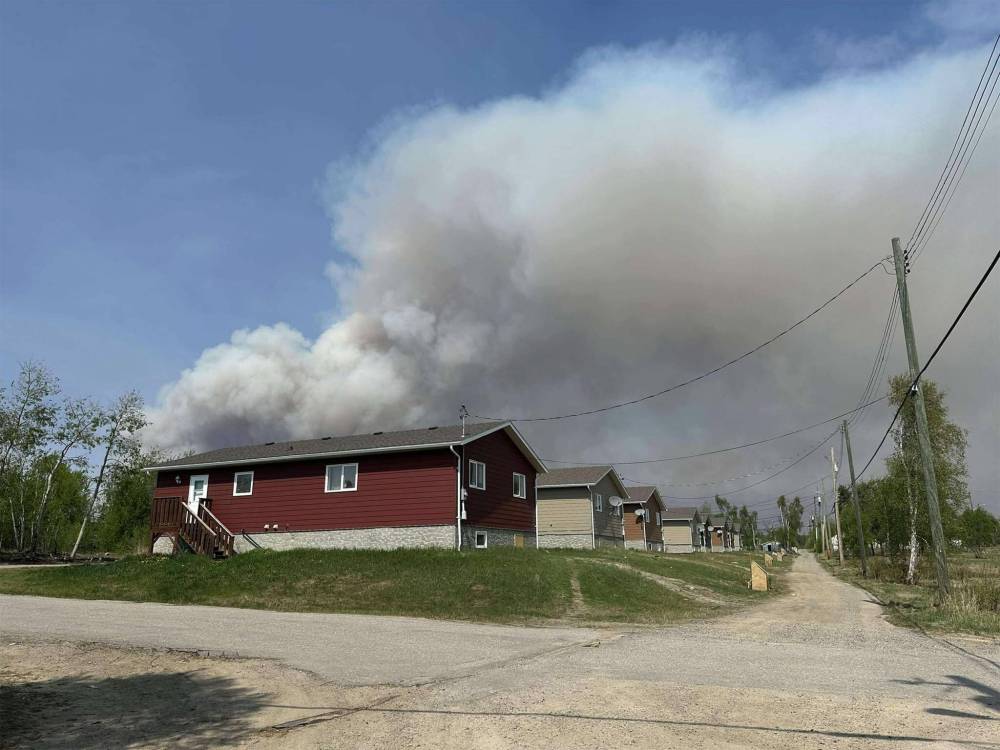
The view from a residential street in Lynn Lake Wednesday afternoon as fires approach the town. (Tristen Durocher)
He wouldn’t confirm whether any of the charges were related to drones or the fires that are currently burning out of control across Manitoba.
Hayward said 92 fires to date are confirmed or suspected to be caused by human activity.
Manitoba Parks announced the phased reopening of areas in Whiteshell Provincial Park as a 3,700-hectare fire burns at the Manitoba-Ontario border.
Beginning Thursday at 9 a.m., residents and cabin owners at Brereton, Red Rock, White, and Jessica Lakes, plus parts of Caddy and West Hawk Lakes will be permitted to return.
Campgrounds in the park, as well as Pinawa Dam Provincial Park, will reopen gradually starting May 30.
All other areas remain under an evacuation order.
Nopiming Provincial Park remains closed and park reservations are cancelled until at least June 12. Black Lake and Beresford Lake campgrounds are to remain closed all season.
An out-of-control fire continues to burn near Bird River and has grown to more than 124,000 hectares. Provincial road 315 is closed and blocked at Poplar Bay Road in the Bird River area, with no travel beyond that to Bird River and onward up to provincial road 314 and Bissett.
A fire at the Manitoba-Ontario border is approximately 31,000 hectares in size, with 3,770 hectares burning on the Manitoba side of the border.
The communities of Sherridon and Wabowden have declared states of emergency as fires spanning 40,000 hectares and 37 hectares, respectively, burn nearby.
A wildfire located five kilometres from Manitoba Hydro’s Jenpeg Generating Station about 200 kilometers south of Thompson was last mapped at approximately 3,290 hectares and is out of control.
Officials couldn’t say if any evacuees from Flin Flon will be housed in Brandon or in other Westman locations.
But there are people who were forced from their homes in three northern Manitoba First Nations staying in Brandon and several other communities, said the Canadian Red Cross.
People from Marcel Colomb First Nation, Chemwawin Cree Nation and Pimicikamak Cree Nation were evacuated because of wildfire smoke.
The Red Cross has provided transportation, registration, information, temporary accommodations, meals and personal services to the evacuees, a spokesperson told the Sun. But they did not have an official number of how many people are staying in Brandon.
About 60 people who were evacuated from the Sherridon area, about 126 kilometres northeast of Flin Flon, are registered in Dauphin.
» Winnipeg Free Press, with files from The Brandon Sun